Friday, 9 December 2011

Elephant No. 68: Pompoms


It's another crazy day—and I'm sure there will be many more before Christmas—so I decided to work with something simple again: pompoms.

In the world of needlework, pompoms are related to tassels and fringe, but differ in that they are round. Usually attached to a string or cord, allowing them to sway freely, pompoms are found in virtually every world culture. They generally decorate clothing and accessories, as well as soft furnishings, stuffed toys and ceremonial items.

The military hats of many nations often sport pompoms, with colour usually designating rank or regiment. In Asia, the Mien women of Thailand are known for their long black jackets trimmed with pompoms, and the festival dragons paraded through the streets at Chinese New Year are usually festooned with pompoms in various colours.


Head of a Chinese New Year dragon, adorned with multicoloured pompoms.
Source: http://new-year-card.blogspot.com/2010/12/new-year-dragon-card.html


In Peru, the traditional clothing of both men and women features pompoms. The colour of a man's pompom-topped hat, and the way it is worn, indicates whether he is married, engaged or single. Women's skirts have different colours of pompoms attached to the hems, and pompoms worn at the back of the leg indicate different things, depending on colour: a multicoloured pompom, or several colours of pompom, means happiness, for example, while a mostly blue pompom suggests sadness.

In Greece, the official national costume worn by the Presidential Guard features large black pompoms on the toes of the shoes. And in Scotland, the traditional Balmoral cap is dark blue, green or brown, and is usually decorated with a red pompom.


A typical Balmoral cap.
Source: http://www.scotsconnection.com/Scottish-Gifts/
Scots-Bonnets/Balmoral-Bonnet---Diced/p-69-240-1463/


I couldn't find any real information on how or where the pompom originated, but some speculate that it was created by accident. Traditional knitted hats were often finished by tying a simple knot at the top, leaving several loose strands of yarn. When these strands frayed, they eventually formed a ball of fluff.

For today's elephant, I bought four packages of "tinsel-poms" and "glitter-poms" for a dollar each. My original idea was to simply glue them to a piece of board, but then I decided they would look better if I sewed them together. I also remembered that I never liked the feel of hardened glue on a pompom when I was a kid, so sewing made more sense.


The pompoms came in multiple colours and three sizes—the different sizes came in handy for this particular elephant.


I started with one of the largest white/silver pompoms for the head, then added pompoms in the next two sizes down for a trunk. 


Next came the ears. I used two of the large pompoms for these, flattening them a bit by drawing a couple of stitches through the centre of each.


I stitched three large pompoms together for the body and made some legs, which I then attached. Attaching the legs was actually the hardest part of this whole thing, because it took me a while to figure out how to make them all stay at a sensible angle. One or the other kept trying to stick out, probably because of the way I pulled the thread through the legs and then back through the body.


I sewed the head to the body next. At this point, I decided that the legs were too short, so I sewed another mid-sized pompom to the bottom of each leg.


It looked a bit plain when I was done, so I decided to add a scarf made of the smallest green pompoms. To give the scarf a bit of shape and make it look like it was blowing in the wind, I sewed on the final pompoms at a bit of an angle.


This turned out better than I expected. The strands of tinsel, or whatever the silver bits are made of, came out all over the place, but otherwise it was an easy elephant to make, and held its shape surprisingly well.


Sparkly and slightly tacky I know, but what are the holidays without a bit of silly glitz?


Elephant Lore of the Day
Among some African peoples, elephants are traditionally believed to have mystical powers. The Shona of southern Africa, for example, called the long bony protrusions along an elephant's temples "wisdom sticks" and believed that they allowed elephants to know the time and place of their death. That is why, they say, very old elephants often separate from the herd, looking for a place where they can die alone and in peace. 

There are also a number of superstitions related to the hunting of elephants. A man who goes out hunting while harbouring a grudge or secret grief will only wound the elephant, and be unable to kill it. Also, those guilty of adultery can expect to be charged and killed by tuskless elephants, unless they quickly confess their guilt to the elephant. For this reason, it is said, a hunter will not allow others to come with him, unless he can be absolutely sure that they are free of grief, grudges and guilt.

Elephants are also considered omniscient. If a hunter encounters an elephant with its trunk curled around its head, he knows that a tragedy has occurred at home. And, if the hunter sees an elephant flinging dirt over its back, he knows that his wife is swimming or bathing: something she is not supposed to do while he is out hunting.

Finally, elephants are believed to keep track of their age by swallowing a pebble a year.


To Support Elephant Welfare 

World Society for the Protection of Animals
Elephant sanctuaries (this Wikipedia list allows you to click through to information on a number of sanctuaries around the world)
Performing Animal Welfare Society
Zoocheck
Bring the Elephant Home
African Wildlife Foundation

Thursday, 8 December 2011

Elephant No. 67: Painting on Feathers


For today's elephant, I decided to try painting on a feather.

I didn't actually know that painting on feathers was an art form until I did some research on feathers a few weeks ago. Most of the painted feathers I saw were mini-masterpieces, featuring incredibly detailed images of birds, animals and people. It seems to be a particularly popular form of art in the southwestern United States, although there are feather artists all over the world.

Feather artists tend to paint on large, wide feathers from birds such as turkeys, swans, pheasants and the like. Sometimes they use the inherent pattern of the feather itself as part of the design; sometimes they simply paint over it. From the bit of online research I did today, I gleaned a few tips:

1. A wide, flat feather is best, as it provides you with a relatively good canvas.

2. A heavier feather is best, because the feather stays together better when you slide your paintbrush across it.

3. Feathers are oily, so acrylics are the best paint, because they sit on the surface. Because acrylics sit on the surface, they will also flake off if you don't spray your painting with fixative afterwards.

4. Thinner acrylics are best, as they will allow you to create finer detail, and will sit more lightly on the surface of the feather.


A selection of painted feathers by Julie Thompson.
Source: http://listverse.com/2008/03/01/top-10-amazing-paintings-on-feathers/


I don't have access to any of the recommended types of feathers, so I bought a selection of the widest feathers I could find at a discount store. I also bought some short peacock feathers, because it occurred to me that it might be nice to paint an elephant on the eye of a peacock feather.


I had no idea what to expect, so I originally thought of trying out something on a plain feather first. Then I decided that, since I had three peacock feathers, I'd just dive in and paint right away on one of those.

The first thing I did was paint a tiny silhouette in grey. I discovered immediately that thinned-down paint is actually not great on a peacock feather. Perhaps because a peacock feather is sort of soft, it seemed to absorb and spread any paint that was the least bit watery.


Next I added some pink inside the ear, some tusks and a hat. I also did a bit of shading in the grey.


Thinking it should have a bit of shimmer to match the iridescence of the feather, I added some gold accents.


To finish it off, I decided to add fine dots of gold paint. I think I went a bit overboard, but I don't completely hate it.


In total, this took me about half an hour, so it's not a huge investment of time—or money, for that matter. It looks better with the naked eye than in the camera's rather cruel close-up, but it's nowhere near as accomplished as any of the feather art I saw online. I do like it, though, and I may even try painting on a peacock feather again sometime.


Elephant Lore of the Day
Elephants are apparently quite ticklish. The wilder they are, the more ticklish they are, and it can take a long time for an elephant to lose this sensitivity.

Despite their thick skins, elephants can feel almost anything that touches them. They are even sensitive enough to feel a fly alight on their backs. Scientists are not quite sure how dense the nerve endings are in an elephant's skin, although they believe that the nerve endings in skin differ from those in the trunk.

Elephants are also very susceptible to sunburn. Without regular baths and a coating of mud, an elephant's skin can suffer terribly. Albino elephants—more common among Asian elephants—are particularly vulnerable to sunburn, as are baby elephants. This is why elephant calves usually shelter in the shade beneath their mothers.


Asian elephants often have pink on their ears and trunks.
Source: http://www.upali.ch/skin_en.html


To Support Elephant Welfare 
World Society for the Protection of Animals
Elephant sanctuaries (this Wikipedia list allows you to click through to information on a number of sanctuaries around the world)
Performing Animal Welfare Society
Zoocheck
Bring the Elephant Home
African Wildlife Foundation

Wednesday, 7 December 2011

Elephant No. 66: Tea Lights


Today it wasn't raining, snowing or windy, so it seemed like a perfect opportunity to make an elephant with tea lights. The snow we had yesterday is already gone, so even the ground is reasonably dry.

Tea lights are small candles in thin metal casings, allowing the candle to melt completely when lit. They have multiple uses, including heating scented oils, warming foods, as accent and mood lighting, and even as votive candles. Each candle is supposed to be able to burn for about three to five hours. 


Modern tea lights are remarkably similar to the Hindenburg light, or hindenburglicht, which was used as a source of lighting in the German trenches of the First World War. Hindenburg lights were also used in air raid shelters in Germany during the Second World War, and were required lighting during blackouts. 

Hindenburg lights were larger than tea lights, measuring 5 to 8 cm (2 to 3 inches) in diameter and burning for several hours. The case was made of cardboard and was filled with tallow. Later models were encased in tin, and sometimes had two wicks.
Hindenburg light, ca. 1943–1945.
Photo: Patrick Götz
Collection of the Museum Geiserschmiede, Bühlertal, Germany
Source: http://en.wikipedia.org/wiki/File:Hindenburglicht.jpg
For today's elephant, I started by raking and sweeping the stray leaves and detritus from a flagstone area in our backyard, then let it dry out for a couple of hours.

I had 57 tea lights, so I laid them out in an elephant shape. I've never done anything like this before, so I wasn't really sure if I had too many or too few, or if they'd blow out as I was lighting them.


Sunset was at 4:20 p.m., today, so I waited until about 5:00 to light everything. Remarkably, every last tea light stayed lit, despite the light breeze that picked up while I was lighting them. 


It was really pretty when it was all illuminated. I was a bit sad to blow this out, but it was too cold to hang around outside. Next time I do something like this, I'll make sure it's in the summer, so that I can sit outside for a bit and enjoy it.


Elephant Lore of the Day
John L. Sullivan, named after a famous boxer, was a tuskless male Asian elephant. Born around 1860, John L. Sullivan performed first with the Adam Forepaugh Circus in New York, and later the Ringling Brothers and Barnum & Bailey Circus. 
In his early career, the elephant and his trainer, Eph Thompson, performed a boxing act. A boxing glove was attached to the end of John L. Sullivan's trunk, allowing him to spar with Thompson.

Ad for the Adam Forepaugh Circus, featuring John L. Sullivan.
Source: http://bucklesw.blogspot.com/2010/01/
adam-forepaugh-bolivar-and-john-l.html

After he retired from performing, John L. Sullivan remained with the circus. He babysat the performers' children, led the elephant herd to and from the fairgrounds and the trains, and did heavy lifting. In 1922, in a publicity stunt honouring America's first elephant, Old Bet, John walked the 85 kilometres (53 miles) from Madison Square Garden in New York City to the Elephant Hotel in Somers, New York. When he arrived in the small town four days later, he laid a wreath at a monument dedicated to Bet.
John L. Sullivan lived to the age of 72—the average life expectancy for an elephant is 70 years—and likely died of heart failure or simple old age.


To Support Elephant Welfare 
World Society for the Protection of Animals
Elephant sanctuaries (this Wikipedia list allows you to click through to information on a number of sanctuaries around the world)
Performing Animal Welfare Society
Zoocheck
Bring the Elephant Home
African Wildlife Foundation


Tuesday, 6 December 2011

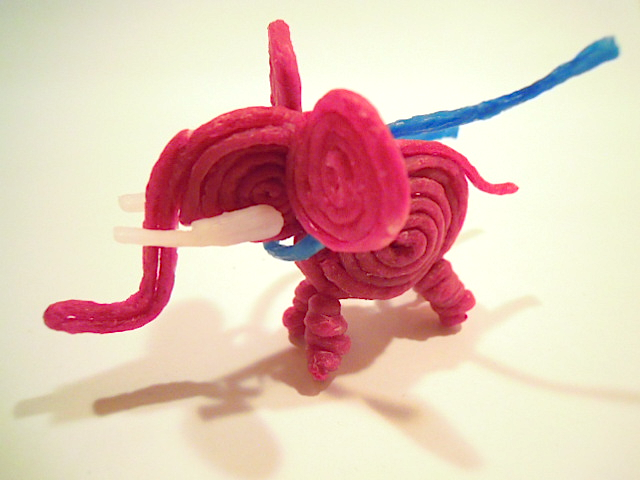
Elephant No. 65: Wax Sticks


Today is a bit of a crazy day, so I'm doing something relatively simple: wax sticks.

Wax has been used by humans for thousands of years, likely beginning with beeswax. Employed in everything from writing tablets to bow-making, beeswax could be considered humankind's first plastic.

The word "wax" describes a class of organic compounds—both synthetic and natural—that are relatively malleable at room temperature, and melt at a mere 45˚C (113˚F). Waxes can be derived from plant, animal and mineral sources, and can also be synthesized from non-waxy materials.

The most common animal wax is beeswax, although other insects also secrete waxes. Lanolin, a wax derived from sheep's wool, is another common animal wax. Plant waxes come largely from tropical plants, which secrete wax as a way of controlling evaporation. Common plant waxes include carnuba from the Brazilian palm tree, jojoba oil, sugar cane wax, and candelilla wax.

In addition to these natural ester-based waxes, there are numerous synthetic waxes. Paraffin waxes, for example, are hydrocarbon-based and are used in a wide range of products such as chewing gum, cosmetics and adhesives. Montan wax—a fossilized wax extracted from coal and lignites—is another synthetic variety. Synthetic waxes can also be produced by cracking polyethylene at 400˚C (752˚F).

I have no idea what kind of wax is in the wax sticks I'll be using for today's elephant. Surprisingly, although this is a product made for children, there is nothing on the package to suggest that it's non-toxic. It does say that it's "Tested safe—approved for fun!" but I don't know if that means "non-toxic". I'm guessing something paraffin-based, as that would be the least expensive material, and this was not a high-end purchase.


I've never seen or used wax sticks before, but the package says that this is "Magical wax over super-strong string!" that will apparently "stick and stay and then lift away for non-stop play!" Goody.

There was more pink in this particular package than any other colour, so today I decided to make a pink elephant.


The instructions in the package were for flowers and butterflies, so there was nothing I could really use as a model for an elephant. I decided to wing it, starting with a simple coil to make a body shape.


Because I didn't want a flat elephant, I wadded up one of the wax sticks and stuck it to the middle of the coil, then made another coil to form the other half of the body.


Next, I made four coiled spring-like things for its legs, and attached them to the body. This stuff sticks to itself reasonably well, so as long as you don't press too hard, it holds its shape fairly well. If you do press too hard, however, it will deform and become virtually impossible to push back into shape without deforming lots of other areas.


I added two coils for the head next—one on each side, but without a filler as in the body. I then shaped one of the sticks into a trunk that extended over the back to also form a tail. This piece had the added bonus of helping to hold the head to the body more securely.


The ears were two slightly wedge-shaped coils, simply stuck onto the sides.


To finish the elephant, I cut two small pieces from a white wax stick, folding them over at one end, and pinching the finer end to a bit of a point. Because of the string inside, a precise point isn't really possible, but this worked well enough.


Because it's a bit of a blustery day here, I decided to give him a scarf. I did this simply by adding a blue wax stick, twisted loosely around his neck. I was afraid to twist it too tight, in case it might pop his head off or something, but I did like that it was stiff enough to look like it was blowing in the wind.


I rather liked working with these sticks. They hold their shape well, and also stick together properly while you're working with them. Unfortunately, I don't think this is anything like permanent—even the packaging suggests that you can uncoil and reuse the wax sticks. I'm sure this little guy will ultimately fall apart if he gets a slight knock, but for now he's kind of cute.


Elephant Lore of the Day
The phrase "seeing pink elephants" refers to hallucinations caused by extreme drunkenness, and usually results from long-term alcoholism.

The first known use of the term comes courtesy of author Jack London, who in 1913's John Barleycorn describes "the man whom we all know, stupid, unimaginative, whose brain is bitten numbly by numb maggots; who walks generously with wide-spread, tentative legs, falls frequently in the gutter, and who sees, in the extremity of his ecstasy, blue mice and pink elephants."

A Wikipedia entry on pink elephants describes a story in Superman (Action Comics #7, December 1938), in which the Man of Steel lifts an elephant over his head at a circus. This causes a drunk in the audience to say, "I don't mind seeing pink elephants, but (-hic-) this is too much!" The same source also quotes Raymond Chandler's 1943 novel, Lady in the Lake, which refers to a doctor "who ran around all night with a case of loaded hypodermic needles, keeping the fast set from having pink elephants for breakfast."

And then there is the famous pink-elephant sequence in the 1941 Walt Disney film, Dumbo. Dumbo and his mouse friend Tim, having drunk water laced with champagne, hallucinate dancing and singing "pink elephants on parade". It's probably one of the most psychedelic sequences I've ever seen in a Disney film, outside of Fantasia.


A still from the "Pink Elephants on Parade" sequence in the Walt
Disney movie, Dumbo (1941).
Source: http://disney.wikia.com/wiki/Pink_Elephants


Interestingly, hallucinations such as this are not the result of drunkenness itself, but are one of the symptoms of withdrawal. Alcoholic hallucinosis, or alcohol-related psychosis, develops twelve to twenty-four hours after drinking has ceased. It can involve both auditory and visual hallucinations, usually accusatory or threatening in nature. It comes on and goes away quickly—unlike its sister ailment, delirium tremens—and tends to occur in those with a history of long-term alcohol or drug abuse.


To Support Elephant Welfare


World Society for the Protection of Animals
Elephant sanctuaries (this Wikipedia list allows you to click through to information on a number of sanctuaries around the world)
Performing Animal Welfare Society
Zoocheck
Bring the Elephant Home
African Wildlife Foundation

Monday, 5 December 2011

Elephant No. 64: Suet Cake


A few days ago, my friend Ken suggested I try making a suet cake elephant for the wild birds that come to my garden.

Suet cakes normally come in the form of bells, squares and discs, and contain ingredients such as seeds, nuts, chunks of dried fruit and, of course, suet. Although it seems counterintuitive to feed birds the beef and pork fat contained in suet, it's actually quite important to their winter diet. The fat is a substitute for the insects birds eat in the warmer months, and helps keep them warm and active throughout the winter.

I was going to make a suet cake from scratch, but suet appears to be rather hard to find these days. There were alternate recipes suggesting lard and shortening, but these also warned that the resulting suet cake would be soft and not hold together very well in warmer winter weather. It would also have to be poured into a mould, and I don't have an elephant mould big enough.

Instead, I opted to simply reshape a pair of existing suet cakes. I bought these two at the grocery store. The disc is made primarily of suet, so it's somewhat more firm; the square has mostly lard and shortening, so it's a bit nasty to handle.


The first thing I did was shape the disc by carving off a small slice, then cutting around the edge to get a piece I could use for the trunk.


Once that was done, I scooped out the softer material in the square container and mushed it all over the underlying disc shape. This is something that could really only be done by hand, and it has to be done mostly in one go. I thought about taking some photos as I went along, but it would have required that I scrub my hands every few minutes.


When I was more or less happy with the shape, I added some sunflower seeds for an eye—also Ken's suggestion.


I saved the netting from the disc to hang the finished product—mostly because the suet cage hasn't yet been made that can hold this particular animal. I was a bit surprised at how well it held together when I slid it inside the netting, because it was quite soft from being handled. It's probably a good idea to freeze it overnight before hanging it outside.

It's going to be interesting—and perhaps a little tragic—to see how the birds go about pecking this elephant to bits.


Elephant Lore of the Day
African elephants are often seen with small grey birds on their backs. These particular birds are oxpeckers, and ride on many other large animals as well.

It was originally believed that oxpeckers were primarily beneficial, because they eat large numbers of ticks, botfly larvae and other parasites—as many as 12,000 tick larvae a day. It has recently been discovered, however, that although they do eat unwelcome parasites, oxpeckers will also open new wounds to drink the blood of their animal hosts.

Elephants are not particularly fond of the birds—although oxpeckers do benefit elephants by warning them of approaching predators.


Red-billed oxpecker on elephant.
Source: http://ecocomic.com/2011/07/02/red-billed-oxpecker/


To Support Elephant Welfare
World Society for the Protection of Animals
Elephant sanctuaries (this Wikipedia list allows you to click through to information on a number of sanctuaries around the world)
Performing Animal Welfare Society
Zoocheck
Bring the Elephant Home
African Wildlife Foundation