Thursday, 29 December 2011

Elephant No. 88: Continuous-Line Drawing


Today I thought I'd try something I'm not sure I've ever tried for more than a small doodle: continuous-line drawing.

Continuous-line drawing, as the name suggests, involves drawing something without lifting the pen or pencil from the paper. Closely related to contour drawing and blind-contour drawing, continuous-line drawing usually results in sketch-like outlines—although there are also continuous-line drawings made with a series of concentric lines of various weights, creating something that looks vaguely numismatic or philatelic.


Continuous-line drawing from 1884, published
by Knowles & Maxim.
Source: http://www.darkroastedblend.com/2007/10/
continuous-line-art.html


For today's elephant, I decided to use a black Faber-Castell Pitt artist pen. I rarely use these because they make fat lines, and I'm not big on fat lines. For this particular exercise, however, I thought it would be helpful to have various weights of line to work with, in case I decided to give the drawing extra dimensionality. I'm not sure if that's cheating on the purest form of the continuous-line-drawing concept, but if cheating it be, then cheater I am.


Obviously, since I'm drawing this in a continuous line, there won't be any photographs of the various stages, but perhaps that's a mercy to people who don't care all that much about process. If so, this is your lucky day!

Because this was astonishingly easy, I did three drawings. The first was done just to get a feel for the technique. This was drawn on the fly and looks pretty primitive, but I kind of like it. I started at the eye and ended up at the base of the tusk.


The second elephant was also drawn on the fly, but with a little more thought. This time, I started at the top of the head and went back towards the ear first, ending up in the strings of the tassel.


For the third drawing, I thought I'd try drawing from a photograph. This is the photograph I chose.


African elephant in stream.
Source: http://www.deshow.net/animal/African_Elephant_
Pictures_hant_photos_529.html


And this is my continuous-line drawing, made from that photograph. This time I started at the top of the head and went for the ear on the right first, ending up with the blade of grass closest to the elephant.


I really liked this activity, and will try it again sometime. It forces you to think ahead as to where your pen needs to go next, but is otherwise not terribly demanding—and it's fast, at an average five minutes per drawing. I may even try one of those concentric drawings next time.


Elephant Lore of the Day
In addition to never forgetting a slight or injury, elephants also maintain a mental map of their entire range. For most elephants in Africa, this means that they know the terrain of an area measuring over 3,000 square kilometres, or nearly 1,250 square miles—if you're American, an area approximately the size of Rhode Island.

Within this territory, elephants will remember the precise locations of watering holes, sources of food and minerals, roads, obstacles such as rivers and mountains, and human settlement. Studies on radio-tracked elephants have shown that they will unerringly return to specific areas, along specific routes, no matter how far they wander over the course of a year.

Although some of this ability is likely due to the inbuilt directionality of most animals, elephants also seem to learn quickly from their mistakes and successes. They avoid areas where bad things have happened—such as the culling of their herd; and are likely to return to areas in which good things have happened—such as a successful raid on a banana plantation.


To Support Elephant Welfare 
World Wildlife Fund 
World Society for the Protection of Animals 
Elephant sanctuaries (this Wikipedia list allows you to click through to information on a number of sanctuaries around the world) 
Performing Animal Welfare Society
 Zoocheck 
Bring the Elephant Home 
African Wildlife Foundation

Wednesday, 28 December 2011

Elephant No. 87: Torn Paper Collage


For today's elephant, I thought I'd try something from a long-ago art class. I dimly remember that we were told to reproduce a masterpiece with bits of torn construction paper, but I don't remember why. It may have had something to do with learning to see tones and shades.

I chose something from Gauguin's Tahitian period, although I no longer recall which painting it was. I probably thought something with bright colours would make the exercise easier. I don't think it did, however, because I distinctly remember not finishing the thing. To keep me at it today, I'll make sure to create something small.

The word "collage" comes from the French coller, "to glue", and was coined by Pablo Picasso and Georges Braque at the beginning of the twentieth century. The term is taken to describe any work of art that involves the gluing of paper and other materials on top of one another to create an image, whether abstract or representational.

Historically, collage was first used around 200 B.C., coinciding with the invention of paper in China. The use of the technique remained quite limited, however, until tenth-century Japan, when calligraphers glued paper to their work. In Europe, collage appeared in the thirteenth century, with the gluing of gold leaf and gemstones to religious icons, coats of arms and similar pieces. By the nineteenth century, collage was used by many ordinary people for scrapbooks, albums and other forms of memorabilia, as well as small decorative items such as firescreens, fans and boxes.

Collage as an artistic medium originates with Cubist painter Georges Braque, who took a roll of oak-textured paper and cut it into pieces, which he then arranged on canvas. Pablo Picasso picked up the technique soon after, and collage has been recognized as an art form ever since. 

I couldn't find anything on the origins of torn-paper collage, although it seems to have found its earliest artistic expression in the works of Dada artist Jean Arp, continued through to the present day in the works of well-known modern artists such as Damien Hirst. I love pieces like the one below, but doubt very much that I'll be making anything this elaborate today. Or ever.


Detail from Tina's Toad "Quispehuaman"by artist Terri Welch.
Source: http://tornpaperart.blogspot.com/


For today's elephant, I decided to use a pad of inexpensive construction paper that I picked up a few years back to use for tags or something. I thought about using my stack of much-loathed origami paper (I loathe the activity, not the paper); however, although origami paper is nice and bright, when you rip it you get white edges, which wasn't really what I wanted.


For glue, I thought about using a glue stick, then decided that white glue would be better.


For this technique, I figured it would be a good idea to work from a photograph; otherwise, I'd be a bit lost with all the tones and highlights. I chose this profile photo, which in retrospect wasn't the best choice, since it's way too finely detailed for torn paper.


Iringa the elephant, at the Toronto Zoo.
Photo: Sandy Nicholson
Source: http://www.torontolife.com/daily/informer/from-print-
edition-informer/2010/06/29/what-the-elephants-know/


I had decided that I was only going to use the colours in the pad of construction paper. This presented problems right away, since there was no white, no grey and no black. Instead I chose a pale beige for the white, dark eggplant-brown for the darkest areas, and a pale blue and a canary yellow for mid-tones. Not ideal, but I wasn't going for high art here, anyway.

Using a small piece of canvas board measuring 15 x 23 cm (6 x 9 inches), I started by putting in the brightest highlights with beige paper.


Next, I put in some of the darkest shadows with the eggplant-brown.


I had by now resigned myself to this looking nothing like the original photograph, and nothing like my original vision. Instead, it became an exercise in seeing tones of colour, without any regard for the actual colours of the photograph.

Another thing I had forgotten was that paper has a distinct grain. This means that, while it is easy to tear a straight line if you go with the grain, it's virtually impossible to tear sensibly across the grain. That's why many of the edges look as though they've been nibbled by mice.


When I was as done as I was going to be with this, I added some brighter colours for grass and a sun. It's not completely horrible, but it would have been better if I'd had a bunch of shades of grey. Just for fun, I changed the image to greyscale to see what it looked like in terms of its tonal values.


This wasn't a technique I loved, since it's a bit tedious and fiddly, but I did like the challenge of picking out the highlights and lowlights, and trying to tear bits of paper to fit. It did take me nearly three hours, however, so it's not high on my list of things to try again.


Elephant Lore of the Day
The Year of the Elephant (ˤĀmu l-Fīl in Arabic) is the name given in the Islamic calendar to the year 570 A.D.: the year that Muhammad was born.

According to Islamic tradition, this is the year in which a notable event occurred at Mecca, in modern-day Saudi Arabia. Abraha, the Ethiopian governor of Sheba in Yemen—also on the Arabian peninsula—had ordered people to worship at a Christian cathedral he had built at Sana'a. The people refused, preferring to revere the Kaaba in Mecca instead. Incensed, Abraha marched on Mecca and the Kaaba with an army numbering some 40,000 men. A white elephant called Mahmud led the way, along with as many as seven other elephants. Abraha's intention was to raze the Kaaba and, although several Arab tribes fought him along the way, Abraha defeated them all.

Reaching the outskirts of Mecca, Mahmud the elephant suddenly stopped and refused to enter. He could neither be beaten nor cajoled into moving forward. If he was turned away from Mecca, he was happy to move, but if turned towards Mecca, he is said to have fallen to his knees as though in reverence.

Abraha sent an envoy into Mecca to tell them that Abraha wished only to destroy the Kaaba, and that he would not harm the rest of the city unless its people resisted. Thinking he had made himself clear, Abraha planned to enter Mecca the next day. 

According to the Qur'an, a thick cloud of small birds appeared the following morning, just as Abraha and his army were preparing their assault. The birds carried small rocks in their beaks and pelted Abraha's forces, who fled. Abraha was also seriously wounded. He retreated towards Yemen, but died of his wounds on the way.

The year accordingly became known as the Year of the Elephant, and was used for reckoning dates throughout the Arabian Peninsula until it was replaced by the official Islamic calendar some twenty years later.


To Support Elephant Welfare
World Wildlife Fund  
World Society for the Protection of Animals
Elephant sanctuaries (this Wikipedia list allows you to click through to information on a number of sanctuaries around the world) 

Tuesday, 27 December 2011

Elephant No. 86: Seed Bead Embroidery


I was making bracelets for my little nieces about a week ago, trailing seed beads all over the place, when I realized that I hadn't done a seed bead elephant yet.

Seed beads are small, uniform round beads, commonly used for bead weaving, as well as jewellery, embroidery, knitting and crocheting.


Hanks of glass seed beads, most of which in this photograph
are foil-lined.
Source: http://www.topoftherangedesigns.com/beads_
and_kits.htm


Although adding small beads to clothing dates back 40,000 years or so, a pair of beads approximately 100,000 years old—made from the shell of the Nassarius sea snail—are thought to be the earliest examples of beaded jewellery.

During the Late Stone Age (ca. 40,000 to 10,000 years ago), beads on clothing were usually made of shell or ivory. More elaborate beadwork, in multiple shades and repeating patterns, was first produced in Ancient Egypt around 2000 B.C., using small faience beads. There were beaded items, for example, in the tomb of King Tutankhamun, including a hassock and some slippers he had likely worn as a child.

In India, the earliest mention of beadwork is from around the ninth century B.C., referring to the braiding of beads into the tails of horses, and into the hair of men and women. And in a document from around 300 B.C., Buddhist monks are told not to wear beaded shoes, with the obvious implication that beaded shoes were common by this time.


Traditional beaded slippers from India.
Source: http://www.tradekey.com/product_view/id/7417.htm


Surviving examples of early beaded items are relatively rare, largely because the material onto which they were sewn—usually leather or cloth—has disintegrated over time. That being said, elaborate beadwork from the eighth century A.D. has been discovered in the Shosoin Temple in Nara, Japan, and early African beadwork has been found in a tomb in Nigeria, dating from sometime between the eighth and eleventh centuries A.D. In Europe, the earliest known beadwork features blue glass beads, seed pearls and coral beads, and comes from a thirteenth-century tomb near Burgos, Spain.

The first mass-produced seed beads were made in India and other parts of South Asia. They dominated the bead trade from the ninth century B.C. to approximately 1480 A.D., when glassworkers in Venice learned how to make thin glass tubes and turn them into small beads. In Europe, these beads were used primarily for beaded purses, although they also had great importance as trade items, particularly in North America and Africa.


Bandolier bag, Ojibwa, ca. 1880–1890.
Collection of the Royal Ontario Museum, Toronto, Canada.
Source: http://images.rom.on.ca/public/index.php?
function=query&action=smpl&ccid=&sid=


Today, two primary techniques are used to produce seed beads. The "wound" (as in "winding" not "harming") method is more traditional. Because it is also more time-consuming, it is no longer widely used in modern bead production. In this method, a chunk of glass is heated on an iron bar until molten. A second iron bar is then pushed into the molten blob, and the two rods are drawn quickly apart. This creates a long glass rod, which is then cut into shorter lengths. These shorter lengths are wound around a hot metal wire, creating a ring of glass, which is then shaped until it is smooth and round. This process is repeated several times on the hot wire, creating several glass rings, which are then slid off the wire to be used as beads.

The second method is the "drawn" method, which also involves the heating of a chunk of glass on an iron bar. Next, an air bubble is created inside the blob of molten glass. This means that, as the two iron bars are drawn apart, a tube is created, rather than a rod. This tube is then cooled and cut into small pieces, which are tumbled to remove any sharp edges.

Prior to the Second World War, there was a thriving bead industry in Eastern Europe, particularly in Bohemia (today part of the Czech Republic). Germany, Italy and France were also noted producers of small beads. Most of these were glass, although some were also made of metals such as aluminum or steel, and were sometimes faceted. During the Second World War, many of the bead-producing factories were destroyed or converted to munitions facilities and similar installations. After the war, however, hoards of pre-war beads suddenly surfaced, and are now much sought after.

Today, most higher-quality seed beads are made in either Japan or the Czech Republic, with some specialty seed beads made in France for the restoration or reproduction of antique textiles. Lesser-quality seed beads are made in large quantities in China, India and Taiwan. Modern seed beads are made by machine, using glass rods that are heated until red-hot. The rods are then fed into a steel stamping machine that forms the round shapes, which are then pierced with a moving needle that makes the hole.

Seed beads can be glass, plastic, metal and foil lined, with finishes ranging from an AB (for "aurora borealis") rainbow effect, to pearlized, striped, or even matte. Interestingly, the recipe for a true black glass was lost during the First World War, and modern black glass, when held up to sunlight, is actually a deep purple.

I made a sizeable elephant on the back of a jean jacket a few years ago, but it took me a couple of weeks, if I remember correctly. So for today's elephant, it was going to have to be something small.


I started by yet again dragging out all my seed beads. As you can see, I have many different colours. What I didn't realize is that I also have different sizes. This would annoy me later.


I decided to embroider onto a piece of black velvet, and started by outlining the trunk area with some silver-grey shiny beads. I was either too lazy or too impatient (take your pick) to outline anything with chalk or thread, so I was winging it to a certain extent. I also apologize for some of the photos: the camera was deeply disturbed by this whole exercise.


Because I knew I wanted to add a little headdress, I put that in next, followed by the ear area. At this point, I thought I detected a slight difference in size in the purple beads, but I ignored it. This would come back to bite me later.


Next, I added the lower jaw, and a bit of pink in the ear area, the tip of the trunk and the mouth. I also added a larger black bead for the eye.


I began adding details such as darker beads for a bit of shading, a tusk and some decorations like a tassel hanging over the ear, and a necklace. This is where the stupid purple beads irked the heck out of me. Although they looked the same size when I bought them, they were larger, and didn't fit with the other beads.

Also, because I had by now gotten a visual idea of how much room each seed bead needed in order to fit with the others, the moment I stitched the bigger purple beads in, they crowded themselves and the other beads out. I just couldn't get a fix on how much bigger they actually were. I didn't dare cut them out, however, because the thread was connected to other areas of beading. This meant that, if I cut out the purple beads, I was likely to take some other unexpected area with them. So I left them and tried to ignore their lumpy look.


It was now ready for me to fill in everything else with the main silver-grey colour, so that's what I did. From start to finish, this took me about four hours and, despite its size, contains somewhere between 200 and 300 beads.

I would have liked more time to pattern the beads better: organizing them into rows like brushstrokes, rather than sewing them on a bit higgledy-piggledy. On the other hand, I like the final result enough not to want to mess with it any further. Except for the purple beads—but I think I'm stuck with those.


Elephant Lore of the Day
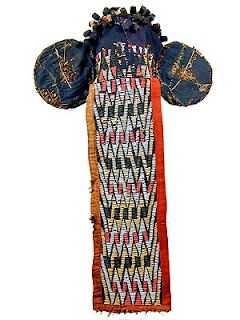
Among the Bamileke people of Cameroon in West Africa, elephant masks were traditionally worn by important leaders, as well as their deputies or messengers. Signifying kingship and wealth, these masks were worn by the ruling Kuosi society, which included royalty, the wealthy, and high-ranking warriors of the Bandjoun kingdom in western Cameroon.

The beads used in these masks were nineteenth-century trade beads from Venice or Czechoslovakia, and were most commonly paid in exchange for a certain rank or position. Elephant masks were thus called "things of money", since their beads were both currency and symbols of wealth.  

Traditional Bamileke elephant masks are made with cloth panels, and hoods that are woven from plantain fibre over raffia. Multicoloured beads are then stitched over this foundation in geometric patterns. The basic form includes a long trunk, round ears and human facial features. The hood fits tightly over the wearer's head. Two long panels, front and back partially conceal the body; the panel in front acting as the trunk. As the wearer dances, ears, trunk and back flap move.


Front view of traditional Bamelike elephant mask.
Photo: Tim Hamill
Source: http://www.hamillgallery.com/BAMILEKE/
BamilekeElephantMasks/Elephant01.html

Back view of traditional Bamelike elephant mask.
Photo: Tim Hamill
Source: http://www.hamillgallery.com/BAMILEKE/
BamilekeElephantMasks/Elephant01.html

The masks are often worn with dark robes. These constrast sharply with the wearer's legs, which are stained bright red. The costume often includes a beaded vest, a belt and even a leopard pelt down the back.

The chief owns the masking society, which performs to drums and gongs while waving poles trimmed with beads and horsehair. The masked dancers whistle "mysteriously and tunelessly" according to one account, and are later joined by chiefs and princesses in a parade and performance that includes crowd participation.

The profligacy with which the masks were beaded—often including cowrie shells, another symbol of wealth and power—displayed the wealth of the chief and his people. The masks were also colour-coded, with black indicating the relationship between the living and the dead; white referring to potent medicines and the ancestors; and red symbolizing life, women and kingship. A prominent triangle symbolized a leopard's spots, the leopard being a royal symbol of power, like the elephant.


The King and Kuosi society members, Bandjoun, ca. 1930.
Source: http://www.randafricanart.com/images/bamileke_kuosi.jpg


To Support Elephant Welfare
World Wildlife Fund  
World Society for the Protection of Animals
Elephant sanctuaries (this Wikipedia list allows you to click through to information on a number of sanctuaries around the world)


Monday, 26 December 2011

Elephant No. 85: Snow Footprints


It snowed quite a lot here yesterday, so I had originally wanted to make a snowman-type elephant today. Unfortunately, it's not the kind of snow that sticks together. I tried tossing a small snowball at a birdfeeder-raiding squirrel, but it fell apart before it could get anywhere near the little rascal.

It's lovely fresh snow, however, so I decided to try "drawing" an elephant in a clean blanket of snow in my driveway. Although I've made snow angels before, I've never tried something like this.


I thought the whole elephant would take me about five minutes, but drawing with your feet is actually harder than I expected. If you don't want lines running off to the side, you have to jump into what you hope is an appropriate spot to start off your drawing. And you have to try not to lose your balance and fall over—a challenge for me, it seems.


I started out by making a vague outline, which is also a bit difficult. Because you can't see the big picture, it's partly guesswork to figure out where your footprints should go next. It's also surprisingly awkward to walk with one foot directly in front of the other.


Although I had originally thought I'd just do an outline,  I screwed up a bit around the mouth, so I decided I needed to stamp down some extra snow in that part of the elephant.


It was also quite hard to photograph the whole thing from the ground. My husband—who was shovelling the snow off the driveway, but was forbidden to come near my drawing—kindly brought me a ladder to try for an overhead shot. Any way you look at it, however, it's a bit distorted.


I don't mind the final result, but I'd like to try it again sometime—with a bigger "canvas", a better idea of what it should look like, and a better vantage point to see the big picture.


Elephant Lore of the Day
Despite the fact that snow is not found in the modern elephant's natural environment, elephants love to play in the snow. This is due partly to the fact that elephants don't lose their body heat as fast as smaller mammals do, so they don't feel the cold, despite going directly from a warm environment to the snowy outdoors.

At the Smithsonian Zoo in Washington, D.C., they have a number of rules about when and how their elephants are allowed outside during the winter. They are not allowed outside after their morning baths, for example, until they are completely dry. They are not allowed outside if the temperature drops too far below freezing.

Precipitation is also an important factor, because elephants are not good skaters. Like horses and many other animals, elephants like the footing to be solid. They will avoid icy areas—unless they think they might find food on the other side of the ice. In that case, they will carefully cross the icy area, but then will not want to cross back to the warmth of their barn. This means that keepers spend a great deal of time during the winter checking the elephant enclosures for patches of ice larger than a metre in diameter. They also make sure that there are always plenty of cleared pathways through the enclosures, so that the elephants never feel trapped.

So, while elephants generally love the first snow of winter, just like us, they are less thrilled when there is a lot of snow and ice on the ground—also just like us.


Kandula enjoying the snow at the Smithsonian National
Zoological Park in Washington, D.C.
Photo: Courtney Janney/NZP
Source:http://nationalzoo.si.edu/Animals/AsianElephants/Diary/9.cfm

To Support Elephant Welfare
World Wildlife Fund  
World Society for the Protection of Animals
Elephant sanctuaries (this Wikipedia list allows you to click through to information on a number of sanctuaries around the world)


Saturday, 24 December 2011

Elephant No. 84: Happy Holidays


No detailed blog today, just a sincere wish for a Merry Christmas, Happy Chanukah, Joyous Eid, and happy holidays with loved ones near and far.

And, since Christmas is my personal tradition, I will leave you with two of my favourite quotations:

"We hear the beating of wings over Bethlehem and a light that is not of the sun or of the stars shines in the midnight sky. Let the beauty of the story take away all narrowness, all thought of formal creeds. Let it be remembered as a story that has happened again and again, to men of many different races, that has been expressed through many religions, that has been called by many different names. Time and space and language lay no limitations upon human brotherhood." —New York Times editorial, December 25, 1937

"And the Grinch, with his Grinch-feet ice cold in the snow, stood puzzling and puzzling, how could it be so? It came without ribbons.  It came without tags. It came without packages, boxes or bags. And he puzzled and puzzled 'till his puzzler was sore. Then the Grinch thought of something he hadn't before. What if Christmas, he thought, doesn't come from a store. What if Christmas, perhaps, means a little bit more." —Theodore Geisel (Dr. Seuss), How the Grinch Stole Christmas


Elephant sanctuaries (this Wikipedia list allows you to click through to information on a number of sanctuaries around the world)
Performing Animal Welfare Society
Zoocheck
Bring the Elephant Home
African Wildlife Foundation


Elephant No. 83: Stickers


Today is Christmas Eve, which seemed like a good occasion to use a set of butterfly stickers I bought a few days ago. Although I've never been someone who would bedeck her house, her clothes, or herself with butterflies, butterflies on Christmas Eve seemed like a good fit. 


In Japan, the butterfly was once seen as the personification of a person's soul, whether alive, dying or already gone. Similarly, the Ancient Greek word for butterfly is psȳchē, which means "soul" or "mind". The Naga people of India trace their ancestry to a butterfly, and in China, two butterflies flying together symbolize love.

Because butterflies emerge from a soup of imago cells that were once a caterpillar, they are most particularly a symbol of rebirth in cultures all over the world. As Taoist philosopher Zhuangzi once wrote, following a dream: "Was I before a man who dreamt about being a butterfly, or am I now a butterfly who dreams about being a man?" 

They are also a symbol of the power of small things to make a big difference. This is based on the butterfly effect first proposed by Edward Lorenz, which suggests that a single butterfly flapping its wings in a Mexican rainforest can cause a typhoon on the other side of the world.

For today's elephant, I started by simply sketching an elephant outline onto a piece of black paper.


Once I had an outline, I simply filled it in with butterfly stickers. I didn't care much if things overlapped, or if I had a few bits of black showing through.


Because of what butterflies represent, and because it's Christmas Eve, today's elephant is dedicated to absent family and friends: those we love, those we have lost, and those we hope to see again one day, in whatever form that may be.


Elephant Lore of the Day
Elephants mourn loved ones, even many years after a death. When an elephant walks by the place in which a loved one died, he or she will pause silently, often for several minutes. While standing over the bones, the elephant will touch them, smell them, turn them over, and caress them with its trunk. They don't do this with the bones of any other animal.

This moving display is still not completely understood by researchers. They assume the elephants may be grieving. Other possibilities are that the elephant is trying to recognize the dead elephant, or perhaps reliving memories. What is known is that elephants have a surprising range of emotion, and very long memories, making it quite conceivable that they are remembering and mourning the loss of elephants they may have known.

Elephant sanctuaries (this Wikipedia list allows you to click through to information on a number of sanctuaries around the world)
Performing Animal Welfare Society
Zoocheck
Bring the Elephant Home
African Wildlife Foundation