Showing posts with label painting. Show all posts

Sunday, 9 September 2012

Elephant No. 343: Miniature Velvet Painting


One of my friends dislikes velvet paintings so much that he has vowed to buy every one he sees at a yard sale or flea market, just so he can destroy it and take it off the market. I think he must mean the kind featuring children and clowns with large, sad eyes, because would you really destroy a large velvet Elvis? Well, I might, but I know others who would be horrified at the very idea.

Although mostly viewed as a kitsch form of art, black velvet paintings actually have much more venerable origins.

Velvet was invented in Kashmir, on the border between India and Pakistan. The first paintings on velvet likely originated here, and were later introduced to Western Europe by Marco Polo. In the Caucasus, early velvet paintings were religious in nature. Painted by Russian Orthodox priests, they portrayed saints and other figures as icons. Some of these works can still be found today in the collections of the Vatican Museums.


Modern painting of the Hindu goddess Durga, India, 2011.
This design shares similar content with earlier paintings produced
in parts of Kashmir and India.
Source: http://handicrafts-india-info.blogspot.ca/2011/01/
velvet-paintings.html


Over the centuries, velvet was painted with small patterns for use in high-end clothing. As with virtually all older forms of art and craft the technique also enjoyed a bit of a resurgence in Victorian times, as a craft for ladies. Firescreens, portraits, upholstery and other forms of painted velvet all appeared in the mid- to late nineteenth century.

American artist Edgar Leeteg is thought to have initiated the modern taste for paintings on velvet. In the mid-1930s, he moved to Tahiti, where he painted semi-clothed Tahitian women on black velvet, as well as religious subjects such as Jesus. His work eventually found its way to a gallery in Hawaii, where his paintings sold for thousands of dollars. Although some compared Leeteg to artists such as Frederick Remington and Paul Gauguin, most viewed his work as kitsch.

Leeteg died in a motorcycle accident in 1953, his body riddled with an antibiotic-resistant strain of venereal disease that had resulted in women publicly warning others away from him. Leeteg probably would have concurred, having once described himself as a "fornicating, gin-soaked dopehead."


Conch Blower by Edgar Leeteg.
Source: http://www.zuckerloft.com/archives/2006/09/


The heyday of velvet painting, however, was likely the 1970s. In Ciudad Juárez, Mexico, an expatriate Georgia, U.S.A. farm boy named Doyle Harden created an enormous velvet-painting factory, turning out paintings by the thousands. The factory was run something like an assembly line, with one artist painting one section of a picture, then passing it to the next artist, who would paint another section, and so one. Harden's factory approach is thought to have single-handedly fuelled the American craze for velvet paintings during the 1970s.

Following on the craze for buying ready-made velvet paintings were kits that allowed people to paint their own in a paint-by-numbers format. Popular topics included clowns, cowboys, landscapes, and of course sad-eyed children. I'm pretty sure I painted one of the latter myself when I was little.

Today, velvet paintings are still widely available, particularly in the United States, often with kitsch themes. They often feature iconic figures such as Elvis Presley, Dale Earnhardt, Marilyn Monroe, and Jesus. Other popular subject matter includes Native Americans, cowboys, wolves, nudes, bullfights, as well as more avant garde themes.


Spock by Bruce White.
Source: http://velvetgeek.com/?p=758

In recent years, some artists have also revisited the content of vintage velvet paintings to inspire other works. My favourite is Angelina Wrona, who happens to be a local girl, with a gallery in Merrickville, Ontario.


Clarice by Angelina Wrona,
Source: http://www.squidoo.com/angelina-wrona


So iconic is the notion of velvet painting in pop culture that, from 2005 to 2010, there was an entire museum devoted to the art in Portland, Oregon, called the Velveteria.


The now-closed Velveteria in Portland, Oregon.
Photo: © 2006 Casey Bisson
Source: http://tlc.howstuffworks.com/family/portland-city-guide11.htm


For today's elephant, I wanted to work small. I also thought I should have an elephant with large, sad eyes.

I decided to base my design on my Etch a Sketch elephant and fabric markers elephant, since these struck me as most likely to accommodate sad eyes with tears. Neither of these was based on a photograph, so the pose is probably unrealistic. Elephants don't cry or shed tears as we do, either, so I was taking a fair amount of artistic license here.


For my painting surface, I used a piece of black cotton velveteen measuring approximately 12.5 cm (5 inches) square. To keep my painting surface taut, I put it in a small embroidery hoop. This gave me a canvas of about 10 cm (4 inches) in diameter.

I started by making a faint sketch using a white tailor's chalk pencil. You could also use regular chalk.


Next, I used white bottled acrylic paint to emphasize some of the outlines. I used white because I thought a bit of white underlay would probably make the design pop a bit against the black background.


Next, I added some mauve, blended with a bit of white. I used it mostly full-strength, working it into the fibres to create some shading. I also discovered at this point that, if the paint is the least bit watery, it sucks right into the fabric. Full-strength paint, however, is hard to manipulate on velvet, so it's a bit of a toss-up.


After this, I added blue, then leaf green, then yellow and a hint of red. I mostly layered these colours over one another, to make the colours dance a bit.
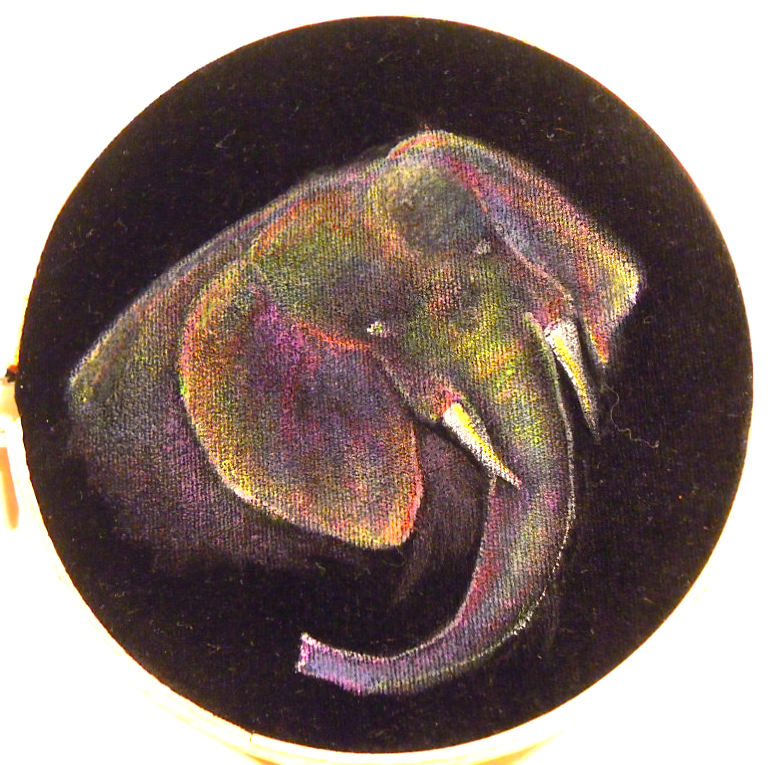


To finish up, I added some more white to create additional highlights, working it into the fabric so that it didn't overwhelm the colours. I also added the sad eyes. I didn't really know how to draw eyes with tears, so maybe these should have been a bit more transparent. Oh well.


If you decide to try this, here are a few tips.

1. You can use either acrylic or oils on velvet. I chose acrylics because they're easier to thin, but either works nicely on fabric.

2. The thinner the paint, the more likely it will be to suck into the fabric and not sit on the surface. This can be good if you want to create subtle shading, but will require considerable layering if you want more vibrant colours.

3. Let the background colour do some of the work. I thought about this too late in my painting, and wish I'd left a bit more black near the outlines and in the shadows.

4. If you do layer, use lots of colours you may not think you need. It will give your design depth and life.

5. Be sure to include a few highlights in thicker paint to make your design pop against the dark background.

6. Play with your brushstrokes. I found that I got the most interesting effects if I ground a small amount of paint into the velvet fibres. You can also play with paint thickness: watery paint creates more subtle effects than thick paint, for example.

This took me nearly two hours, which was more time-consuming than I expected it to be. I was very glad I'd decided to work small today.

In the end, I was happy with the way this turned out, but I doubt very much that I'll ever start producing velvet paintings. This would probably be an interesting technique to use in connection with other fibre-based art, however, and I'll probably play with it some more.

I just hope my friend likes this little piece well enough not to want to kill it.


Elephant Lore of the Day
Although there are no elephants today in velvet's home state of Kashmir, the fossil record indicates that the mountain region may once have had a sub-tropical climate in which elephants flourished.

In 2000, Indian geologists unearthed a 50,000-year-old elephant fossil in the state of Jammu and Kashmir. It was unexpectedly discovered in a field of saffron near Srinagar by geology students. The find consisted of a skull measuring 1.5 by 1.2 metres (5 by 4 feet), with complete upper and lower jaws, a broken tusk, and a vertebra.

Similar fossils had been discovered on India's central Gangetic Plain and in the southern Narmada Valley, but this was a first for Kashmir. The find was expected to shed new light on changes in climate and wildlife patterns in Kashmir, and initial research suggests that Kashmir once had a sub-tropical climate—unlike the cooler climate it has today. 


Elephant fossil being unearthed in Kashmir, 2000. It took four days to remove it.
Source: http://news.bbc.co.uk/2/hi/south_asia/913788.stm


To Support Elephant Welfare

Tuesday, 4 September 2012

Elephant No. 338: Painting with a Toothbrush


While researching spatter painting with a toothbrush several months ago, I came across the idea of actually using a toothbrush as a painting tool, rather than a tool for simply flicking paint at a canvas. So today I thought I'd finally try it.

Although the most common toothbrush technique involves flicking paint from the bristles, some artists use toothbrushes directly on the paper or canvas itself, just as you'd use a paintbrush. Although there doesn't appear to be a substantial amount of toothbrush-as-paintbrush art out there, the video below—featuring artist Ivan Vesely—will give you an idea of how it's done.


I bought a trio of toothbrushes for today's activity because I liked the diamond shape of the bristles on these. All three cost me a dollar at the grocery store, so it wasn't a big investment.


For paint, I decided to use gouache, and I decided to paint on mid-range watercolour paper. I thought about using acrylics and canvas, but I liked the idea of gouache, because it reactivates with water. If it could be reactivated, I reasoned, it might be more blendable.

Because the technique looks like it results in something fairly abstract, I decided to start from a photograph. This is the photograph I chose:


Laura the elephant, during her visit to Randall Elementary School in
Taylor, Michigan, October 2009.
Source: http://www.thenewsherald.com/articles/2009/10/03/news/
doc4ac782a774817753462702.txt?viewmode=fullstory


This is the toothbrush I chose to use. It was the smallest of the three, and I thought it would give me the most control and finesse—if you can call it that when painting with a toothbrush.


I started by, yes, spatter-painting the background. I didn't want the buildings and trees from the photograph, so I just lightly spattered a random series of colours.

Once I was happy with the background, I began painting the elephant. I used very light strokes to start with, as I wasn't quite sure what I was doing.


I noticed a couple of things right away. One was that, if the brush was a bit on the wet side, it smeared the paint quite a lot. The other was that using almost full-strength gouache straight from the tube gave me a look I preferred.

I added more colours, playing with the way I used the toothbrush.


I found that, if I really rubbed the brush into the surface, it gave me a nice blending effect. By the same token, if I loaded the tip of the toothbrush with heavy paint, I could make relatively fine lines and dots. The worst moments were when I either had a brush that was too wet, or too loaded with paint, resulting in a big blob, or a smeary mess. Luckily, this could be fixed by simply layering on more paint.


Using a toothbrush as a paintbrush is a bit of a strange experience. It offers a level of control that's somewhere between a palette knife and a paintbrush—perhaps even slightly less than a palette knife.

That being said, I actually quite like the final result. It's got a rough and crazy look that reminds me of Francis Bacon or Willem de Kooning, but I like the way the colours work together, and I didn't mind the crude brushwork.

It took me about an hour and a half to produce this once the spatter painting was dry—mostly because it took me about half an hour to figure out how to actually paint with a toothbrush. In the end, however, I was pretty happy with the technique, and will probably use it again if I'm in the mood for something with a wild sort of vibe.


Elephant Lore of the Day
Although it would obviously take forever to clean an elephant with a toothbrush, a good scrubbing is actually quite beneficial.

At many tourist facilities featuring elephants, guests are invited to climb into the water with elephants and give them a scrubbing with long-handled brushes. At zoos, elephants are often scrubbed as well, as a way of cleaning and conditioning their skin.

In Kerala, which has a long history of domesticating elephants, they take a slightly different approach to scrubbing. Although elephants are bathed and cleaned with coconut husk on a regular basis, the elephants are also scrubbed with a pumice stone from time to time.


Scrubbing an elephant with pumice, Chitwan National Park, Nepal, 2007.
Photo: Graham Hurst
Source: http://www.flickr.com/photos/monkeyimages/2126805999/


Logging elephants, in particular, are subjected to scrubbing with pumice. This is done, not to clean the elephants, but to improve skin tone and relax the muscles. There are also a number of beliefs related to pumice scrubs and elephants, based loosely on the concepts of pressure points and chakras.

Scrubbing for more than an hour, for example, is believed to cause an elephant's eyes to water. Juveniles will become weak if scrubbed during musth. Elephant calves and juveniles should never be scrubbed above the knee. And if an elephant becomes too used to a nice pumice scrub, it is likely to experience problems if the practice is discontinued, including arthritic joints.


Scrubbing an elephant with coconut husks, Kothamangalam, Kerala, India, 2007.
Photo: Roxy Mathew
Source: http://www.rocksea.org/elephant-bath-kerala/


To Support Elephant Welfare

Saturday, 25 August 2012

Elephant No. 328: Scumbling


Although I used a dry brush technique for a previous blog entry, apparently scumbling is something different, so I thought I'd try it for today's elephant.

As far as I can tell, scumbling involves applying relatively thick, dry paint to a surface in a circular movement. So I suppose it's a bit like circulism with paint.

The usual purpose of scumbling is to soften edges in atmospheric landscapes and similar types of work. Because the paint is "see-through", and because scumbling generally involves painting light colours over dark, scumbling can give a painting a sense of depth, similar to applying multiple glazes.

Since I figured I might end up with something rather impressionistic, I decided to start from a photograph. This is the photograph I chose, which I also used for my painted metal pail. I chose this photograph because it has large expanses of colour and a nice range of tonal values.


A teenage elephant makes a warning charge, Okavango Delta, Botswana, 2010.
Photo: Nick Pattinson
Source: http://www.australiangeographic.com.au/journal/elephant-fiesta-
in-the-okavango-delta.htm


Because scumbling apparently has to be done over dry paint, I decided to use acrylics. I also chose to work on a 20 x 25 cm (8 x 10-inch) canvas board today, thinking that this might be the most sturdy surface for a process that would probably destroy even heavy watercolour paper.

I started by roughing in the elephant shape in blue. Right away, I could see that the brush I'd chosen was going to be ruined by the time I was finished this painting. Luckily I had chosen a cheap brush. The most important thing is that the brush be relatively stiff. Quality isn't that important, except that you don't want it to be so cheap that it loses bristles all over your work.


I roughed in the background next. I didn't plan to do a very elaborate background, so scumbling was a perfect technique. At this point, I was using fairly watered-down paint. I know you're supposed to use thick, dryish paint, but I liked the subtlety of watery paint.


I added purple to the elephant next, then green.


After this, I added yellow, orange and red, shading and shaping the elephant with colour.


At this point, I felt it was more or less ready for highlights and shadows. I used white with just a touch of blue in it for the highlights. This time I used the paint almost full strength, although I put very little paint on the brush each time.


For the shadows, I used a very dark grey, just touching it to the end of the bristles and scumbling it into the surface.


This was quite an easy technique, although it doesn't allow for a high degree of precision. However, if you're okay with something Impressionistic, this is great. I really liked the way the final piece shimmered, which is perhaps partly due to the colours I chose, as well as the layering and glazing effect of the scumbling.

It took me about an hour and a half to paint this, and I'm quite happy with the final piece. As far as I can tell, many people use scumbling for backgrounds and landscapes, but I think it works very nicely for a elephant, too.


Elephant Lore of the Day
Elephants often appear relatively placid and gentle. However, according to Henry Sheak—a man who spent most of his life with elephants—frightened elephants are a force to be reckoned with. "When an elephant is badly scared," he said, "he becomes panic-stricken and takes complete leave of his senses. Then he is likely to run over you, trample on you, or crush you against something."

In a 1923 article, Sheak also described the sad fate of George William Lockhart, a famous Victorian elephant trainer. Lockhart's four elephants had stampeded in the past at various venues near London, and it was in a stampede that Lockhart was killed. One morning in 1904, while Lockhart was loading his elephants at Walthamstow Station in London, something frightened the small herd.


Poster for Lockhart's elephants, although whether these are George William Lockhart's
elephants, or his brother Sam's, is unclear.
Source: http://theblogofrichie.blogspot.ca/2010/05/sightings-salt-sauce.html


In a blind panic, the elephants began careening through the rail yards, with Lockhart in pursuit. A large bull elephant named Sauce, in a mad terror, accidentally crushed Lockhart against the side of a rail car, killing him.

Oddly enough, after Lockhart's death, his elephants became celebrities in their own right. Sold on to a series of other owners, the two most famous elephants in Lockhart's herd—Salt and Sauce—went on to live long lives. Despite accidentally killing other handlers, they remained well-loved in the press. Salt, a male elephant, lived until 1952, and Sauce lived until 1960, eventually dying at a holiday camp in Skegness.


Salt and Sauce with little Mary Burt, 1947.
Source: http://theblogofrichie.blogspot.ca/2010/05/sightings-salt-sauce.html


According to Sheak, elephants are normally very careful animals and—unless enraged, in musth or terrified—will rarely hurt a man, even accidentally. Sheak noted that he had walked for hours in circus rings with elephants, giving them exercise, and never suffered even the slightest touch of an elephant's foot. On the other hand, when he walked horses around the ring to accustom them to the elephants, the horses were constantly stepping all over him. Having been stepped on by horses more times than I can count, this doesn't surprise me.


Source: http://blogs.elca.org/hungerrumblings/2010/04/


To Support Elephant Welfare

Wednesday, 8 August 2012

Elephant No. 311: Teabag Art


I'd never heard of this form of art before, and thought it was pretty strange until I looked at what people have done with the lowly teabag.

People seem to use the teabags in a number of ways. Some use the dried teabag, string and all—sometimes still full of tea—as a painting surface.


Teabag ornaments by Coco2005.
Gesso, paint and collage.
Source: http://www.flickr.com/photos/85087573@N00/6332361400/


Others take the dried teabag apart, empty it of tea, then paint, embroider or otherwise embellish the resulting tea-stained material.


Tea bag project by Original T-Bag Designs, South Africa.
Emptied, painted and arranged.
Source: http://cityroom.blogs.nytimes.com/2008/02/27/the-tea-bag-
basks-in-its-moment-to-simmer/


Some stitch multiple teabags together, layering them with other fabrics, or mounting them on board before adding additional decoration.


Teabag art by Beryl Taylor (detail).
Painted, embroidered, quilted with other fabrics.
Source: http://www.clothpaperscissors.com/blogs/
clothpaperscissorstoday/archive/2012/03/16/how-to-use-tea-
bags-in-fabric-art.aspx?a=cpe120713


Some use them to produce artist trading cards and books.


Art book by Australian artist Carmel, 2012.
Each page is made from an emptied, used teabag, painted and embellished.
Source: http://carmel-makemeapictureofthewind.blogspot.ca/2012/01/tea-for-one.html


And some produce large-scale assemblages with numerous teabags, relying in part on the different shades of the teabags to create visual interest.


Teabag collage by Armén Rotsch, ca. 2007.
Dried teabags, full and emptied, in natural colours.
Source: http://www.curbly.com/users/diy-maven/posts/9932-10-marvelous-examples-of-tea-bag-art


Well, who knew there were so many kinds of teabag art? I was just as surprised by the existence of teabag art as I was by tortilla art a few weeks back.

I decided to try a couple of things for today's elephant. I had two teabags with strings, and one round bag with no strings. I started by hanging them all up outside in the hot sun to dry.

When they were dry, I brought them inside. These were the three teabags I had to work with.


I decided to paint on one with the string intact and the tea still inside. I decided to give the round teabag a similar treatment. For the second teabag with a string, I decided to take it apart, empty out the tea, and use the resulting surface as a sort of paper.

To remove the tea from a "pocket" teabag, you simply remove the staple, unfold it, tip the tea out, then gently unfold the crease in the middle.


The first teabag I tried was the unfolded sheet. I started by giving it a greenish background wash with gouache. The paint soaks right through this, making it difficult to build up layers. It makes sense for the teabag material to be porous, since the tea has to seep out. In art terms, however, this presents a bit of a challenge. I suppose I could have added gesso, or perhaps used acrylic paint, but it wasn't a real problem for the kind of painting I envisaged here.


Once I'd done the background, I let it dry, then painted on the elephant. The paint soaked right through on this as well, so I began using thicker paint and added quite a few layers. Thicker paint is harder to spread on this particular surface, so it's a bit of a trade-off. On the other hand, I liked the way some of the brown tea stains peeked through, and didn't worry too much about making it opaque.

These are such quick paintings that I didn't bother to photograph all the mini-stages in each. Truth be told, I got a little too engaged in the process to remember to go to my photography area.


My next elephant was the other pocket teabag, with the string and tag still attached. Since I was planning to leave the tag on, I built up a background using the colours in the tag.


I let this dry for a bit, then painted on the elephant. This time, I found that having tea inside the bag helps to keep the paint a little closer to the surface. There are still several layers in the background, but the painting on top needed only three or four.


For my final elephant, I used the round teabag, also keeping the tea inside. I began by applying a thick layer of purple, deep blue and dark red. It took about four layers to create a surface thick enough to keep the paint from soaking in. The paper on this type of teabag appeared more porous than the others to the eye, but it didn't seem to make any difference in terms of how much paint I needed to apply.

When this had dried, I painted on the elephant with about three or four layers of gouache, then added a delicate crown using dots of full-strength bottled gold acrylic paint. Because it was acrylic and full strength, it sat nicely on the surface.


I was surprised at how well these turned out. It's a sort of weird art form, but teabags actually make interesting canvases for miniature works of art. I preferred to work on the teabags that were still full, but I can see using the flattened version as a background if I wanted the look of stained parchment.

It only took me about two hours to produce all three of these, and it's something I'd definitely try again.


Elephant Lore of the Day
Elephants are frequent visitors to tea plantations, particularly as their own ranges become smaller and less contiguous. Such unsolicited visits are unwelcome, however—partly because of the plants that are trampled and destroyed, and partly because human-elephant conflict often results in death and injury, both to elephants and to humans.

The tactic used by most plantations these days involves trying to scare the elephants away by tossing firecrackers, shouting at them, and chasing them. This generally has mixed results, as shown in a video I posted on this blog a couple of months ago. Whether in the dark or in broad daylight, chasing elephants and using noise often terrifies the animals so much that they cluster together in a "last stand", often charging their persecutors.


A firecracker exploding near elephants on the Sholayar tea plantation,
Valparai Plateau, Tamil Nadu, India.
Source: http://www.hindu.com/2006/09/06/stories/2006090613510200.htm

In some parts of India, people are trying a couple of interesting new ideas in order to limit deadly encounters between people and elephants. One of the most promising and important initiatives involves creating wildlife corridors across the tea plantations. Since most elephants aren't trying to destroy or eat crops so much as cross from one side to the other, corridors are seen as one of the best ways of mitigating human-elephant conflict.

Elephant corridors would involve more than allowing simple pathways through the plantations. Elephants need large quantities of water and reasonable forage along the way, if they are to be kept from straying onto the plantations. As a result, most wildlife specialists suggest that elephant corridors follow rivers. They also suggest that some corridors will need to be planted or replanted with appropriate crops such as eucalyptus, and that human habitations be moved away from the rivers.

Because unexpected encounters with humans are just as disturbing to elephants as unexpected encounters with elephants are to humans, some areas have also begun to set up Elephant Early Warning Systems. In a number of pilot projects, people use mobile phones to call in the location of elephants. This information is broadcast on local television stations in a "ticker-tape" format at the bottom of the screen. Knowing where the elephants are has proven a boon to people wary of happening upon an elephant on the way home from work. Early reports suggest that this is proving a fairly effective way of keeping elephants and people apart.

In another pilot project, plantations began using domesticated elephants to keep out wild elephants. The idea was that wild elephants wouldn't invade an area in which other elephants were already living. This initiative has had mixed results, especially when humans get into the act and try to help domesticated elephants chase away any wild interlopers. The chaos that results can often become extremely dangerous, as seen in the video below.


To Support Elephant Welfare
Elephant sanctuaries (this Wikipedia list allows you to click through to information
on a number of sanctuaries around the world)