Showing posts with label craft blog. Show all posts

Sunday, 30 September 2012

Elephant No. 364: Kaleidoscope


I've loved kaleidoscopes ever since I was little, and have a small collection of at least three different types.

The word "kaleidoscope"—from the Greek kalos (beauty/beautiful), eidos (shape) and skopeo (to see/observe)—was coined in 1817 by Scottish inventor Sir David Brewster, who developed the device as an outgrowth of his experiments on the polarization of light.

His first design consisted of a tube with a pair of mirrors at one end, translucent disks at the other, and beads sandwiched in between. The kaleidscope was an instant success when it hit the market in 1817, with Brewster and his manufacturing partner Philip Carpenter selling 200,000 kaleidoscopes in London within the first three months. Realizing that they would never be able to keep up with the demand, the men licensed other companies to produce kaleidoscopes.


Toy kaleidoscope, ca. 1965.
Photo: Sheila Singhal


Kaleidoscopes were originally produced as a science tool, but were soon being made in cheaper toy versions. Most kaleidoscopes today consist of a tube, a trio of mirrors formed into a triangle, and a selection of beads, bits of coloured glass and shiny shapes, floating freely in a small receptacle at the opposite end from the eyepiece. As light enters the receptacle end of the kaleidoscope, and the user turns the receptacle, multifaceted and ever-changing patterns are created.

In addition to the typical mirrored tube, there are also liquid versions. Tiny coloured pieces suspended in a thick liquid drift past a mirrored tube, creating the pattern.


Inexpensive liquid kaleidoscope.
Photo: Sheila Singhal


And finally, there are teleidoscopes. These also employ mirrors; however, instead of having integral coloured pieces, they reflect objects outside the tube, producing a similar multifaceted effect.


Teleidoscope, ca. 1960.
Photo: Sheila Singhal


Although the vast majority of modern telescopes consist of inexpensive cardboard tubes, plastic mirrors and plastic beads, there is also a high-end market for kaleidoscopes produced by artists. Many craft galleries carry artisan kaleidoscopes and teleidoscopes, and they are a popular item at craft fairs.

For today's elephant, I bought this kaleidoscope kit, made for children.


And this is what it contained.


I didn't like the purple flowered paper provided for the outside of the tube, so I decided I would paint elephants on the outside, using a sheet of canvas from a canvas pad.


I cut the canvas into the appropriate sizes for the main part of the tube, the receptacle, and the little band dividing the two, and drew some elephants on all three pieces.


I painted everything next, bearing in mind that there would be a small overlap when everything was glued.


I glued all of the canvas pieces to the tube with a glue gun. I glued only the seams at the back, but made sure to smooth the canvas tightly around the tube before glueing the overlap.


Next, I assembled the mirrors. The kit included special tape to hold them in the requisite triangle formation. I then inserted the assemblage into the tube.


I planned to use many of the coloured bits that came with the kit, but I thought there should be at least one elephant shape in the mix. I didn't have any coloured plastic handy, so I bought this plastic food container for a dollar, then cut out three small elephant shapes. This was probably the hardest part of the whole activity, because the plastic was a bit thick, and wasn't very forgiving, splitting and cracking at will.


I put the elephants in the little plastic receptacle that goes in the bottom of the kaleidoscope tube, and added a bunch of other beads from the selection that came with the kit. When I was happy with the mix, I pushed the cup into the tube.


Now came the fun part. The three photos below show my best attempts at capturing my three pink elephants. You have to squint a bit, but at least I know they're there.


If I hadn't decided to redesign the decoration on the outside of the tube, and if I hadn't decided to cut out little elephants, this would probably have taken an hour or so. As it was, it took me most of the afternoon.

That being said, I really like the final result, and think it will make a nice little addition to my existing collection.


Elephant Lore of the Day
In 1887, Toby the elephant was added to Moore Park in Sydney, Australia. For many years, she was a great favourite with the public, performing a wide range of clever tricks. She could remove her keeper's hat when asked, take a handbell in her trunk and ring it, and ride an elephant-sized seesaw.

In those days, Australia's circuses and menageries often travelled by sea. And Toby, like all elephants, had a very good memory. On one voyage, a deckhand fed Toby an orange loaded with hot pepper—a rather cruel thing to do, considering the sensitivity of an elephant's trunk and mouth. On a much later voyage, the same deckhand happened to be passing by, when Toby grabbed him with her trunk. She tried to dump him overboard, but the man landed in the rigging and was saved.

Over time, as do many other performing elephants, Toby became more sour and less reliable. Sold to the Wirth Circus, she continued to perform, but was prone to tantrums. In July 1904, in a fit of pique, she broke free of her chains and rampaged through the grounds where the circus was encamped. She broke the pole holding up the main tent, the curtains and a stage, then dashed across the grounds, pulled down some fencing, and trampled a few trees. She only came to a stop when she happened upon an interesting snack consisting of a sack of wheat and a half-dozen loaves of bread. This restored her temper, and she was safely led back to her enclosure.

Toby continued to perform with the Wirth Circus until about 1914, when she collapsed on a bridge, holding up horse-drawn traffic for twelve hours. Although she recovered, she collapsed again about a year later, dying in April 1915 after an illness lasting about three days. It was suggested at the time that she was close to eighty years old—which would have been exceptionally old for an elephant. It is more likely, however, that she was born in 1877, making her only 37 or 38 at the time of her death.


A picture of Toby from a newspaper article.
Source: http://circuszooanimals.blogspot.ca/2011/11/
toby-troublemaking-elephant.html


To Support Elephant Welfare
Boon Lott's Elephant Sanctuary (Thailand)
Wildlife SOS (India) 
 
The Elephant Sanctuary (Tennessee

Saturday, 29 September 2012

Elephant No. 363: Party Blowout


I didn't actually know the name of this type of party favour—and I'm still slightly suspicious that "blowout" is a made-up descriptive name—but since I'm almost done with this yearlong project, a party favour seemed like the thing to make for today's elephant.

Also known as party horns, blowers, noisemakers, jolly Jonathans, squeakers and fizoos, party blowouts consist of paper cones attached to paper tubes that are flattened and rolled into coils. Most contain a coiled metal strip to make the tube retract again, as well as a small diaphragm, so that when you blow into the mouthpiece, it makes a noise.

The most familiar type of party blowout is the kind with a simple tube and a plastic mouthpiece. When I was little, they always had a small feather on the end as well, which fluttered when the tube was fully extended. Although I don't usually keep these, I did keep a rather unusual blowout with three extending tubes, brought back from India by my father.


Triple-tubed Divali noisemaker from India.
Photo: Sheila Singhal


There are also blowouts with novelty faces attached, which is the kind I'll be making for today's elephant. I had actually forgotten about the face version, until I saw this package in the party supplies section of a discount store. None of the packages contained an elephant face, which seemed odd to me.


This was dead simple to make, of course. All I had to do was disassemble one of the blowouts from the package, and use the headpiece as a template.

I traced around two of the animals on a piece of artist-quality bristol board. It obviously didn't matter which one I used as a guide, because it was going to be altered, anyway. To hedge my bets, however, I chose two different shapes and superimposed them. The main thing was to get the general size right, and to get the openings in approximately the right spot.


Once I'd traced around everything, I expanded it to add the elephant's features, obviously sans trunk.


This looked a bit like a vampire bat, which worried me, so I cut it out and fit one of the plain blowouts through the opening before I went to the trouble of painting it.


It looked okay, so I painted everything with gouache. I thought about painting the tube, but the harlequin pattern already had grey in it, and I didn't know what might happen if I added paint. I feared I might end up with a dissolving paper mash, so I left well enough alone.


To reassemble this, I simply slipped the new face over the basic blowout. And voilà!


And this is what it looked like in action. The squeaker on this blowout was eccentric, so I added my own sound effects.


This was very simple, and might make an interesting party activity for children—or adults, for that matter. In fact, I might try to coax some friends into trying this sometime, just for the fun of seeing what they come up with.


Elephant Lore of the Day
Elephants use their trunks to make a wide range of sounds, from loud trumpeting to a squeak said to be as tiny as that of a mouse. As far as I can tell, this is the general repertoire of trunk noises:

Loud trumpeting: Anger or fear. In a bull elephant, loud trumpeting—said to be "loud enough to bring down the walls of Jericho"—is often an expression of dominance. In a female, it is often an expression of anger, or warning to anyone foolish enough to get in between a mother and her calf. In both genders, it can also be a signal to flee.

Medium trumpeting: This is the most varied type of trumpeting, and can be used as a form of greeting between elephants, a means of saying goodbye, or even a way of expressing excitement and pleasure, as at feeding time. Elephants will also trumpet to express moderate displeasure, or to tease their human keepers.

Squealing: Baby elephants squeal partly because they aren't yet equipped to trumpet. They also squeal when feeling anxiety or distress. Never get between a squealing baby and its mother.

Screaming: This is, as in humans, an out-and-out distress call. Elephants scream when attacked by predators, poachers and snakes. They scream when frightened or cornered. They scream to let other elephants know there is an extreme threat in the area. They scream as they flee.

Squeaking: Even the largest bull elephant can make a tiny squeak. This is the sound many elephants emit when unsure, nervous or slightly anxious.

When elephants rumble, it doesn't involve the trunk at all, but a vibration in their vocal chords, just as we use ours to speak or sing. Many rumbles are at the infrasonic level, inaudible to human ears.


Trumpeting elephant, Tanzania, 2005.
Photo: Matt Lindop
Source: http://www.flickr.com/photos/pod0/24250869/


To Support Elephant Welfare
Boon Lott's Elephant Sanctuary (Thailand)
Wildlife SOS (India) 
 
The Elephant Sanctuary (Tennessee

Wednesday, 26 September 2012

Elephant No. 360: Marbles


When I was little, someone gave me a small worm made of marbles glued together with some kind of silicone. It even had tiny googly eyes. Even back then, I found it intriguing that something as slippery as glass could be stuck so firmly together with glue—as witnessed by my many attempts to pry the pieces apart—so I thought I'd try it for today's elephant.

Marbles are small spherical toys made usually of glass, although there are also marbles made of agate, clay, steel and plastic. The earliest known marbles were made of stone, and date to the Indus Valley civilization (ca. 3300–1300 B.C.). Games involving marbles made of stone, clay and glass were also played in Rome and Ancient Egypt.

In 1846, a German glassblower invented special "marble scissors" which could be used to clip off and form individual marbles. Mass-production of marbles began with ceramic marbles in the 1870s, followed by the first sets of mass-produced clay marbles, which were produced in the early 1890s.


Traditional marble scissors.
Source: http://dumpdiggers.blogspot.ca/2007_12_01_archive.html


In 1903, the first U.S. produced glass marbles were being mass-produced in Akron, Ohio on a machine patented by Martin Frederick Christensen. M.F. Christensen & Son manufactured millions of toy and industrial glass marbles until the company closed up shop in 1917.

For millennia, children and adults have played games with marbles. One of the most common games involves first drawing a circle in the sand. Players then take turns rolling their marbles into the circle, attempting to knock other marbles out. Other commonly played games involve shooting marbles at holes or at target marbles. In many of these games, the winner of each round keeps the other player's marble.

Most marble-related games involve rolling marbles along a surface; in others, players toss marbles from a standing position. Marbles are also used in board-style games such as Chinese Checkers, in which each player hops his or her marbles over those of other players.


Chinese Checkers board.
Source: http://mathworld.wolfram.com/ChineseCheckers.html


There are many colourful terms in the world of marbles. One of my favourites is the move called the "elephant stomp". This is when a player gets to stomp his or her marble level with the surface of the ground, making it virtually impossible for other players to hit it.

Different types of marbles also have interesting names. Alleys, for example, are marbles made of marble or alabaster—"alley" being short for "alabaster". Toothpaste marbles are the ones with a little twist of coloured glass in the centre. Aggies look like agate; bumblebees are yellow with two black stripes on each side; catseyes have a central eye-shaped insert of coloured glass; and elephant eggs are a type of particularly large marble. For an exhaustive list of marble names and types, visit the Wikipedia page on marbles.


Different types of marbles.
Source: http://mariemillard.blogspot.ca/2007/12/i-havent-lost-my-marbles.html


When I was young, I had a small jar of marbles—some of which I had won away from my brothers and other neighbourhood boys, and some of which I bought because they were pretty. Today, a marble collection can range from a couple of handfuls contained in a jar or bowl, to elaborate displays grouped by maker, style, material, quality, age and rarity. Because of their relative fragility, even a tiny chip can have a major impact on value.

Marbles were originally made by hand. If made of stone, bone or ivory, they were carved and polished. If made of clay, ceramic or porcelain, they were rolled into balls then fired and usually glazed. Handmade glass marbles are produced by stacking glass rods together to form a pattern, which is then cut into marble-sized pieces with marble scissors and rounded while still molten. Mass-produced glass marbles are produced by dropping blobs of molten glass into a groove. As the glass passes along the groove and cools, it is shaped into spheres.

In the United States, many companies started in Akron, Ohio, where the original marble-making machine was located. Today, the world's largest maker of mass-produced marbles is Vacor de Mexico, which produces 90 per cent of the world's marbles, at the rate of more than 12 million per day.

Glass artists also produce art marbles for the collector market. Many of these are much larger than the average playing marble, and are meant solely for display.


Spectacular art marble by Mike Gong.
Source: http://www.marblesgalore.com/page/15/


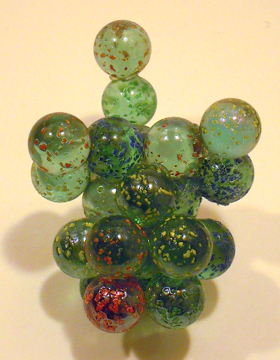
For today's elephant, I bought a sort of hodge-podge bag of strange bumpy marbles for less than two dollars. I bought these particular marbles because there were weird-looking, and because there were twice as many marbles in this bag as in any of the nicely packaged sets.


To glue the marbles together, I bought a tube of clear silicone.


I had absolutely no idea what I was doing, nor if I was even going to be able to construct an elephant shape of glass marbles. The trunk was a particular concern, as there aren't teeny marbles anywhere to be found.

Accordingly, I started with the trunk, glueing three marbles together in a slight curve.


Next, I put four marbles together in a square to provide a place to hold the trunk. I then added another marble to the back of this head shape. My idea was that the extra marble at the back of the head would help to anchor any body shape I added.


I attached the trunk next, and left things to set for a while. Although this process is very, very easy, it takes at least 10–15 minutes for the silicone to set each time. It won't be completely cured within 15 minutes, but you can at least handle the piece enough to glue on something else. Because of this, making this small elephant took most of the day—although the total actual working time was probably about 45 minutes.


After this, I got a bit distracted with other work I had to do today, every so often wandering over to glue on another marble or two. I also forgot to photograph the various stages. To give you an idea of how I did it, however, I glued on the marbles approximately like this: four marbles between the existing head and the body; a ring of six marbles around a central marble for the main body; four single marbles glued to the bottom of the body for legs; two marbles at the back to fill out the body; and two marbles stuck to each side of the head for ears.


This was easy enough for a child to try—although it would have to be a child with considerable patience, unless he or she was making something like a simple worm or snake. For more complicated forms, they have to be built in a sort of modular fashion, reassessing the shape at each stage. In my experience, the shape can't really be laid out any other way.

In the end, I rather liked this process. It's not something you'd use if you were in a hurry, but the final piece is actually rather pretty, despite the strange mismatched marbles and my rather lackadaisical approach to a tidy glueing technique. It's also quite heavy, so I think it will probably end up on my desk as a rather fun paperweight.


Elephant Lore of the Day
Lawrence Anthony—who became known as "The Elephant Whisperer" for his ability to heal the psyches of traumatized adult elephants—writes about being out in the bush one day, watching the still-unfriendly herd. He was studying them to learn the locations of their favourite watering holes, as well as what they were eating and where.

When he thought the herd was a safe distance away, he got out of his landrover to make a call on his brand-new cellphone. Some instinct, however, made him look over his shoulder, just as he was about to complete his call. To his horror, he saw the herd's most dangerous elephant, Frankie, a mere twenty metres away, with the rest of her family herd in tow.

Anthony leapt into his landrover with, as he wrote, "an alacrity which surprised even me." In his haste, he dropped his new cellphone. Soon the herd had arrived at the very spot where he'd been, and were milling about the phone. Anthony had no choice but to wait until they left, before he could retrieve the hapless device.

Suddenly the phone rang, its sound piercing the quiet. The elephants stopped in their tracks, turned around and approached the source of the unusual noise. Frankie arrived first, sleeking her trunk over the small piece of plastic, trying to figure out what it was. The others soon followed suit, and Anthony watched as seven elephants swung their trunks around over a chirping cellphone in the African bush.

Frankie finally decided that she'd had enough. Raising one of her feet, she stomped on the cellphone. The ringing stopped. The herd then turned around and ambled off.

When the herd was finally out of sight, Anthony went to retrieve his phone. Although it was buried deep in the soil, it still worked.

In addition to becoming famous for helping to rescue animals from the Baghdad Zoo during the recent conflict in Iraq, Lawrence Anthony has also become known for an unusual tribute paid to him following his death in March 2012. As if knowing that their friend and rescuer had died, the herds of Thula Thula walked twelve hours from their home in the bush to visit Anthony's home, remaining there for a short time before turning around and walking back.


Lawrence Anthony with an unnamed member of the Thula Thula herd.
Source: http://www.smh.com.au/environment/conservation/what-
elephants-can-teach-us-about-love-20090617-chyi.html


To Support Elephant Welfare
Fauna & Flora International