Showing posts with label yearlong blog. Show all posts

Tuesday, 4 September 2012

Elephant No. 338: Painting with a Toothbrush


While researching spatter painting with a toothbrush several months ago, I came across the idea of actually using a toothbrush as a painting tool, rather than a tool for simply flicking paint at a canvas. So today I thought I'd finally try it.

Although the most common toothbrush technique involves flicking paint from the bristles, some artists use toothbrushes directly on the paper or canvas itself, just as you'd use a paintbrush. Although there doesn't appear to be a substantial amount of toothbrush-as-paintbrush art out there, the video below—featuring artist Ivan Vesely—will give you an idea of how it's done.


I bought a trio of toothbrushes for today's activity because I liked the diamond shape of the bristles on these. All three cost me a dollar at the grocery store, so it wasn't a big investment.


For paint, I decided to use gouache, and I decided to paint on mid-range watercolour paper. I thought about using acrylics and canvas, but I liked the idea of gouache, because it reactivates with water. If it could be reactivated, I reasoned, it might be more blendable.

Because the technique looks like it results in something fairly abstract, I decided to start from a photograph. This is the photograph I chose:


Laura the elephant, during her visit to Randall Elementary School in
Taylor, Michigan, October 2009.
Source: http://www.thenewsherald.com/articles/2009/10/03/news/
doc4ac782a774817753462702.txt?viewmode=fullstory


This is the toothbrush I chose to use. It was the smallest of the three, and I thought it would give me the most control and finesse—if you can call it that when painting with a toothbrush.


I started by, yes, spatter-painting the background. I didn't want the buildings and trees from the photograph, so I just lightly spattered a random series of colours.

Once I was happy with the background, I began painting the elephant. I used very light strokes to start with, as I wasn't quite sure what I was doing.


I noticed a couple of things right away. One was that, if the brush was a bit on the wet side, it smeared the paint quite a lot. The other was that using almost full-strength gouache straight from the tube gave me a look I preferred.

I added more colours, playing with the way I used the toothbrush.


I found that, if I really rubbed the brush into the surface, it gave me a nice blending effect. By the same token, if I loaded the tip of the toothbrush with heavy paint, I could make relatively fine lines and dots. The worst moments were when I either had a brush that was too wet, or too loaded with paint, resulting in a big blob, or a smeary mess. Luckily, this could be fixed by simply layering on more paint.


Using a toothbrush as a paintbrush is a bit of a strange experience. It offers a level of control that's somewhere between a palette knife and a paintbrush—perhaps even slightly less than a palette knife.

That being said, I actually quite like the final result. It's got a rough and crazy look that reminds me of Francis Bacon or Willem de Kooning, but I like the way the colours work together, and I didn't mind the crude brushwork.

It took me about an hour and a half to produce this once the spatter painting was dry—mostly because it took me about half an hour to figure out how to actually paint with a toothbrush. In the end, however, I was pretty happy with the technique, and will probably use it again if I'm in the mood for something with a wild sort of vibe.


Elephant Lore of the Day
Although it would obviously take forever to clean an elephant with a toothbrush, a good scrubbing is actually quite beneficial.

At many tourist facilities featuring elephants, guests are invited to climb into the water with elephants and give them a scrubbing with long-handled brushes. At zoos, elephants are often scrubbed as well, as a way of cleaning and conditioning their skin.

In Kerala, which has a long history of domesticating elephants, they take a slightly different approach to scrubbing. Although elephants are bathed and cleaned with coconut husk on a regular basis, the elephants are also scrubbed with a pumice stone from time to time.


Scrubbing an elephant with pumice, Chitwan National Park, Nepal, 2007.
Photo: Graham Hurst
Source: http://www.flickr.com/photos/monkeyimages/2126805999/


Logging elephants, in particular, are subjected to scrubbing with pumice. This is done, not to clean the elephants, but to improve skin tone and relax the muscles. There are also a number of beliefs related to pumice scrubs and elephants, based loosely on the concepts of pressure points and chakras.

Scrubbing for more than an hour, for example, is believed to cause an elephant's eyes to water. Juveniles will become weak if scrubbed during musth. Elephant calves and juveniles should never be scrubbed above the knee. And if an elephant becomes too used to a nice pumice scrub, it is likely to experience problems if the practice is discontinued, including arthritic joints.


Scrubbing an elephant with coconut husks, Kothamangalam, Kerala, India, 2007.
Photo: Roxy Mathew
Source: http://www.rocksea.org/elephant-bath-kerala/


To Support Elephant Welfare

Thursday, 30 August 2012

Elephant No. 333: Plastic Animals


I've drawn an elephant made of elephants before for this blog, but when I came across a tube of plastic animals a couple of days ago, it occurred to me that I might also be able to use them to make an elephant.

The word "plastic" comes from the Greek plastikos, meaning "capable of being shaped or moulded"—a key characteristic of the polymers which end up as plastic toys and the like.

The earliest plastics were derived from organic materials such as egg proteins, which are themselves polymers. One of the most common plastic-type materials during the Middle Ages in Europe was cattle horn, which was used to shield lantern flames. The earliest manufacture of a sort of plastic was actually the production of a material that mimicked horn, made by blending milk protein (casein) with lye.

During the nineteenth century, materials similar to modern plastics were developed. One of the key discoveries on the road to developing modern plastics was vulcanization. Vulcanization was essentially a means of producing durable rubber by heating it, leading to a whole new world of products using heat-setting technologies.

The first true plastic material was parkesine, invented in 1856 by Alexander Parkes of Birmingham, England. Interestingly, Parkes produced his plastic using cellulose—which makes it not that dissimilar from the newest crop of water bottles, produced using corn cellulose. Parkesine was made by adding nitric acid to cellulose. The resulting compound could then be heated to make it malleable and mouldable; it could also be tinted to look like ivory.

The first fully synthetic plastic material was Bakelite, invented in 1909 by Belgian chemist Leo Baekeland. Made from phenol and formaldehyde, bakelite was discovered by accident. Baekeland had been looking to make an insulating coating for wires in motors and generators by combining phenol and formaldehyde. He later discovered, however, that the sticky material he'd concocted could also be mixed with wood dust, asbestos and powdered slate to create strong composite materials. Originally used for electrical and mechanical parts, by the 1920s bakelite in widespread use for everything from household goods to jewellery.


Bakelite bracelets.
Source: http://pamglover.wordpress.com/2010/06/28/bakelite/


Although we generally think of plastic as being completely synthetic, most plastics are made of organic polymers. These are usually chains of carbon atoms, either alone or combined with oxygen, sulphur or nitrogen. Inorganic compounds are usually added to the mix, depending on what the plastic is for. Food wrap, for example, containes no additives, while electronic components can be more than 50 per cent inorganic. Many plastics also contain fillers such as chalk, colourants, fire retardants and stabilizers.

In addition to petrochemical-based plastics, there are biodegradable plastics, which are essentially plastics that contain starch, allowing them to fragment more easily. This does not mean that they break down completely. There are also bioplastics, which are produced with cellulose from corn and other plants.

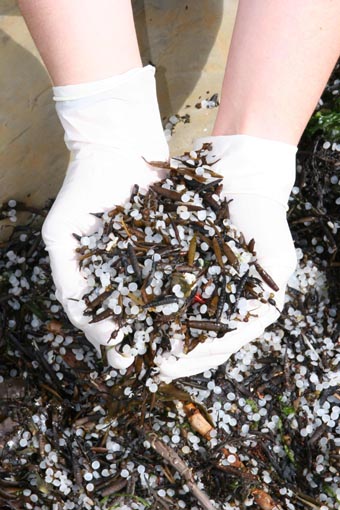
Because most plastics degrade slowly, they can have a significant impact on the environment. Since the 1950s, one billion tonnes of plastics have been discarded. In addition, plastics bags which are not recycled can become a danger to animals—both marine and land-based—who often ingest plastic when scavenging for scraps of food. The greatest threat to animal life, however, is "nurdles": small pre-plastic pellets that animals often mistake for food. Nurdles kill large numbers of fish and birds each year.


Nurdles on the seashore. They are often mistaken
for fish eggs by birds and marine life.
Source: http://www.wildlifeextra.com/go/news/
dorset-nurdles892.html#cr


At present, one of the world's most significant concentrations of discarded plastic is the Great Pacific Garbage Patch, which is a gigantic floating "island" of debris in the Pacific Ocean. It is currently larger than the continental United States.

This is not to say that all plastics are bad. Plastics can be turned back into hydrocarbons through proper incineration, providing a source of fuel. Plastics can also be melted down again and reused. The problem is often a lack of political will when it comes to recycling plastics, and a disinclination to cover the costs of recycling technologies which are still relatively new.

There are several types of plastics, all with different properties and uses. This is a partial list of the most common types of plastic and their uses:

• Polyester (PES): fibres and textiles
• Polyethylene (PE): grocery bags, bottles
• Polyethylene terephthalate (PET): jars, bottles, plastic wrap
• High-density polyethylene (HDPE): milk jugs, moulded cases, detergent bottles
• Low-density polyethylene (LDPE): patio furniture, floor tiles, shower curtains
• Polyvinyl chloride (PVC): plumbing pipes, window frames, flooring, shower curtains
• Polyvinylidene chloride (PVDC/Saran): food wrap
• Polypropylene (PP): carpeting, straws, yogurt containers, car bumpers, household appliances
• Polystyrene (PS): packaging peanuts, food containers, CD cases, plastic tableware
• Polycarbonate (PC): CDs, eyeglasses, traffic lights, riot shields
• Plastarch (made of modified corn starch): water bottles


1-PETE 2–HDPE 3-PVC 4-LDPE 5-PP 6-PS 7-Other

1: Polyethylene terephthalate
2: High-density polyethylene
3: Polyvinyl chloride
4. Low-density polyethylene
5. Polypropylene
6. Polystyrene
7. All others


Although the cheapo tube of animals I had for today's elephant lacked the nicety of a little symbol, the animals are likely made of polystyrene. Polystyrene is inexpensive and foams when produced, making it eminently mouldable and an excellent choice for cheap toys.


This was the small pile of animals I had to work with. It contained several giraffes, numerous camels, a few lions, a few rhinos, a few elephants, two or three maybe-a-cows, two monkeys and two palm trees. The package also contained a small plastic sheet with a map of the world to tell me where these animals come from—other than a factory in China. It's actually not a bad little set for less than three dollars.


My first idea was to just kind of sweep these into some kind of elephant shape, as I had with my jelly bean post a week or so ago. Then I decided to see if I could lock these together somehow and make something that would hold a shape.

Easier said than done with these particular animals, because they're just not meant to lock together. I managed to link a few together to make an abstract head, but it took me nearly half an hour to figure this out and make it stay put.


This clearly hadn't frustrated me enough, because I was fool enough to try a three-dimensional standing elephant next. I won't even bother to show my various attempts. I spent about 45 minutes fiddling with various combinations, but it either wouldn't stand up, or looked like a decapitated triceratops when laid flat.

I went back to my original idea, and tried placing the animals in some kind of elephant shape. This worked okay, but it wasn't all that easy, either. If I wasn't positive about where I wanted an animal to go and decided to shift something, the whole thing moved around and I had to redo most of what I'd already done.


Eventually I'd had enough of playing with plastic animals. Plastic animals are really better left in the hands of children, who make interesting noises while marching them around the floor.

In the end, although trying to form an elephant from a plastic menagerie was an interesting exercise, I'm not looking to repeat it anytime soon.


Elephant Lore of the Day
Although elephants sometimes rampage through city streets, it's very rare that they decide to invade a restaurant. In late April 2005, however, that's exactly what a trio of circus elephants decided to do.

Patrons and staff of a restaurant in Seoul, South Korea dove under tables and hid in closets as three elephants charged through the kitchen and into the main restaurant. The elephants, who were clearly in a mood, moved through the room tossing chairs, crushing stools, and overturning tables. They also paused to munch on carrots and other tasty treats.

The trouble started when the elephants were in the middle of a parade at the Seoul Children's Grand Park. One of the elephants became spooked by the crowd and bolted. And where one elephant goes, the rest usually follow. Soon there were six elephants on the loose, running towards the centre of town. Three were caught fairly quickly, but the other three made it to the back entrance of a restaurant.

After scavenging through the bins outside the restaurant's kitchen door, the elephants decided to push their way into the kitchen, and from there into the restaurant itself. Smashing through doors and glass, they trashed the entire room before their keepers caught up with them, calmed them, and led them away.

The restaurant was closed for a month after the disaster. The owner used the insurance money to remodel the restaurant, renaming it "Restaurant Where Elephants Have Been". Sales soon doubled, leading one of the restaurateurs to say, "What can I say about the elephants? Thank you for causing the trouble? Well, that just might be right."


Elephant finally ready to leave the scene of the crime, 2005.
Source: http://www.abc.net.au/news/2005-05-24/restaurant-cashes-
in-on-elephant-rampage/1576968


To Support Elephant Welfare

Wednesday, 29 August 2012

Elephant No. 332: Coloured Wooden Shapes


I'm always attracted to colour, so when I saw some colourful wooden shapes in a dollar store yesterday, I thought they'd be interesting to try for today's elephant. I know from previous experience with pieces like this that it can be difficult for me to make a not-stupid shape, but I thought maybe the colour would help inspire me.


I had no idea when I started what, exactly, I was going to do to make an elephant shape. Glue them on top of a box? Glue them together to make a wooden pin? Arrange them on a piece of white cardboard and be done with it?


I started by laying out the pieces on a white surface to see if it was really possible to make an elephant with such disparate shapes. I quickly decided that the thing that would please me most was making small elephant pins.


This was actually easier said than done. None of the shapes really lent themselves to a proper elephant, so I decided they were all going to look abstract and vaguely Cubist.

I ended up making six of these before I ran out of ideas that wouldn't be repetitive. Most of the time I started with the legs, layering the body on top next, followed by head, ear, trunk, and sometimes a tail. I used a glue gun to adhere everything—not my favourite tool, but it sure saves time when making things like this.


Along the way, I discovered many other animal shapes I could make with these, including turtles, rabbits, and even a lion.

To finish these, I will need to examine them closely to remove any excess glue. I also need to get some pinbacks to glue onto the reverse of each.


It was a bit hard to figure out what shapes to put together, and I think I've more or less exhausted most of the possibilities with these six elephants. But I did enjoy making them, and can actually see making more at some point as little gifts.


Elephant Lore of the Day
Another sad little story about elephants and their often unfortunate encounters with humans.

In September 2010, a herd of Asian elephants was crossing railway tracks in a heavily forested area of West Bengal, when they were hit by a speeding freight train. An astonishing seven elephants were killed in this single incident.

What makes this story particularly poignant is the reason that so many elephants were on the tracks in the first place. Apparently two baby elephants, crossing behind the main herd, suddenly stopped in the middle of the rails. Perhaps they sensed the vibrations of the coming train through their feet and panicked, or perhaps their feet somehow became caught.

Whatever the cause, when the rest of the herd realized that the baby elephants were still on the tracks, they turned around to rescue them. And that's when the train ploughed into them. The dead included three adult females, three youngsters and an adult male.

The incident shocked wildlife activists and forest officials, who called it the worst incident of its type in the state. Wildlife activists were particularly vocal, noting that they had complained to railway authorities on numerous occasions, asking them to divert the trains, or at least avoid running them through the forest at night. Conservationists had also long been urging railroad companies to instruct their drivers to slow down when passing through forested areas.

As more rail lines and roadways cut through ever-shrinking areas of forest, elephant encounters with fast-moving vehicles are on the rise. Sadly, in most of these encounters, elephants are the losers—although, on at least one notable occasion, an enraged mother elephant head-butted a train that had injured her baby, until the train was put out of commission.


Young Asian elephant hurrying across railway tracks in India.
Source: http://mujtabas-musings.blogspot.ca/2010/09/need-to-
scale-up-elephant-protection.html


To Support Elephant Welfare