
I'd never heard of this form of art before, and thought it was pretty strange until I looked at what people have done with the lowly teabag.
People seem to use the teabags in a number of ways. Some use the dried teabag, string and all—sometimes still full of tea—as a painting surface.
 |
| Teabag ornaments by Coco2005. Gesso, paint and collage. Source: http://www.flickr.com/photos/85087573@N00/6332361400/ |
Others take the dried teabag apart, empty it of tea, then paint, embroider or otherwise embellish the resulting tea-stained material.
 |
| Tea bag project by Original T-Bag Designs, South Africa. Emptied, painted and arranged. Source: http://cityroom.blogs.nytimes.com/2008/02/27/the-tea-bag- basks-in-its-moment-to-simmer/ |
Some stitch multiple teabags together, layering them with other fabrics, or mounting them on board before adding additional decoration.
 |
| Teabag art by Beryl
Taylor (detail). Painted, embroidered, quilted with other fabrics. Source: http://www.clothpaperscissors.com/blogs/ clothpaperscissorstoday/archive/2012/03/16/how-to-use-tea- bags-in-fabric-art.aspx?a=cpe120713 |
Some use them to produce artist trading cards and books.
 |
| Art book by Australian artist Carmel, 2012. Each page is made from an emptied, used teabag, painted and embellished. Source: http://carmel-makemeapictureofthewind.blogspot.ca/2012/01/tea-for-one.html |
And some produce large-scale assemblages with numerous teabags, relying in part on the different shades of the teabags to create visual interest.
 |
| Teabag collage by Armén Rotsch, ca. 2007. Dried teabags, full and emptied, in natural colours. Source: http://www.curbly.com/users/diy-maven/posts/9932-10-marvelous-examples-of-tea-bag-art |
Well, who knew there were so many kinds of teabag art? I was just as surprised by the existence of teabag art as I was by tortilla art a few weeks back.
I decided to try a couple of things for today's elephant. I had two teabags with strings, and one round bag with no strings. I started by hanging them all up outside in the hot sun to dry.
When they were dry, I brought them inside. These were the three teabags I had to work with.

I decided to paint on one with the string intact and the tea still inside. I decided to give the round teabag a similar treatment. For the second teabag with a string, I decided to take it apart, empty out the tea, and use the resulting surface as a sort of paper.
To remove the tea from a "pocket" teabag, you simply remove the staple, unfold it, tip the tea out, then gently unfold the crease in the middle.


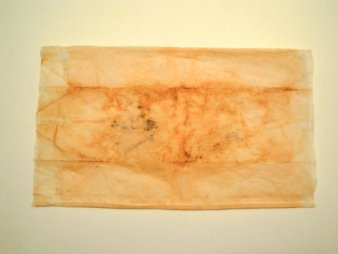
The first teabag I tried was the unfolded sheet. I started by giving it a greenish background wash with gouache. The paint soaks right through this, making it difficult to build up layers. It makes sense for the teabag material to be porous, since the tea has to seep out. In art terms, however, this presents a bit of a challenge. I suppose I could have added gesso, or perhaps used acrylic paint, but it wasn't a real problem for the kind of painting I envisaged here.

Once I'd done the background, I let it dry, then painted on the elephant. The paint soaked right through on this as well, so I began using thicker paint and added quite a few layers. Thicker paint is harder to spread on this particular surface, so it's a bit of a trade-off. On the other hand, I liked the way some of the brown tea stains peeked through, and didn't worry too much about making it opaque.
These are such quick paintings that I didn't bother to photograph all the mini-stages in each. Truth be told, I got a little too engaged in the process to remember to go to my photography area.


I let this dry for a bit, then painted on the elephant. This time, I found that having tea inside the bag helps to keep the paint a little closer to the surface. There are still several layers in the background, but the painting on top needed only three or four.

For my final elephant, I used the round teabag, also keeping the tea inside. I began by applying a thick layer of purple, deep blue and dark red. It took about four layers to create a surface thick enough to keep the paint from soaking in. The paper on this type of teabag appeared more porous than the others to the eye, but it didn't seem to make any difference in terms of how much paint I needed to apply.
When this had dried, I painted on the elephant with about three or four layers of gouache, then added a delicate crown using dots of full-strength bottled gold acrylic paint. Because it was acrylic and full strength, it sat nicely on the surface.

I was surprised at how well these turned out. It's a sort of weird art form, but teabags actually make interesting canvases for miniature works of art. I preferred to work on the teabags that were still full, but I can see using the flattened version as a background if I wanted the look of stained parchment.
It only took me about two hours to produce all three of these, and it's something I'd definitely try again.

Elephant Lore of the Day
Elephants are frequent visitors to tea plantations, particularly as their own ranges become smaller and less contiguous. Such unsolicited visits are unwelcome, however—partly because of the plants that are trampled and destroyed, and partly because human-elephant conflict often results in death and injury, both to elephants and to humans.
The tactic used by most plantations these days involves trying to scare the elephants away by tossing firecrackers, shouting at them, and chasing them. This generally has mixed results, as shown in a video I posted on this blog a couple of months ago. Whether in the dark or in broad daylight, chasing elephants and using noise often terrifies the animals so much that they cluster together in a "last stand", often charging their persecutors.
 |
| A firecracker exploding near elephants on the Sholayar tea plantation, Valparai Plateau, Tamil Nadu, India. Source: http://www.hindu.com/2006/09/06/stories/2006090613510200.htm |
In some parts of India, people are trying a couple of interesting new ideas in order to limit deadly encounters between people and elephants. One of the most promising and important initiatives involves creating wildlife corridors across the tea plantations. Since most elephants aren't trying to destroy or eat crops so much as cross from one side to the other, corridors are seen as one of the best ways of mitigating human-elephant conflict.
Elephant corridors would involve more than allowing simple pathways through the plantations. Elephants need large quantities of water and reasonable forage along the way, if they are to be kept from straying onto the plantations. As a result, most wildlife specialists suggest that elephant corridors follow rivers. They also suggest that some corridors will need to be planted or replanted with appropriate crops such as eucalyptus, and that human habitations be moved away from the rivers.
Because unexpected encounters with humans are just as disturbing to elephants as unexpected encounters with elephants are to humans, some areas have also begun to set up Elephant Early Warning Systems. In a number of pilot projects, people use mobile phones to call in the location of elephants. This information is broadcast on local television stations in a "ticker-tape" format at the bottom of the screen. Knowing where the elephants are has proven a boon to people wary of happening upon an elephant on the way home from work. Early reports suggest that this is proving a fairly effective way of keeping elephants and people apart.
In another pilot project, plantations began using domesticated elephants to keep out wild elephants. The idea was that wild elephants wouldn't invade an area in which other elephants were already living. This initiative has had mixed results, especially when humans get into the act and try to help domesticated elephants chase away any wild interlopers. The chaos that results can often become extremely dangerous, as seen in the video below.
To
Support Elephant Welfare
Elephant
sanctuaries
(this Wikipedia list allows you to click through to information
on a number of
sanctuaries
around
the
world)


