Showing posts with label elephant deterrents. Show all posts

Wednesday, 8 August 2012

Elephant No. 311: Teabag Art


I'd never heard of this form of art before, and thought it was pretty strange until I looked at what people have done with the lowly teabag.

People seem to use the teabags in a number of ways. Some use the dried teabag, string and all—sometimes still full of tea—as a painting surface.


Teabag ornaments by Coco2005.
Gesso, paint and collage.
Source: http://www.flickr.com/photos/85087573@N00/6332361400/


Others take the dried teabag apart, empty it of tea, then paint, embroider or otherwise embellish the resulting tea-stained material.


Tea bag project by Original T-Bag Designs, South Africa.
Emptied, painted and arranged.
Source: http://cityroom.blogs.nytimes.com/2008/02/27/the-tea-bag-
basks-in-its-moment-to-simmer/


Some stitch multiple teabags together, layering them with other fabrics, or mounting them on board before adding additional decoration.


Teabag art by Beryl Taylor (detail).
Painted, embroidered, quilted with other fabrics.
Source: http://www.clothpaperscissors.com/blogs/
clothpaperscissorstoday/archive/2012/03/16/how-to-use-tea-
bags-in-fabric-art.aspx?a=cpe120713


Some use them to produce artist trading cards and books.


Art book by Australian artist Carmel, 2012.
Each page is made from an emptied, used teabag, painted and embellished.
Source: http://carmel-makemeapictureofthewind.blogspot.ca/2012/01/tea-for-one.html


And some produce large-scale assemblages with numerous teabags, relying in part on the different shades of the teabags to create visual interest.


Teabag collage by Armén Rotsch, ca. 2007.
Dried teabags, full and emptied, in natural colours.
Source: http://www.curbly.com/users/diy-maven/posts/9932-10-marvelous-examples-of-tea-bag-art


Well, who knew there were so many kinds of teabag art? I was just as surprised by the existence of teabag art as I was by tortilla art a few weeks back.

I decided to try a couple of things for today's elephant. I had two teabags with strings, and one round bag with no strings. I started by hanging them all up outside in the hot sun to dry.

When they were dry, I brought them inside. These were the three teabags I had to work with.


I decided to paint on one with the string intact and the tea still inside. I decided to give the round teabag a similar treatment. For the second teabag with a string, I decided to take it apart, empty out the tea, and use the resulting surface as a sort of paper.

To remove the tea from a "pocket" teabag, you simply remove the staple, unfold it, tip the tea out, then gently unfold the crease in the middle.


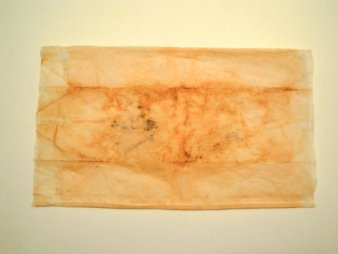


The first teabag I tried was the unfolded sheet. I started by giving it a greenish background wash with gouache. The paint soaks right through this, making it difficult to build up layers. It makes sense for the teabag material to be porous, since the tea has to seep out. In art terms, however, this presents a bit of a challenge. I suppose I could have added gesso, or perhaps used acrylic paint, but it wasn't a real problem for the kind of painting I envisaged here.


Once I'd done the background, I let it dry, then painted on the elephant. The paint soaked right through on this as well, so I began using thicker paint and added quite a few layers. Thicker paint is harder to spread on this particular surface, so it's a bit of a trade-off. On the other hand, I liked the way some of the brown tea stains peeked through, and didn't worry too much about making it opaque.

These are such quick paintings that I didn't bother to photograph all the mini-stages in each. Truth be told, I got a little too engaged in the process to remember to go to my photography area.


My next elephant was the other pocket teabag, with the string and tag still attached. Since I was planning to leave the tag on, I built up a background using the colours in the tag.


I let this dry for a bit, then painted on the elephant. This time, I found that having tea inside the bag helps to keep the paint a little closer to the surface. There are still several layers in the background, but the painting on top needed only three or four.


For my final elephant, I used the round teabag, also keeping the tea inside. I began by applying a thick layer of purple, deep blue and dark red. It took about four layers to create a surface thick enough to keep the paint from soaking in. The paper on this type of teabag appeared more porous than the others to the eye, but it didn't seem to make any difference in terms of how much paint I needed to apply.

When this had dried, I painted on the elephant with about three or four layers of gouache, then added a delicate crown using dots of full-strength bottled gold acrylic paint. Because it was acrylic and full strength, it sat nicely on the surface.


I was surprised at how well these turned out. It's a sort of weird art form, but teabags actually make interesting canvases for miniature works of art. I preferred to work on the teabags that were still full, but I can see using the flattened version as a background if I wanted the look of stained parchment.

It only took me about two hours to produce all three of these, and it's something I'd definitely try again.


Elephant Lore of the Day
Elephants are frequent visitors to tea plantations, particularly as their own ranges become smaller and less contiguous. Such unsolicited visits are unwelcome, however—partly because of the plants that are trampled and destroyed, and partly because human-elephant conflict often results in death and injury, both to elephants and to humans.

The tactic used by most plantations these days involves trying to scare the elephants away by tossing firecrackers, shouting at them, and chasing them. This generally has mixed results, as shown in a video I posted on this blog a couple of months ago. Whether in the dark or in broad daylight, chasing elephants and using noise often terrifies the animals so much that they cluster together in a "last stand", often charging their persecutors.


A firecracker exploding near elephants on the Sholayar tea plantation,
Valparai Plateau, Tamil Nadu, India.
Source: http://www.hindu.com/2006/09/06/stories/2006090613510200.htm

In some parts of India, people are trying a couple of interesting new ideas in order to limit deadly encounters between people and elephants. One of the most promising and important initiatives involves creating wildlife corridors across the tea plantations. Since most elephants aren't trying to destroy or eat crops so much as cross from one side to the other, corridors are seen as one of the best ways of mitigating human-elephant conflict.

Elephant corridors would involve more than allowing simple pathways through the plantations. Elephants need large quantities of water and reasonable forage along the way, if they are to be kept from straying onto the plantations. As a result, most wildlife specialists suggest that elephant corridors follow rivers. They also suggest that some corridors will need to be planted or replanted with appropriate crops such as eucalyptus, and that human habitations be moved away from the rivers.

Because unexpected encounters with humans are just as disturbing to elephants as unexpected encounters with elephants are to humans, some areas have also begun to set up Elephant Early Warning Systems. In a number of pilot projects, people use mobile phones to call in the location of elephants. This information is broadcast on local television stations in a "ticker-tape" format at the bottom of the screen. Knowing where the elephants are has proven a boon to people wary of happening upon an elephant on the way home from work. Early reports suggest that this is proving a fairly effective way of keeping elephants and people apart.

In another pilot project, plantations began using domesticated elephants to keep out wild elephants. The idea was that wild elephants wouldn't invade an area in which other elephants were already living. This initiative has had mixed results, especially when humans get into the act and try to help domesticated elephants chase away any wild interlopers. The chaos that results can often become extremely dangerous, as seen in the video below.


To Support Elephant Welfare
Elephant sanctuaries (this Wikipedia list allows you to click through to information
on a number of sanctuaries around the world)

Friday, 20 April 2012

Elephant No. 201: Sprinkled Salt Art


There are many types of salt art, but today I thought I'd try the kind that involves sprinkling plain white salt over a black surface.

Table salt—which is what I'll be using today—is a compound of sodium and chloride (NaCl). Although essential for animals and plants in small quantities, it can be harmful if too much is consumed. As I noted in a previous blog post, even elephants will die of salt poisoning if they are unable to find enough water to dilute the salt they consume.

Although salt is ubiquitous today in food, it was once a valuable substance, particularly as a preservative for meat. As far back as 6050 B.C., people of the Neolithic Precucuteni Culture in Romania were boiling the water from a salt spring to distill salt, and it has been suggested that the rapid growth of this society's population is directly related to the availability of this important mineral.

In China, salt was harvested from Xiechi Lake in Shanxi as early as 6000 B.C., and salt—along with salted birds and fish—was placed in Ancient Egyptian tombs beginning in the third millennium B.C. By 2800 B.C., the Egyptians were exporting salt fish to the Phoenicians in return for glass, cedar and Tyrian purple dye. The Phoenicians in turn traded Egyptian salt fish and salt from North Africa throughout the Mediterranean trade. The Phoenician city of Carthage was also famously (and perhaps erroneously) sowed with salt in ancient times. After rasing the city to the ground in 146 B.C., the Romans are said to have poured salt over the city to ensure that the land would remain unproductive for years to come.

Around 800 B.C., Celtic communities began mining salt, and by 400 B.C. they were trading salt and salted meat to Ancient Greece for luxuries such as wine. The word "salary", as many know, originates from the Latin word salarium, which referred to the money that Roman soldiers were given to buy salt. The word "salad" actually means "salted", and comes from the Ancient Roman practice of salting leafy greens.

Across the Sahara, the Tuareg have long maintained routes for salt caravans, and as late as 1960 these caravans were still transporting 15,000 tonnes of salt a year. Today, the trade involves roughly one-third that amount.  

Interestingly, some of the ancient salt-producing sites in Austria derive their names from the word salz, which means "salt". Salzburg, for example—which literally means "salt city"—lies on the River Salzach, which means "salt water".

The type of salt art that involves sprinkling salt over a surface—rather than gluing coloured salt or adding salt to wet paint—is similar in many ways to bonseki. Salt is sprinkled over a dark surface, then pushed into place with some kind of tool. To get different tonal variations, extra layers are built up until the desired density is achieved. For a video of artist Bashir Sultani creating this type of work, click here.

I can remember making salt art with paint when I was about eight years old, and I actually thought that salt art was primarily a children's activity. Clearly, I'm out of touch. Today, artists are creating astonishing works with simple table salt, from room-sized installations, to three-dimensional forms.


Japanese artist Yamamoto Motoi creating
Forest of Beyond
, 2012.
Each tendril is a poured line of salt.
Source: http://laughingsquid.com/astonishing-salt-art-
installations-by-yamamoto-motoi/


For today's elephant, I used a sheet of plain black bristol board, and basic table salt in a small shaker that I probably bought for cinnamon or something. This particular shaker has largish holes, but it didn't really matter in the end. 


I had no clue what I was doing, so I more or less followed the basic method used by Bashir Sultani in one of his videos. The tool he uses seems to be a folded piece of paper—which makes sense to me as a way of pushing salt around—so I did that, too. These are honestly all the tools you need.


I started by sprinkling a fine dusting of salt where I thought the elephant's head might go. I didn't have any preconceived design in mind, so I was mostly waiting to see what occurred to me as I worked. 


I pushed this first bit of salt around rather tentatively, not doing much more than creating a thin outline for the top of the elephant's head. I quickly discovered that the best part of the paper to use for this is a thin, unfolded edge. An unfolded edge is slightly sharper, allowing the salt to be manipulated in a fairly precise way.


Guessing that it might be very difficult to remove excess salt, I continued to apply it somewhat delicately. I sprinkled a light dusting in strategic areas to form a trunk and the beginnings of an ear, then added a bit more over the lower ear and bottom of the jawline to provide some dimension.


You can form very fine lines by gently pushing the salt into place with the edge of the paper. You can also remove salt to make lines and open spaces by shoving the sand aside. I found that a sort of wiggling motion worked best to remove salt, as just pushing it forwards will simply deposit it where you may not want it.

I began forming a body next, although I only wanted to put in part of the elephant's back and a bit of its chest.


After this, I just kept working various parts of the drawing, sprinkling salt over areas that I wanted to build up, and pushing things around. At one point, my piece of paper actually wore out, becoming too floppy to use, so I guess you'd need at least two of these high-tech tools.


To finish up, I added a spray of water—or dust, if you prefer—from the elephant's trunk, since salt seemed the perfect medium for this particular effect.


This was surprisingly easy, and only took me about 20 minutes from beginning to end. I recommend the Bashir Sultani video link above to give you a better idea of how to make this kind of salt art, but you're really only limited by your imagination. Obviously it helps if you know how to draw, but an abstract using this technique would be interesting as well.

I'm quite happy with the final result, and wish I could keep it. In fact, from now on, I may never look at salt the same way.


Elephant Lore of the Day
Since today's blog post is about salt, I thought I'd write about elephants and pepper. With the growing incidence of human-elephant conflict, many people are working on solutions which will protect human lives, while also not harming elephants. Electric fencing, although relatively common in some areas, is beyond the reach of most farmers—and can also be ineffective once elephants have learned how to drop logs on top of it.

Other solutions include strings of bells to at least warn people that elephants are in the vicinity, patrols, ditches and berms, water and even firebreaks. One of the most novel new ideas, however, involves chili peppers.

Researchers in Zimbabwe's Zambezi Valley have developed a number of low-tech pepper-based deterrents that could be used by small farms. Because capsaicin—the active ingredient in chili peppers—is an irritant to elephants, researchers have found that chili peppers not only keep elephants away from crops, but also prevent them from seeing farm raids as a good idea.


Aerial view of crop-raiding elephants heading for a farm, Kenya.
Source: http://www.ruffordsmallgrants.org/rsg/projects/lucy_king

  
Farmers are being taught to use the peppers in a number of ways. They plant bands of chilies as a buffer zone between their more valuable crops and elephant habitats. They erect string fences with bells, and coat the string with chili-infused grease. And they burn chili briquettes around their fields. 

The reasoning goes that, by gaining some sense of control in the short term, farmers will be less antagonistic towards elephants—and less likely to shoot, poison or otherwise harm them. For more on the Elephant Pepper Trust initiative, click here.

  
Felix looks over his ruined fields after a herd of elephants has been through, Kenya.
Source: http://www.ruffordsmallgrants.org/rsg/projects/lucy_king