Showing posts with label picasso. Show all posts

Wednesday, 20 June 2012

Elephant No. 262: Cubism


I have to admit that I've never really understood how Cubism works, nor how to create a Cubist drawing or painting. I know what Cubist works look like, but I've never gotten how they were produced. This meant that today's elephant could be interesting—or just plain weird.

Cubism developed sometime between 1907 and 1911 as an avant-garde art movement. Pioneered by Pablo Picasso and Georges Braque, Cubism not only changed the visual arts, but also influenced architecture, music, and even literature. The word itself is often said to derive from comments by artist Henri Matisse, referring to the "cubes" of colour he saw in a 1908 painting by Braque. Art critics, however, were already using the word "cube" in 1900 to describe similar work. However it originated, by 1911, "Cubism" was an established artistic movement.


La Femme en pleurs ("The Weeping Woman"), 1937
Pablo Picasso (1881–1973)
Collection of the Tate Britain, London, England
Source: http://www.tate.org.uk/art/artworks/picasso-weeping-woman-t05010


The chunky depiction of three-dimensional forms by French artist Paul Cézanne is thought to have had a major influence on the development of Cubism. Cézanne was the first major artist to deconstruct objects into planes and geometric shapes such as cubes, spheres, cylinders, and cones—something that was revolutionary at the time.

Cubism took Cézanne's concept one step further. In Cubism, objects are broken down into various sections—as seen from different vantage points—then reassembled in an abstract fashion. In this way, the artist is thought to be representing the totality of the subject matter.


Maison et arbres  ("House and Trees"), 1890–1894
Paul Cézanne (1839–1906)
Collection of the Barnes Foundation, Merion, Pennsylvania, U.S.A.
Source: http://www.ibiblio.org/wm/paint/auth/cezanne/land/


The first organized group exhibition of Cubist art was held in Paris in 1911, featuring artists such as Fernand Léger, Henri Le Fauconnier and Robert Delaunay—although oddly, no works by either Picasso or Braque. In addition to Picasso and Braque, important early Cubist painters included Juan Gris, Fernand Léger and Marcel Duchamp. Sculptors such as Ossip Zadkhine and Jacques Lipchitz followed soon afterwards.


Nu descendant un escalier n° 2, 1912
Marcel Duchamp (1887–1968)
Collection of the Philadelphia Museum of Art, U.S.A.
Source: http://en.wikipedia.org/wiki/File:Duchamp
_-_Nude_Descending_a_Staircase.jpg


Cubist architecture was a natural progression in many ways. Just as Cubist artists break down three-dimensional objects into a series of planes and geometric shapes, architects works with planes and shapes to create three-dimensional structures. Cubist architects, such as Le Corbusier (Charles-Édouard Jeanneret), Peter Behrens and Walter Gropius focused on deconstructing and reconstituting three-dimensional forms, using pared-down geometric shapes. Elements were overlapped, wedged into one another and made transparent, all while maintaining spatial relationships and structural integrity.


Palace of Assembly, Chandigarh, India.
Le Corbusier (1887–1965)
Source: http://en.wikipedia.org/wiki/File:Palace_of_Assembly_Chandigarh_2006.jpg


Cubist music follows similar principles: structural elements of conventional music are broken apart then reassembled into a new form. A frequently cited example of Cubist music is Igor Stravinsky's Piano-Rag-Music for solo piano. Written around 1919, when Stravinsky lived in France, the piece includes harmonies and rhythms from Russian music and American ragtime.

In literature, Gertrude Stein created Cubist works by repeating phrases to build paragraphs, or even full chapters. Poets such as Guillaume Apollinaire and Jean Cocteau also used Cubism in their poetry, which would laterinfluence Dada and Surrealist writings. The 1917 poem Thirteen Ways of Looking at a Blackbird by Wallace Stevens is considered a good example of Cubism's multiple perspectives in poetic form.

Today, Cubism continues to influence the work of contemporary artists. In addition to Cubist paintings, sculptures, writing and music, mixed-media work in a Cubist style has grown considerably in popularity in recent years. Interestingly, Cubist "drawings" and "paintings" are now produced as often by computer as they are by hand.

Although my brain was slightly reluctant to engage with Cubism, the more I read, the more straightforward the concept appeared. This didn't mean I would find it easy to translate into a work of art, but at least I understood the concept.

From a few websites describing "how to make Cubist art", here is my distilled cheat sheet:

1. Forget about making something realistic. Forget, too, about classical ideals of beauty and proportion.

2. Try to see things in segments. Instead of seeing a three-dimensional object against a background, see the individual planes and shapes that make up the object and/or its background. Consider imagining what you can't see as well, even if it's on the other side of the object. For example, Cubist art often features noses and eyes seen as if straight on, despite the fact that a face may be in profile. The idea is to see the individual parts as your brain might focus on them, rather than the whole that your brain stitches together.

3. Consider your subject in terms of simple geometric shapes. Use squares, triangles, cones, ovals, and of course cubes.

4. When you assemble your image, don't worry too much about how things fit together. It's a bit like an eccentric collage—or flattened roadkill.

5. Use hues within the same colour family and tonal range. Cubists often used browns, greys, and blues. Shading is often done within the shapes to give each its own texture and modelling.

6. Outline your shapes with lines of various weight.

Although the concept almost sounds simple—break the object into shapes, stick them together any old which way, add shading—I had a feeling that this was going to be one of those things that's so simple it's a nightmare. Still, I felt more like drawing and/or painting than building or glueing anything, so this seemed like a good alternative.

I decided to use watercolour pencils today, because I didn't really feel like dragging out a bunch of paints, but I also wanted to be able to get a painterly effect if I felt like it. The beauty of watercolour pencils for me is always that you can turn them into paint if you want.

I thought it would be best to work from a photograph to keep myself from going completely bonkers trying to deconstruct and reconstruct something imaginary. I suppose it would have been possible, but my brain is tired these days, so I just didn't want to. I chose the photograph below, because it seemed to have lots of interesting angles, and would force me to imagine the opposite side.


African elephant.
Source: http://www.xmwallpapers.com/wallpaper/animals/misc/wallpaper_
animals_misc_elephant-002.htm


I started by staring at the photograph, trying to figure out what I was doing. I decided to simply begin by drawing shapes that I could see in the planes of the elephant. This mostly meant triangles.


So far, it wasn't as painful as I had expected, so I kept drawing angular shapes until I'd finished the elephant. I ended up with something that looked like an animation wire form.


I had originally thought I would leave the background blank, but I'd seen a few Cubist works with intersecting curves lines, and liked the effect. So I swooped green lines across the background.


When I liked the general outlines of everything, I coloured it all in with Derwent Inktense watercolour pencils, using two shades of purple, and two shades of green. I modulated the saturation of the colours within each shape, to give it some visual interest.


Once I'd coloured in everything with the pencils, I got some water and a paintbrush, turning the watercolour pencil into paint.

This took me most of the afternoon, but that was primarily because I took so long to colour and paint everything. The drawing itself took me a little under an hour, and some of that was time spent staring and trying to figure out how to draw a Cubist elephant.

Once I felt that I'd gotten the general idea, I didn't mind this at all. It doesn't have enough of the elephant's other angles to be good Cubism; then again, Cubism Lite may be as good as it gets for me. And, although this wasn't my favourite drawing exercise, I can still see trying it again sometime.


Elephant Lore of the Day
Sometimes elephants really won't take no for an answer. In early 2012, an elephant was seen lurking under a coconut tree in a family's garden in Sri Lanka. Having experienced previous elephant raids on their home, the men of the family jumped up, got their flashlights and ran outside to chase the elephant away.

The elephant moved off the property and seemed to be heading back into the bush, when it turned around and charged the men. The men had just managed to flee back inside the house, when the elephant rammed the wall of the home. The wall exploded in a volley of bricks and cement, injuring one of the men.


Wall destroyed by elephant, Sri Lanka, February 2012.
Photo: SLWCS
Source: http://slwcsupdates.blogspot.ca/2012/03/fence-jumping-and-house-breaking.html


Once the wall was broken, the elephant calmly stuck its head inside. While the family scrambled to get out of the room, the elephant reached down with its trunk, picked up a bag of rice and sauntered off. By the time the village had mobilized to chase the elephant away, it was already long gone.


Hole through which the elephant reached to snag a bag of rice.
Photo: SLWCS
Source: http://slwcsupdates.blogspot.ca/2012/03/fence-jumping-and-house-breaking.html


This was not the first time an elephant had attacked the house. Only two nights before, an elephant—according to the family, perhaps the same one—had destroyed the wall on the exact opposite side of the house, also making off with a bag of rice.


Lurking elephant, Sri Lanka.
Source: http://www.earthphotos.com/Countries/Sri-Lanka/
4264903_57dLwW/250043922_Skp8j#!i=250043922&k=Skp8j


To Support Elephant Welfare
Elephant sanctuaries (this Wikipedia list allows you to click through to information
on a number of sanctuaries around the world)
Wildlife Trust of India

Wednesday, 28 December 2011

Elephant No. 87: Torn Paper Collage


For today's elephant, I thought I'd try something from a long-ago art class. I dimly remember that we were told to reproduce a masterpiece with bits of torn construction paper, but I don't remember why. It may have had something to do with learning to see tones and shades.

I chose something from Gauguin's Tahitian period, although I no longer recall which painting it was. I probably thought something with bright colours would make the exercise easier. I don't think it did, however, because I distinctly remember not finishing the thing. To keep me at it today, I'll make sure to create something small.

The word "collage" comes from the French coller, "to glue", and was coined by Pablo Picasso and Georges Braque at the beginning of the twentieth century. The term is taken to describe any work of art that involves the gluing of paper and other materials on top of one another to create an image, whether abstract or representational.

Historically, collage was first used around 200 B.C., coinciding with the invention of paper in China. The use of the technique remained quite limited, however, until tenth-century Japan, when calligraphers glued paper to their work. In Europe, collage appeared in the thirteenth century, with the gluing of gold leaf and gemstones to religious icons, coats of arms and similar pieces. By the nineteenth century, collage was used by many ordinary people for scrapbooks, albums and other forms of memorabilia, as well as small decorative items such as firescreens, fans and boxes.

Collage as an artistic medium originates with Cubist painter Georges Braque, who took a roll of oak-textured paper and cut it into pieces, which he then arranged on canvas. Pablo Picasso picked up the technique soon after, and collage has been recognized as an art form ever since. 

I couldn't find anything on the origins of torn-paper collage, although it seems to have found its earliest artistic expression in the works of Dada artist Jean Arp, continued through to the present day in the works of well-known modern artists such as Damien Hirst. I love pieces like the one below, but doubt very much that I'll be making anything this elaborate today. Or ever.


Detail from Tina's Toad "Quispehuaman"by artist Terri Welch.
Source: http://tornpaperart.blogspot.com/


For today's elephant, I decided to use a pad of inexpensive construction paper that I picked up a few years back to use for tags or something. I thought about using my stack of much-loathed origami paper (I loathe the activity, not the paper); however, although origami paper is nice and bright, when you rip it you get white edges, which wasn't really what I wanted.


For glue, I thought about using a glue stick, then decided that white glue would be better.


For this technique, I figured it would be a good idea to work from a photograph; otherwise, I'd be a bit lost with all the tones and highlights. I chose this profile photo, which in retrospect wasn't the best choice, since it's way too finely detailed for torn paper.


Iringa the elephant, at the Toronto Zoo.
Photo: Sandy Nicholson
Source: http://www.torontolife.com/daily/informer/from-print-
edition-informer/2010/06/29/what-the-elephants-know/


I had decided that I was only going to use the colours in the pad of construction paper. This presented problems right away, since there was no white, no grey and no black. Instead I chose a pale beige for the white, dark eggplant-brown for the darkest areas, and a pale blue and a canary yellow for mid-tones. Not ideal, but I wasn't going for high art here, anyway.

Using a small piece of canvas board measuring 15 x 23 cm (6 x 9 inches), I started by putting in the brightest highlights with beige paper.


Next, I put in some of the darkest shadows with the eggplant-brown.


I had by now resigned myself to this looking nothing like the original photograph, and nothing like my original vision. Instead, it became an exercise in seeing tones of colour, without any regard for the actual colours of the photograph.

Another thing I had forgotten was that paper has a distinct grain. This means that, while it is easy to tear a straight line if you go with the grain, it's virtually impossible to tear sensibly across the grain. That's why many of the edges look as though they've been nibbled by mice.


When I was as done as I was going to be with this, I added some brighter colours for grass and a sun. It's not completely horrible, but it would have been better if I'd had a bunch of shades of grey. Just for fun, I changed the image to greyscale to see what it looked like in terms of its tonal values.


This wasn't a technique I loved, since it's a bit tedious and fiddly, but I did like the challenge of picking out the highlights and lowlights, and trying to tear bits of paper to fit. It did take me nearly three hours, however, so it's not high on my list of things to try again.


Elephant Lore of the Day
The Year of the Elephant (ˤĀmu l-Fīl in Arabic) is the name given in the Islamic calendar to the year 570 A.D.: the year that Muhammad was born.

According to Islamic tradition, this is the year in which a notable event occurred at Mecca, in modern-day Saudi Arabia. Abraha, the Ethiopian governor of Sheba in Yemen—also on the Arabian peninsula—had ordered people to worship at a Christian cathedral he had built at Sana'a. The people refused, preferring to revere the Kaaba in Mecca instead. Incensed, Abraha marched on Mecca and the Kaaba with an army numbering some 40,000 men. A white elephant called Mahmud led the way, along with as many as seven other elephants. Abraha's intention was to raze the Kaaba and, although several Arab tribes fought him along the way, Abraha defeated them all.

Reaching the outskirts of Mecca, Mahmud the elephant suddenly stopped and refused to enter. He could neither be beaten nor cajoled into moving forward. If he was turned away from Mecca, he was happy to move, but if turned towards Mecca, he is said to have fallen to his knees as though in reverence.

Abraha sent an envoy into Mecca to tell them that Abraha wished only to destroy the Kaaba, and that he would not harm the rest of the city unless its people resisted. Thinking he had made himself clear, Abraha planned to enter Mecca the next day. 

According to the Qur'an, a thick cloud of small birds appeared the following morning, just as Abraha and his army were preparing their assault. The birds carried small rocks in their beaks and pelted Abraha's forces, who fled. Abraha was also seriously wounded. He retreated towards Yemen, but died of his wounds on the way.

The year accordingly became known as the Year of the Elephant, and was used for reckoning dates throughout the Arabian Peninsula until it was replaced by the official Islamic calendar some twenty years later.


To Support Elephant Welfare
World Wildlife Fund  
World Society for the Protection of Animals
Elephant sanctuaries (this Wikipedia list allows you to click through to information on a number of sanctuaries around the world) 

Friday, 16 December 2011

Elephant No. 75: Oil Pastels

There are less than ten days until Christmas and things are starting to get hectic, so today I decided to do something that I thought would be simple: oil pastels.

Oil pastels were invented in Japan in the early twentieth century. Dissatisfied with the Japanese education system, which he felt concentrated too much on learning by rote, Kanae Yamamoto proposed a new learning concept that allowed for greater self-expression. In a book called The Theory of Self-Expression, Yamamoto described the Jiyu-ga method, or "learning without a teacher".

Taken with Yamamoto's ideas, teacher Rinzo Satake and his brother in law Shuku Sasaki decided to do something about the many hours Japanese children spent learning to draw Japanese characters with black ink. Instead, they implemented "free drawing" periods, using lots of colour. Feeling that the wax crayons available at the time weren't quite right for this process, the two men produced their own crayons in 1921, founding the Sakura Cray-Pas Company—named for the Japanese word for colour (sakura), and abbreviated forms of "crayon" and "pastel".

Their first efforts weren't entirely successful, as the crayons didn't have enough pigment and didn't allow for artistic effects such as blending and impasto. By 1924, they had developed a better crayon, using coconut oil, paraffin and stearic acid as a binder for the pigment. Thus was born the oil pastel. Until stabilizers were added in 1927, oil pastels came in two varieties: winter pastels with additional oil to keep them from hardening in cold temperatures; and summer pastels, which came with less oil to keep them from melting in warmer weather. Interestingly, Japan's state schools, leery of the concept of "self-expression"—and unable to afford oil pastels anyway—preferred coloured pencils, a less-expensive German invention that was mysteriously marketed in Europe as a means of instilling work discipline in young children.

Elsewhere, however, oil pastels were immediately successful. Manufacturers around the world began producing their own versions of the new medium. The quality of these early pastels was nothing like the oil pastels we have today, as they were intended simply as a teaching medium, and not for fine art. Despite this, some artists adopted oil pastels, including Pablo Picasso, who eventually convinced French manufacturer Henri Sennelier to bring out a high-quality oil pastel for artists.

Sennelier's version debuted in 1949. Intended specifically for professional artists, Sennelier's product was superior in every way to run-of-the-mill oil pastels. Other companies soon followed suit, and by the mid-1980s, the Japanese "Holbein" brand—named for a German artist—had appeared, with a range of 225 colours of professional-grade oil pastels.

Oil pastels vary highly in quality. The most inexpensive oil pastels are the kind we all used in public school, and are generally the hardest and least vibrant. The highest level is aimed at professional artists and can be quite expensive at five dollars or more per oil pastel, depending on pigment quality and colour.

For today's elephant, I decided to use whatever I had on hand. I hadn't looked at my oil pastels in years, but I suspected that they might be the most basic grade, as it's not a medium I ever loved all that much.

Yep, the most basic grade. I also discovered today that time hasn't softened my attitude towards oil pastels.


I made a perhaps misguided decision early on to use a small canvas board for this. I thought the texture of the board might make this a bit more interesting, but it didn't. Canvas wasn't the best way to go unless I was going to lay in quite a lot of colour, and today I wasn't really in the mood for lots of colour.

I also decided to use blending stumps and tourtillons—I know there's a difference between the two, but I'm not sure what it is. The main thing for me is that I can use them instead of my fingers to blend stuff.


I started with a very tentative line for the top of the elephant's head, then blended it.


I added a few more lines, blended those, then a few more. So far, I wasn't much in love with this process—nor today's drawing skills, for that matter.


After adding some more colours, I started to like it a little better.


After I'd finished all the colour work I was going to do, I added a bit of black to make the elephant pop a bit more, and to differentiate it from the background I had foolishly added.


I really didn't like it when I was finished, but it's starting to grow on me—a little. I think I would have had to spend a lot more time on it, putting in lots of colour and blending the heck out of it to make it something I'd be happy with. Maybe I'll try it again when I have more time to play with the technique.


 Elephant Lore of the Day
A few weeks ago, Ian reminded me of a stunning show that toured Europe and South America from 2005 to 2007: The Sultan's Elephant. Created by the Royal de Luxe theatre company of Nantes, France, the show involved a huge mechanical elephant and a giant girl marionette.

The show was commissioned by the cities of Nantes and Amiens to commemorate the centenary of the death of author Jules Verne, and was originally called La visite du sultan des Indes sur son éléphant à voyager dans le temps ("A Visit from the Sultan of the Indies on His Time-Travelling Elephant").

Designed by François Delarozière, artistic director of the French company La Machine, the elephant was made primarily of wood, and weighed 50 tonnes—or the weight of seven African elephants. It required twenty-two people to manipulate it, and had hundreds of moving parts and scores of pistons, including twenty-two for the trunk alone. The elephant's skeleton featured steel ribs, and more than 56 square metres (602 square feet) of reclaimed poplar. The flapping ears were made of leather.

The show was first performed in Nantes in May 2005, followed by a performance in Amiens the following month. For its London appearance in May 2006, the show was renamed The Sultan's Elephant. The show began on a Thursday, with a rocket "crashing" into Waterloo Place. The elephant and sultan arrived the following day, and an oversized girl marionette emerged from the rocket capsule. The elephant and girl met up and, on Friday evening, the elephant wandered around St. James's Park, while the girl went on a tour of London atop an open double-decker bus.

On Saturday, the elephant walked to Trafalgar Square. The girl was lifted onto the elephant's trunk by crane, and was carried back to Horseguards Parade. The show finished on Sunday when the girl climbed back into the rocket and "took off". Although the rocket didn't actually go anywhere, when the top was removed from the rocket by crane, the girl had disappeared, ostensibly travelling in time.

In London, the elephant and girl were stored at the disused Battersea Power Station, and were taken under police escort to various city locations in the wee hours of the morning. Lamposts and traffic lights had to be removed to allow the elephant through.

Following its London appearance, the show appeared in Antwerp, Belgium; Calais and Le Havre in France; Santiago, Chile; and Reykjavík, Iceland.

Sadly, the elephant no longer exists. According to the London producers of the show, the company got so fed up with being invited all over the world to perform The Sultan's Elephant, that they destroyed it. A 20-foot replica was, however, built in Nantes in 2007 as part of the Machines of the Isle of Nantes exhibition.
The Sultan's elephant walking across a bridge in Nantes.
Photo: Prochasson
Source: http://en.wikipedia.org/wiki/File:Royal-de-luxe-
%C3%89lephant-mai-2005-1.jpg
To Support Elephant Welfare 

World Society for the Protection of Animals
Elephant sanctuaries (this Wikipedia list allows you to click through to information on a number of sanctuaries around the world)
Performing Animal Welfare Society
Zoocheck
Bring the Elephant Home
African Wildlife Foundation

Thursday, 15 December 2011

Elephant No. 74: Linocut


I've been thinking about doing a linocut elephant for a couple of weeks, but I've been avoiding it. My last—and only—experience with linocut many years ago made me pretty sure I'd never want to do it again.

Linocut involves, as the name suggests, carving into a piece of linoleum. Based on the woodcutting technique that preceded it historically, linocut involves incising a design with a V-shaped gouge. The raised area obviously becomes the printing surface. Once the design is ready, ink is rolled onto the linoleum, then pressed onto a piece of paper or fabric. The imprint can either be made by hand, or with a press.


Linoleum as a floor material dates back to the 1860s, although it wasn't used as a printing medium until sometime between 1905 and 1913, when the Die Brücke company in Germany produced linocut wallpaper. To make the production method sound more respectable, they labelled their wallpaper "woodcut", rather than "linocut".

Linoleum is obviously much easier to carve than wood, and has no grain to deal with. It can also be used to print multiple colours. One way of doing this is to produce separate plates that will be printed in succession. The other way is something called the "reductive" method, used by Pablo Picasso and others. This method involves printing one colour with the plate, removing it, cleaning it, then carving away everything that you don't want printed for the next colour.


Picador et Torero, 1959
Pablo Picasso (1881–1973)
Source: http://en.amorosart.com/artwork-picasso-
picador_et_torero-6327-en.html


The only time I tried linocut was in high school art class, with an actual piece of brown linoleum. The teacher was very enthusiastic, but I hated the process. Carving into linoleum, no matter how sharp the tool, is actually quite difficult. Curved lines are hard to achieve, and the tool can slip, gouging the linoleum where you don't want it gouged, and often gouging your hand as well.

Luckily, we now have soft rubber "lino" plates to use. Although these aren't cheap, they're so much easier to carve. I actually enjoyed carving this stuff, and I usually don't enjoy carving anything—not even roast beast.


The first thing I did was sketch something onto the rubber plate. For me it would be the height of stupidity to try carving something on the fly. There are two things to remember at this stage. The first is that your design will be the mirror of what you draw. I can't believe I forgot this again. The second is that you need to think about what areas you want to print, and what areas you don't, and plan accordingly while drawing. There would be nothing worse than carving away an area, then realizing you'd meant that part to print.


As some of you may have guessed by now, I don't like instructions unless I'm utterly clueless about a process. Not knowing how this is supposed to be done, I decided I would carve the fine lines first, in a sort of outline. I don't know if that's the right way to go about it or not, but it seemed to work well enough for me.


Once I had some lines incised around the edges of everything, I started carving away the background. The main thing to remember here is that, if you want some of the carving lines to show in the background, pay attention to how you're carving them—for example, carve them into patterns or all in the same direction, or whatever. And if you don't want the lines to show, carve deeply enough that they won't remain near the surface.


When I'd carved away the bulk of the background, I went back in to clean up the edges. I also tried to ensure that the areas I didn't want to print were deep enough to keep from picking up the ink.


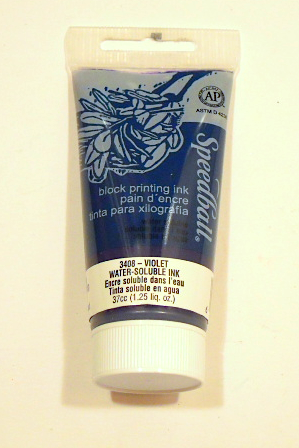
The next stage is to ink the plate. You do this simply by squirting some block printing ink onto a pie plate or something, rolling over it with a brayer, then rolling it onto the printing plate. It's important to make sure that the ink goes on fairly uniformly, that it's not glopped on anywhere, and that it covers the entire design.


The first time I printed, I put the plate onto the paper. It slid around a bit, which annoyed me.


The next time, I put the paper on top of the plate and gently smoothed it down. This made a nice crisp print, but I couldn't see what I was doing. Luckily, the paper was big enough that it didn't really matter; I can trim it later. If you try this, just experiment to see what works best for you.

With this second print, some of the background carving lines were still too close to the surface, so they printed. If I had more of them, I might have kept them, but I didn't like the way this looked, so I carved them away. Obviously, when there's ink on them, it's easy to see where they are.


I cleaned the plate, inked it again and made a final print, again by laying the paper on top of the plate. This one worked perfectly. My only disappointment was that, when I cleaned the plate, it split down the middle, so I'm not sure it can be used again.

I liked this process a lot. It was easy, didn't take long, and I'm very happy with the result. Even better, no linoleum was involved in this particular linocut.


Elephant Lore of the Day
One of the most traditional and widely used design motifs in Turkmen carpets is the "elephant foot". Octagonal in shape, the elephant foot is usually knotted against a red background. 

The elephant foot pattern is common to carpets produced in Turkmenistan, and in Afghanistan by Turkmen weavers—particularly those produced by the Ersari people. No one is quite sure how the elephant foot design evolved, given that elephants are very thin on the ground in a northern country such as Turkmenistan. It is believed that the pattern may have been adapted from motifs that originated in India, coming to Turkmen artisans via long-ago trade along the Silk Road.


Ersari gulli-gol or "elephant foot" motif in a Turkmen carpet.
Source: http://www.tcoletribalrugs.com/article35Moshkova.html


To Support Elephant Welfare 

World Society for the Protection of Animals
Elephant sanctuaries (this Wikipedia list allows you to click through to information on a number of sanctuaries around the world)
Performing Animal Welfare Society
Zoocheck
Bring the Elephant Home
African Wildlife Foundation