Showing posts with label Max Ernst. Show all posts

Sunday, 5 February 2012

Elephant No. 126: Frottage


I have a fair amount of client work this afternoon, so I thought I'd try something that promised to be easy for today's elephant: frottage.

Frottage—from the French frotter ("to rub")—is a Surrealist technique developed by artist Max Ernst. Technically, frottage is very simple: the artist takes a soft lead pencil or other drawing medium and makes a rubbing over a textured surface. The resulting drawing can then be left as is, or used to inspire something further.


Forest and Sun, 1931
Max Ernst (1891–1976)
Frottage: graphite on paper
Collection of the Museum of Modern Art, New York—Gift of Helena Rubenstein
Source: http://www.moma.org/collection/browse_results.php?object_id=37053


Frottage is very similar to brass rubbing and other techniques used to reproduce an existing design—for example, motifs on headstones and church carvings—but is more random in nature. For his first frottage work in 1925, Max Ernst was inspired by a wooden floor with noticeable grain. Seeing strange patterns and images in the grain, he laid sheets of paper over the floor and rubbed them with a soft pencil. He would often use these initial patterns to create more detailed and colourful works.


Frottage II: Spider by David Copper.
Source: http://davidcopper.deviantart.com/art/
Frottage-II-Spider-192637774


Just about any textured surface can be used to create frottage, from coins to bricks. The main idea is to start without a clear idea of what the drawing will look like, using the textures to inspire form, shape and even subject matter.


Frottage Taken on the Floor of the Art Hospital, 2008
Source: http://plopart.blogspot.com/2009/04/frottage-rubbed-off-floor-of-art.html


For today's first elephant, I thought I'd try a preconceived concept: the story of six blind scholars and an elephant. Although I told the full story in a previous blog post, in a nutshell, it goes like this: six men touch different parts of the elephant—side, tusk, trunk, leg, ear and tail—to determine what it must look like. From this they extrapolate as follows: side=elephant looks like a wall; tusk=elephant looks like a spear; trunk=snake; leg=tree; ear=fan; tail=rope. I decided that I would try to find textures similar to these to draw each part of the elephant.

This was not a success by any stretch of the imagination. For the side and head of the elephant, I used a piece of wall that has just been roughly plastered. For the tusk, I used a bamboo skewer. For the trunk, I used a small plastic snake. For the leg, I used some rough floorboard. For the ear, I used the blades of a sandalwood fan. For the tail, I used a frayed bootlace. None of these textures showed up at all the way I expected, even though I tried various softnesses of pencil lead and different types of paper. But here it is, in the interests of full disclosure. I won't be offended if you laugh.


For the second elephant, I decided to stick to one texture. For a while, I've had my eye on the embossed wallpaper in our bathroom that bears some sort of junk Latin. The "e" has always struck me as something I'd like to use in an elephant, so here's that one. Somewhat more successful, but still not what I expected.


Finally, I decided to try some tiny tiles on our sadly retro kitchen floor. These, when taken on an angle, lent themselves quite nicely to the lines of a baby elephant head. Boring, I know, but it at least looked the way I expected it to. Perhaps because my expectations were low for such a uniform surface.


A few tips if you decide to try this:

1. Use a soft pencil, but not too soft. A 2B worked best for me: it's soft enough to pick up the texture, but not so soft that it mushes everything together. The 4B and 6B that I tried tended to smudge easily even while I was taking the rubbing, so the textures are a little less sharp. Parts of my first elephant were done with 4B and 6B.

2. The direction of the pencil is important. For best results, it's a good idea to use only one direction, so choose carefully. Depending on the direction of the pencil, it will either pick up the textures well, or virtually not at all. I discovered with wood grain, for example, that you get a better result if you use the pencil in the direction of the grain.

3. Getting the right pressure is a bit challenging, but important. Too firm and you'll obliterate most textures by creating a mass of dark pencil. Too light and you'll get mostly the texture of the paper.

4. Paper selection is also important. Tissue paper is a bit too light; sketchpad paper is okay, as is basic plain white bond paper. It's a good idea to use a paper without too much tooth or texture, as both will be evident in your final piece. Paper with too much tooth will also snag the graphite in your pencil, leading to a less crisp transfer.

I wasn't really enjoying this activity, as you can probably tell. Then I remembered that, as a child, I used to like making rubbings of coins. I dragged out a few coins from my collection, and decided to try making an elephant from those. My collection is pretty eccentric—it includes everything from ancient Middle Eastern and Indian coins to dairy and casino tokens—so I figured I'd probably be able to make a slightly more interesting elephant using some of these.


For this piece, I used white bond paper and a 4B pencil. The tiny circles that form the elephant's tail and tip of the trunk are made with a real coin—a widow's mite, if my information was correct—and the triangle that forms the elephant's ear is an old aluminum token from a local dairy.


I enjoyed making this elephant a little more, although I'm still not sure frottage is for me. The online world abounds in interesting frottage works, but if I were to use this technique again, I think it would be primarily as a background texture, or because I wanted to reproduce an interesting design without having to copy it.

That being said, it's certainly not a difficult or time-consuming activity, so it's definitely worth a try. And who knows where it might take you. Next time, it should perhaps take me outdoors.


Elephant Lore of the Day
When I was a child, I had a picture book called The Saggy Baggy Elephant by Kathryn and Byron Jackson. In that story, other animals mock a baby elephant for its floppy ears and wrinkly skin, and even offer to eat bits of him. The baby elephant finally comes across creatures as wrinkled as he—other elephants, of course—and they all dance together.


Cover of The Saggy Baggy Elephant by Kathryn and Byron Jackson.
Source: http://www.amazon.com/Saggy-Elephant-
Little-Golden-Storybook/dp/0307160289


Today it occurred to me, for the first time, to wonder why an elephant's skin is so wrinkled. Turns out that the wrinkles actually serve an important purpose. The skin's larger surface area helps regulate cooling, and the wrinkles trap moisture. 

The trapped moisture takes longer to evaporate, cooling the elephant even more. As a result, wrinkles keep an elephant 5–10 times cooler than if it had smooth skin. If a coating of mud is added on top and allowed to harden, the moisture is sealed in, further enhancing the cooling effect. This is why African elephants—which live in a hotter, drier climate—are usually more wrinkled than their Asian cousins, and also tend to be a lot muddier.


To Support Elephant Welfare
World Wildlife Fund
World Society for the Protection of Animals
Elephant sanctuaries (this Wikipedia list allows you to click through to information on a number of sanctuaries around the world)
Performing Animal Welfare Society
Zoocheck
Bring the Elephant Home
African Wildlife Foundation 
Elephants Without Borders
Save the Elephants

Sunday, 11 December 2011

Elephant No. 70: Drip Painting


Now that I've done spatter painting, eyedropper painting and bulletism, I decided that today might be a good time to try drip painting.

Drip painting, as the name implies, involves dripping or pouring paint onto a canvas. The first to experiment with this type of abstract art were artists such as Francis Picabia and Max Ernst, in the first half of the twentieth century. Ernst's famous Lissajous figures were created by the novel—and no doubt rather messy—means of swinging a punctured bucket of paint over a canvas lying flat. Tempting, but no.

The best-known proponent of drip painting, however, is Jackson Pollock. Using it to the exclusion of almost every other painting technique, Pollock employed sticks, hardened brushes, and turkey basters to create his large paintings. He generally used house paint for most of his works, because it was more liquid than oil paint.


Number 8 (detail), 1949
Jackson Pollock (1912–1956)
Collection of the Neuberger Museum, State University of New York
Source: http://www.ibiblio.org/wm/paint/auth/pollock/


Drip painting is said to have been inspired by techniques such as traditional Navajo sand painting, in which sand is trickled through the hand onto a surface lying flat on the ground. Navajo sand paintings are not created as works of art, however, but as part of elaborate healing rituals.


A Navajo sand painter at work.
Source: http://www.artsology.com/navajo_sand_painting.php


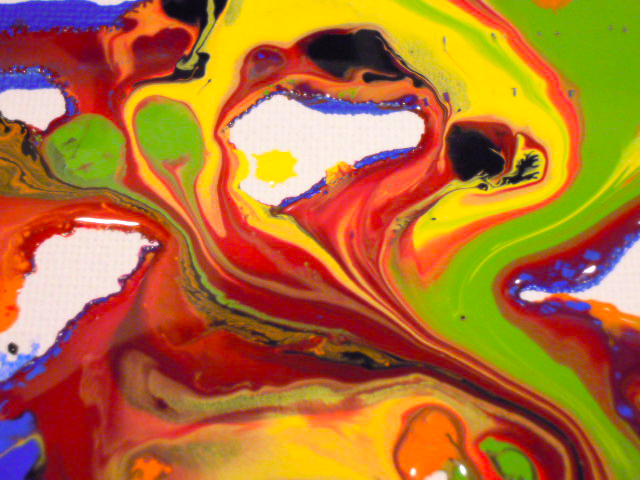
For today's elephant, I decided not to swing buckets of paint with holes in them, or pour house paint over a canvas pinned to the floor. Instead, I decided to simply to drip paint from bottles of acrylic paint onto a smallish canvas lying on top of a sheet of bristol board.

I was expecting the paint to be fairly hard to control, so I thought it might be handy to have some bamboo skewers around as well, just in case that might offer me a finer type of drip. If Jackson Pollock could use sticks, so could I. I had visions of this ending up looking like a really bad drawing by a deeply disturbed individual, but I figured that might be part of its charm. Or not.

I immediately discovered that the paint was too thick straight from the bottle, and that all I would get was a bunch of thick droplets if I used the paint at full strength. Instead, I found a small square plastic container that may once have held spaghetti sauce or something, and poured some paint into one corner, diluting it with a very small amount of water.

This made a paint that was too liquid, but short of pouring half the bottle of paint into a teaspoon of water, I decided to make the best of it.

As I suspected, this is very hard to control in any way. Although I carefully and slowly poured the paint from a fairly pointy corner of the plastic container, the streams of paint were wide, wiggly and quite wet.


After the first colour, I went away to work on some translations for about an hour, thinking this would give the paint time to dry. Not so much. Deciding that this activity would take all night if I waited to let the paint dry, I opted to just keep adding colours, letting them bleed into one another however they liked.


Allowing the colours to bleed made for some pretty and rather interesting effects, however.


I had originally thought I would only use six colours (the three primaries and three secondaries).


Then I decided that a touch of black would accent it a bit better, although I used it sparingly.

I really hated this painting when I started and briefly thought of doing something else instead, but I'm actually pretty happy with the final result. I have no idea how long it will take to dry—I don't think overnight is going to do it—but I liked it enough that I may try this again, perhaps using a bamboo skewer next time to manipulate the paint while it's still wet.


Elephant Lore of the Day
The vaguely psychedelic paint patterns in this elephant reminded me that there is an Elephant Trunk Nebula in Space.

The Elephant Trunk Nebula is located about 2,450 light years from Earth in the IC1396 emission nebula complex in the constellation Cepheus. This area of dust and hydrogen gas is a sort of "stellar nursery" for young stars, and the top region of the Elephant Trunk is actually being blown away by radiation emitted from newborn stars deep within the nebula itself. 


The Elephant Trunk Nebula (Van den Berg 142).
Photo: Steve Cannista, 2004
Source: http://www.starrywonders.com/elephanttrunk.html


To Support Elephant Welfare 
Elephant sanctuaries (this Wikipedia list allows you to click through to information on a number of sanctuaries around the world)
Performing Animal Welfare Society
Zoocheck
Bring the Elephant Home
African Wildlife Foundation

Thursday, 10 November 2011

Elephant No. 39: Soufflage


While researching painting techniques a few days ago, I stumbled across an entire list of Surrealist art practices. Some of them are truly bizarre; a few of them, however, can probably be adapted to an elephant of some sort.

For today's elephant, I chose the Surrealist technique called "soufflage"—otherwise known as "blowing paint around with a straw". The technique apparently originated with artist Jimmy Ernst, son of the well-known Surrealist painter, Max Ernst.

As a Surrealist concept, soufflage involves blowing liquid paint into abstract forms which are then used to either inspire a painting, or to reveal an image. When children blow paint around with a straw, it's mostly used to make pretty patterns. I vaguely remember doing this when I was a child, but I don't remember if I liked it or not.

The technique also lends itself well to forms such as trees, but I had a feeling that making an elephant might be a bit challenging. However, having flicked two hours worth of paint at a piece of paper to make a spatter-painted elephant a few days ago, I couldn't imagine that soufflage could be any more difficult.

If you're trying to make a recognizable image, this is actually a fairly challenging activity. The paint tends to have a mind of its own, particularly if you're blowing it across existing layers of paint, rather than across paper.

For paint, I used thinned-down acrylics, on a mid-range sheet of watercolour paper. For tools, I used regular-diameter plastic straws, and the kind of brown plastic stir-sticks that have tiny straw-like holes. I ditched the latter almost immediately. Although I thought they might allow me to be fairly precise, they didn't allow enough air to hit the paper, making them next to useless for soufflage.


I had originally sketched a faint elephant outline, figuring that I would get completely lost if I didn't have something to guide me. Unfortunately, the pencil line showed through my first bit of paint, so I erased everything.


The whole thing took me about two hours, and here are the main things I learned:

• Thick paint is very hard to blow around and tends to just sit there. Thin paint goes everywhere. Paint the consistency of evaporated milk (i.e., slightly thicker than regular milk) is about right.

• Thin, spiky lines are easier to achieve across unpainted paper. Paint is also easier to guide around curves and such on unpainted paper.

• New paint laid across existing paint will either flow right into existing paint channels and lines, or will spread out in pools. Both of these tendencies are surprisingly difficult to defeat.

• Blowing hard will not necessarily move the paint more than blowing relatively softly. Blowing softly will also give you more control—and may even help you keep from getting lightheaded.

• Make sure to allow areas to dry in between colours (unless you want them to blend). Using a hairdryer will not blow the paint around more.


This is a very easy technique to overwork, as you keep seeing areas you want to fix. Trying to fix soufflage is a relatively pointless activity, however, because it will generally create more things that need to be fixed. I probably should have stopped a bit sooner than I did, because this ended up briefly in incessant-and-stupid-reworking territory.


It was an interesting technique, and I like the final result. It was a more fussy activity than I thought it would be, however, so I don't think I'll be churning out a series of these anytime soon.


Elephant Lore of the Day
There is a great deal of evidence to suggest that elephants may be highly altruistic. Several accounts from around the world describe elephants displaying compassion not only for their own species, but also for other animals in distress, including humans.

In one such account, a rancher was knocked off his camel by a charging female elephant, breaking his leg in the fall. When a search party found him, they discovered that he had been dragged to a shaded area by another female elephant. Refusing to leave his side, she had protected him until help arrived, regularly touching him with her trunk to provide comfort and reassurance.

In another instance, a female elephant worked tirelessly to free a baby rhinocerous from the mud, despite being repeatedly attacked by the baby's mother. And in India, when a logging elephant refused to set down a log she was carrying, her handler discovered a dog sleeping in the hole where the log would have landed. Once the dog was moved, the elephant gently laid down the log.

And there there is the story of Tarra and her dog companion Bella at the Elephant Sanctuary in Hohenwald, Tennessee. Friends for years, Tarra maintained a vigil the whole time Bella was recovering from surgery, and rejoiced when Bella was better, touching the dog with her trunk and squeaking with delight.


Tarra and Bella at the Elephant Sanctuary in Tennessee.
Source: http://www.petstreet.co.uk/stories/?&_from=10

More poignantly, when Bella was recently killed by coyotes, Tarra appears to have carried Bella's body to a spot within sight of the main building of the Sanctuary. Tarra's handlers believe that she was trying to bring Bella home.

Rather sweetly, in response to Tarra's grief, her elephant companions began offering her portions of their own food, as well as comforting her with their trunks.


To Support Elephant Welfare
World Wildlife Fund
World Society for the Protection of Animals
Elephant sanctuaries (this Wikipedia list allows you to click through to information on a number of sanctuaries around the world)
Performing Animal Welfare Society
Zoocheck
Bring the Elephant Home
African Wildlife Foundation