I was never very good with building bricks like LEGO®, but I figured I should try as many things as possible for this blog, so today I decided to try a cheap set of plastic bricks.
Because my knock-off sets are clearly based on the popular LEGO® brand, I'll cover the history of LEGO, rather than the history of cheap Chinese knock-off building bricks.
The Lego Group, which produces LEGO bricks, originated in the workshop of Danish carpenter Ole Kirk Christiansen, who started making wooden toys in 1932. By 1934, his company was known as "LEGO", from the Danish phrase leg godt ("play well"). The company had started making plastic toys by 1947, and in 1949, the famous interlocking LEGO bricks debuted, billed as "Automatic Binding Bricks".
The first LEGO bricks were a modified version of Kiddicraft Self-Locking Bricks, introduced in England in 1947. Over the years, however, new types of plastic and stringent engineering standards where introduced, and in 1958, the current design of LEGO bricks had been patented. LEGO bricks are made to such fine tolerances that bricks from the very first year are still compatible with bricks produced today.
 | |
| LEGO art by Nathan Sawaya. Source: http://www.newlaunches.com/archives/mindblowing_lego_art.php |
Today, in addition to their iconic building bricks, the Lego Group produces sets with mini-figures, gears, motors, wheels and more. There are sets based on popular films, books and television series, and LEGO can be used to build everything from large vehicles and life-sized figures, to cityscapes and and robots. There are also LEGO-based movies, boardgames, clothes and videogames, as well as five LEGO theme parks. In 1998, LEGO bricks were inducted into the National Toy Hall of Fame in Rochester, New York.
As some of you have already surmised, I do not do well with engineering of any kind. I don't remember being terribly skilled with my brother's LEGO as a child, when I think the highlight of my LEGO career involved making a small house with a pitched roof.
For today's elephant, I bought two cheap sets of pseudo-LEGO. If I'd bought real LEGO, I don't think I could have parted with it. I'm pretty sure, however, that I won't mind parting with these.

The first thing I discovered is that, if you want your creation to stay together—in fact, if you want it fit together at all—buy actual LEGO. The cheap stuff is so eccentric that many of the pieces don't snap together securely, if at all. And many of those that do snap together also spring apart at the slightest provocation. The only plus is the entertainment value in handling plastic bricks that behave like Mexican jumping beans.

This was the stuff I was stuck with, however, so I made the best of it. I started by making something that might serve as the basis for a body and legs. I had also decided that, since the kits came with numerous wheels, I was going to make a Trojan elephant.

I discovered along the way that some parts might snap together okay, but if I tried to snap new parts on top of them, nothing fit together properly. There was a great deal of disassembling and reassembling involved in this. If I'd been using actual LEGO, I think I would have been done in about fifteen minutes, rather than over an hour.

I kept on building up the body in a more or less elephantine shape. Since elephants are fairly block-like, this is pretty easy. When I could see the body taking shape, I got bold and added a yellow trunk. It promptly fell off. Three times. I briefly considered glue, but that seemed like cheating.

I also added the beginning of white tusks, and stacked more onto the upper body.

After this, there was so much springing apart, disassembling and reassembling going on that I forgot to photograph the process. I was probably too busy having mini-tantrums. The rest involved adding some more to the tusks, some weird extensions for ears, and adding what I think are supposed to be wigs for the large roundish eyes. The final touches were a snaky sort of green tail, and the leg extensions with wheels.

I hated using these bricks, but I don't hate the final result. It's weird-looking, and it needs a tiny ramp on the front to keep it from falling on its face, but I think if I buy some real LEGO and remake it, I might actually like it.

Elephant Lore of the Day
If ever there were a building that looks like it was made of LEGO-style building bricks, it would have to be the Elephant Building—also known as the Chang Building—in Bangkok, Thailand. Located in the North Bangkok Business District, it is one of the most famous buildings in the city.
Completed in 1997, the building measures 102 metres (335 feet) in height and dominates the surrounding area. It has 32 floors, and includes two office towers, a residential tower, a shopping plaza, recreational areas, gardens, and a parking garage.
 | |
| The Elephant Building is an imposing feature of the Bangkok skyline. Photo: Jarcje Source: http://en.wikipedia.org/wiki/File:Elephant_tower.jpg |
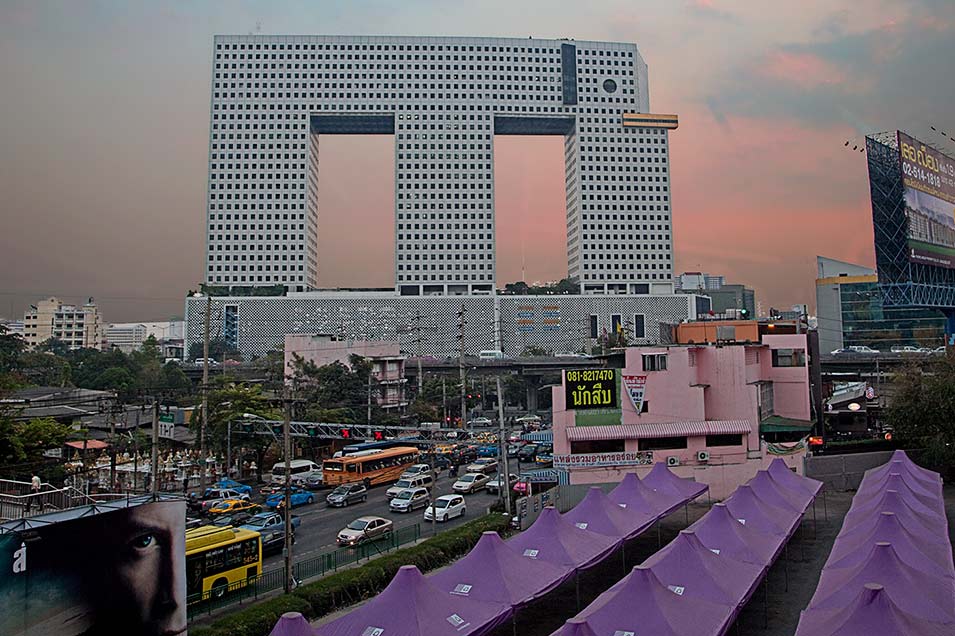 |
| Photo: Thomas Riddle Source: http://thomasriddle.net/high-on-chatuchak/pages/elephant.htm |
To Support Elephant Welfare
World Wildlife Fund
World Society for the Protection of Animals
Elephant sanctuaries (this Wikipedia list allows you to click through to information on a number of sanctuaries around the world)
Performing Animal Welfare Society
Zoocheck
Bring the Elephant Home
African Wildlife Foundation
World Wildlife Fund
World Society for the Protection of Animals
Elephant sanctuaries (this Wikipedia list allows you to click through to information on a number of sanctuaries around the world)
Performing Animal Welfare Society
Zoocheck
Bring the Elephant Home
African Wildlife Foundation