Showing posts with label elephants destroy village. Show all posts

Wednesday, 27 June 2012

Elephant No. 269: Verdaille


I came across this technique a few days ago, and thought it sounded interesting. I've heard of grisalle before, which involves painting solely in various greys; but painting in shades or tints of something other than grey was new to me.

Verdaille is a painting created entirely in green. Unlike other colourwork, in which a single hue is either tinted in lighter tones or shaded into darker tones, verdaille can involve many different hues.

Verdaille originates in the stained glass made for Cistercian monasteries in Europe. The use of colour was prohibited in Cistercian art in A.D. 1134, resulting in paintings that were painted entirely in grey. This style is still used in stained-glass windows in churches to this day. In addition to grisaille and verdaille, there are other forms such as brunaille (brown) and cirage (yellow).


A Chinoiserie Procession of Figures Riding on Elephants with Temples Beyond,
18th century.
Jean-Baptiste Pillement (1728–1808)
Collection of the Honolulu Museum of Art, Hawaii
Source: http://en.wikipedia.org/wiki/File:Jean-Baptiste_Pillement_-_A_chinoiserie_procession_of_figures_riding_on_elephants_with_temples,_
oil_on_canvas_.jpg


I decided to paint from a photograph today, and gave myself permission to use as many colours of green as I wanted. It was quite likely that I would stick fairly close to a single green with variations in tone, but it's nice to have options. This was the photograph I chose:


Elephant eating greenery, Addo Park, Eastern Cape Province, South Africa.
Photo: William Lorenz
Source: http://gallery.hd.org/_c/natural-science/_more2003/_more09/elephant-eating-
greenery-in-Addo-Park-Eastern-Cape-South-Africa-1-WL.jpg.html


Since I had planned to use watercolours, I started out with a very faint pencil sketch of the main outlines on a piece of mid-range watercolour paper. I then went over the most important lines with a sort of dark viridian green called "deep green" in my set of Grumbacher cake watercolours.


Although I'm not particularly confident with any kind of watercolour technique, this was relatively painless, so I added more.


It was sort of strange to use only one colour in various dilutions. It makes painting more like drawing, because you don't have to make decisions about colour. I had originally thought I would use several types of green blended with yellow or brown or even blue and purple, but once I saw how freeing it was to use a single colour, I decided not to blend any colours at all.


I found it easier to build up layers of light green rather than try to figure it out all at once, so I primarily jockeyed between full-strength paint and highly diluted colour, layering all over the place.

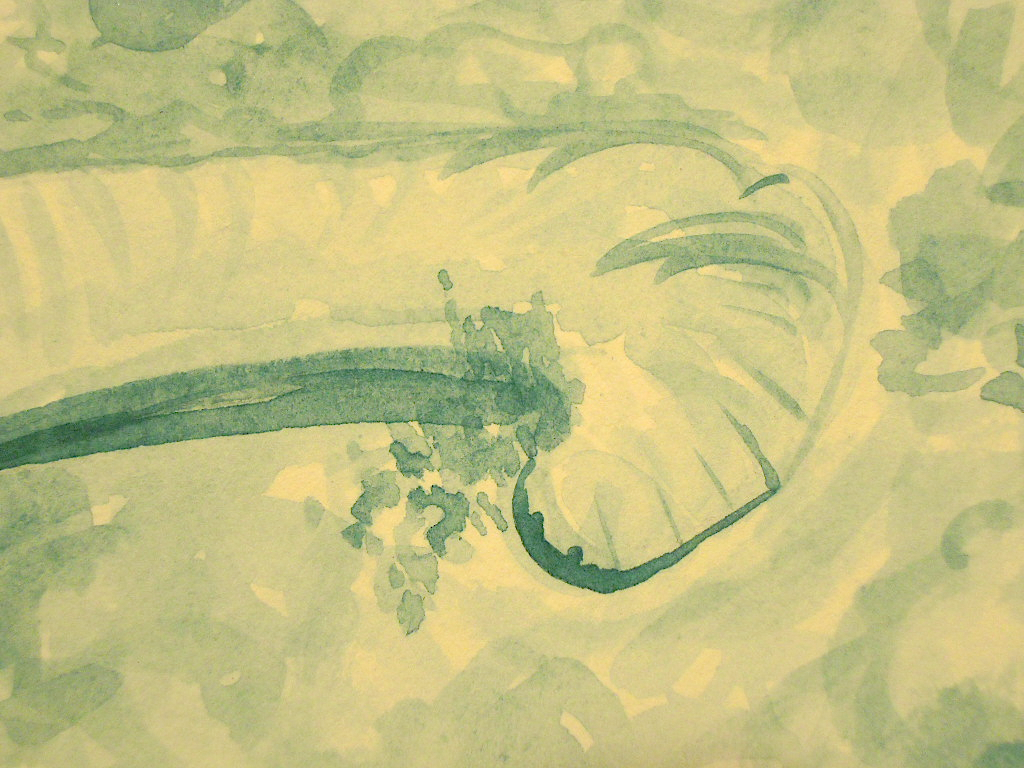


When I felt the elephant was more or less finished, I turned my attention to all the greenery in the background. This was surprisingly tricky to deal with. Unlike the elephant, which was fairly monochromatic in the photograph, the greenery was yellow, brown and green, as well as light and dark. It was also very dense in parts, and very loose in others. In the end, I opted for a mix of swirls in various shades from light to dark, as well as a few lines and dots.

I wasn't sure if I'd like this kind of painting when I started, because I'm usually drawn to lots of colour. I don't even really like green. But I actually enjoyed this exercise. It forces you to think in terms of tonal values, as well as how to translate various colours into green. And it makes life so much easier when all you have to do is dip your paint in a single colour and a bit of water, rather than fuss with how well colours mix, and whether that really is the precise colour you wanted.

This took me less than an hour from start to finish, which surprised me, as I thought it would take a couple of hours at least. I also like the final result very much, and can even see trying all the other variations on this technique—brunaille, grisaille, cirage, and whatever else I can make up—at some point in the future.


Elephant Lore of the Day
A couple of months ago, I wrote about a mother elephant who head-butted a train after it knocked down her baby. Although the news report didn't mention what happened to the baby, it did say that the mother elephant knocked the train out of commission for over five hours.

A similar incident in northeastern India in 1998 had much more serious consequences. Following the killing of a baby elephant by a train in the state of Assam, a herd of about 60 elephants ran amok in a nearby village.

The elephants appear to have bided their time for a few days before launching their attack. They also seem to have called in reinforcements, since the local herd numbered far fewer than 60. During their rampage, the elephants trampled five people to death, four of whom were children. They also destroyed dozens of houses.

Villagers claimed that the elephants were probably drunk on a locally brewed rice beer. Although forestry officials have expressed concern over the elephants' taste for beer, they also felt it highly unlikely that the elephants were on a drunken spree. Grief and revenge over the baby's death were far more probable.

The state of Assam has some 5,500 elephants, making it home to one of the largest elephant populations in India. An average 50 people are killed by elephants in Assam each year.


Herd of Asian elephants.
Source: http://www.conservenature.org/learn_about_wildlife/asian_
elephant/asian_elephant.htm


To Support Elephant Welfare
Elephant sanctuaries (this Wikipedia list allows you to click through to information
on a number of sanctuaries around the world)
Wildlife Trust of India
Answer to yesterday's word puzzle: ENDANGERED SPECIES

Tuesday, 15 May 2012

Elephant No. 226: Intaglio Ring


I picked up a ring at a discount store last week that looked like it might be perfect for carving a small intaglio. It says it's real stone and looks like some kind of agate, so hopefully it won't do evil things when I start drilling into it.

Intaglio, in jewellery terms, refers to a stone which has been engraved with an incised design. This is the opposite of a cameo, which involves a raised design, normally in a multi-layered stone such as sardonyx.

Most intaglios once functioned as seals, and were usually carved into rings or cylinders. These were then pressed into sealing wax to serve as signatures and trademarks. Early intaglios—which appear to have originated in the Indus Valley and the Near East—were cut using abrasive powders and simple hand-drills. Because drills did not really allow fine detail, many intaglios were also cut by hand.

Common designs in Antiquity included human, animal and divine figures, as well as scarabs, geometrical designs, portraits and lettering. The first intaglios were made in softer stones such as limestone, calcite and onyx. As technical know-how improved, harder gemstones were used, such as quartz, amethyst and garnet. As time went on, intaglio remained common for seals, although raised carving became more popular for jewellery. By the end of the second century A.D., the quality of intaglio began to decline. It would be centuries before the art of engraving gemstones was properly revived.


Intaglio portrait of the Roman Emperor Caracalla, ca. A.D. 212.
Photo: Marie-Lan Nguyen
Collection of the Sainte-Chapelle, Paris
Source: http://en.wikipedia.org/wiki/File:Intaglio_
Caracalla_Cdm_Paris_Chab2101.jpg


During the Middle Ages in Europe, antique intaglios were a prized possession, and were often inset by goldsmiths in crowns, book covers and crosses. In addition to the Classical subject matter of these earlier intaglios, new gems were engraved in Byzantium and Europe, usually featuring religious scenes.

By the late Middle Ages, production of intaglios was enjoying something of a revival, with rock crystal the most commonly used material. Because of the translucency of crystal, many of these intaglios were designed to be viewed from the non-engraved side as well. So valued were these pieces, that they were often prominently listed in wills and household inventories.

During this time, Italy became a major centre of intaglio production. Antique intaglios were recast in bronze, and numerous Classical intaglios were reproduced by artists of the time. In addition, nobles and royalty had their portraits created in intaglio gems, often borrowing poses from Antiquity.

By the sixteenth century, intaglios were being collected across Europe for cabinets of curiosities, and their production revived yet again. Sixteenth-century gem-cutters worked with the same types of stones as had been used in Classical times, and even used similar techniques and designs. Many of these were actually produced as forgeries of earlier pieces and, according to experts, it is virtually impossible today to know whether an intaglio is a first-century original, or fifteenth-century knock-off.

Collectors continued to drive up prices, and by 1750, only the wealthiest could afford major collections of intaglios and cameos. Other collectors made do with plaster casts of the originals, or even catalogues of some of the more famous collections.

The British were particularly fond of intaglios and cameos and, during the eighteenth century, routinely beat out even royal collectors on the Continent. Many of these large collections were later bought or bequeathed, often ending up in the collections of museums or wealthy nobles. Sadly, some of the collections were broken up at auction, and are now scattered throughout public and private collections around the world.

Although carved intaglio jewellery is still made today, much of what is sold as intaglio is actually pressed glass or moulded, reconstituted stone.

I actually took a stonecarving course a few years ago, but I can't say I was brilliant at it. While my classmates were carving little Classical statuettes and polar bears, I was making round holes in a small, square piece of green stone. I like to tell myself that I was making an abstract.

However, this does mean that I know a few of the basics. Chief among these is that it's best to cut stone with water in order to lubricate the drill bit and keep things cool. The only other thing I really remember is that it's best to go slow to keep the piece from shattering. Besides those two things, I'm not sure I have any idea what I'm doing.

This is the ring I bought:


I embedded the ring into a large piece of modelling clay so that it would stick to the bottom of my plastic water container, and so that it would stay in place.


To cut the design, I used a rotary tool and a thin diamond drill bit.


I started by working in the water, but I could see what I was doing. Not only did the tool make weird, vibrating patterns in the water, but I also hadn't drawn anything on the stone, which made water refraction an issue. So I took it out of the water. Turns out I didn't really need water for this particular piece.

I started by using the rotary tool to make a general outline. I thought this would incise the design fairly well right off the bat, but it didn't do much more than make a bunch of surface scratches. Still, it was a place to start.


After this, I just kept at it, holding the tool in place to make the lines deeper, or moving it around to clear a bit more of the stone away. I can't say I really had much technique, so there's not a lot I can offer in the way of helpful tips to offer. Mostly it's a matter of patience and a relatively steady hand. It also helps if you can adjust your design as you go, because the tool is likely to slip from time to time.

I tried a couple of other bits along the way, as well as a fine diamond file, but the original bit turned out to be the best tool for this particular elephant.


It took me about 2-1/2 hours to make this, and it's not as deep or as clean as I'd like, by any means. At some point, I will probably play with it a bit more, perhaps using a hand file and some kind of polishing compound, in addition to the rotary tool.


I don't really mind what it looks like, but in these photographs I've left it "dusty" so that the design is clear. If I were to wipe it, you'd have to look a bit more closely to see the elephant, because the edges aren't nearly as crisp as I'd like. Still, for a first attempt, I'm pretty pleased with it. It's just not the kind of thing to which you can really do justice within a couple of hours.


Elephant Lore of the Day
Travelling through India's West Bengal province in 2006, Justin Huggler of The Independent visited a village that had been completely demolished. Not only had the bamboo huts been razed to the ground, but several six-metre (20-foot) palm trees had been uprooted and tossed aside. According to Huggler, it looked as though the village had been hit by an earthquake.

Astonishingly, it was the work of a single male elephant. Villagers told Huggler that the rest of the herd had stood patiently on the sidelines, while a lone bull elephant had destroyed everything in its path.

The reason? A new road had cut across the elephants' traditional migration route. The elephants had thus decided to create a new route—one that did not include a village.


Asian elephants in Cambodia.
Photo: Wildlife Alliance
Source: http://blog.mongabay.com/tag/cambodia/


To Support Elephant Welfare
Elephant sanctuaries (this Wikipedia list allows you to click through to information
on a number of sanctuaries around the world)