Showing posts with label pink elephants. Show all posts

Tuesday, 10 January 2012

Elephant No. 100: Painting with Feathers


For today's elephant, I thought I'd try painting with a feather, rather than with a paintbrush or other conventional tool. My friend Lori often incorporates feathers in her paintings, but I'm not sure if she's ever used feathers in lieu of brushes. 

According to my research, painting with feathers is an activity suitable for toddlers. An online search for various iterations of "painting with feathers" turns up one of three things: daycare centre art painted with feathers; conventional art created by coating a feather with paint and imprinting it on paper or canvas; and paintings depicting feathers in some form or other. 

I'll be going the toddler route—although probably with less immediate success than an actual toddler, if my previous history with kid-friendly activities is anything to go by.


A young artist creating interesting effects with a feather.
Source: http://www.thediscoverystation.com/parentsstation.aspx?id=186


I couldn't find anything that suggested an illustrious history to using feathers as paintbrushes, so I guess it's just the technique, toddlers and me.

The rules I set myself for today's elephant were simple: I could use any colours of acrylic paint I wanted, watered down or not, and I could use any part of the feather except the quill.

I chose an inexpensive feather for this activity. I have a few of these, just in case feathers get "polluted" by paint and can't be used for more than one or two colours. For my painting surface, I used an inexpensive stretched canvas measuring 23 x 30 cm (9 x 12 inches).


I liked the colours in the toddler painting above, so I squeezed out a bit of blue, purple and green acrylic paint into an aluminum pie plate. I mushed the feather about in the colours, then drew my first line. Not having ever painted with a feather before, I wasn't sure what to expect, so I was a bit tentative.


Figuring I could always start over if this turned into a total disaster, I got a little more bold. Using full-strength acrylic paint from a bottle works well to create thick areas of paint and also the dry, sketchy areas. Watering down the paint a bit also works, but gives you less control—not that you have a whole lot of control to start with.

This was done pretty much in one go. For some reason, the feather lends itself to a sort of gestural drawing, so it goes quite quickly. 


I got to the point where I was about to overwork the painting, so I left it as it was in the final below. Although the feather is not nearly as easy to control as a paintbrush, it creates some very interesting lines with a strong sense of movement. 


This took me about ten minutes—which actually shocked me so much that I was sorely tempted to fiddle with it, thinking it couldn't possibly be done already. I had to force myself to put the feather down and just walk away. You can see my indecision in the wrinkle lines in the elephant's trunk. This is where I decided I'd better stop before I wrecked it.

If you decide to try this, just go for it. The technique creates some interesting lines, and blending colours adds even more life. Given how easy this is, I can't believe I couldn't find a whole corpus of fine art devoted to painting with feathers. I was actually nervous about trying this technique, but I'll definitely be using it again sometime. 


Elephant Lore of the Day
Sometimes elephants can be a little too iconic for their own good. In advance of an upcoming election in India, all of the elephants in a public park are being put under wraps. The reason? The elephant is a symbol of one of the parties up for election. 

As reported in The Hindu, some 50 elephant statues of all sizes were hastily wrapped in pink plastic because of a recent Election Commission directive, which ordered the concealment of any statues of the Chief Minister, along with any statues of elephants. Pink plastic was chosen because pink is not the official colour of any particular party.

As hundreds of workers struggled to get the elephants wrapped up before the January 11, 2012 deadline, curious onlookers watched in amusement. Vehicles slowed to a crawl outside the park, and media crews reported on the strange goings-on. 

Many observers were not quite sure why the wrappings were necessary, given that the park is not yet open to the public.


To Support Elephant Welfare
World Wildlife Fund

World Society for the Protection of Animals

Elephant sanctuaries
(this Wikipedia list allows you to click through to information on a number of sanctuaries around the world)
Performing Animal Welfare Society

Zoocheck

Bring the Elephant Home

African Wildlife Foundation


Tuesday, 6 December 2011

Elephant No. 65: Wax Sticks


Today is a bit of a crazy day, so I'm doing something relatively simple: wax sticks.

Wax has been used by humans for thousands of years, likely beginning with beeswax. Employed in everything from writing tablets to bow-making, beeswax could be considered humankind's first plastic.

The word "wax" describes a class of organic compounds—both synthetic and natural—that are relatively malleable at room temperature, and melt at a mere 45˚C (113˚F). Waxes can be derived from plant, animal and mineral sources, and can also be synthesized from non-waxy materials.

The most common animal wax is beeswax, although other insects also secrete waxes. Lanolin, a wax derived from sheep's wool, is another common animal wax. Plant waxes come largely from tropical plants, which secrete wax as a way of controlling evaporation. Common plant waxes include carnuba from the Brazilian palm tree, jojoba oil, sugar cane wax, and candelilla wax.

In addition to these natural ester-based waxes, there are numerous synthetic waxes. Paraffin waxes, for example, are hydrocarbon-based and are used in a wide range of products such as chewing gum, cosmetics and adhesives. Montan wax—a fossilized wax extracted from coal and lignites—is another synthetic variety. Synthetic waxes can also be produced by cracking polyethylene at 400˚C (752˚F).

I have no idea what kind of wax is in the wax sticks I'll be using for today's elephant. Surprisingly, although this is a product made for children, there is nothing on the package to suggest that it's non-toxic. It does say that it's "Tested safe—approved for fun!" but I don't know if that means "non-toxic". I'm guessing something paraffin-based, as that would be the least expensive material, and this was not a high-end purchase.


I've never seen or used wax sticks before, but the package says that this is "Magical wax over super-strong string!" that will apparently "stick and stay and then lift away for non-stop play!" Goody.

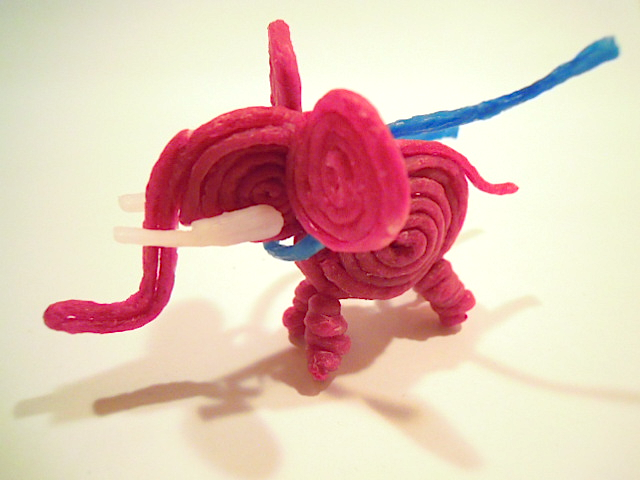
There was more pink in this particular package than any other colour, so today I decided to make a pink elephant.


The instructions in the package were for flowers and butterflies, so there was nothing I could really use as a model for an elephant. I decided to wing it, starting with a simple coil to make a body shape.


Because I didn't want a flat elephant, I wadded up one of the wax sticks and stuck it to the middle of the coil, then made another coil to form the other half of the body.


Next, I made four coiled spring-like things for its legs, and attached them to the body. This stuff sticks to itself reasonably well, so as long as you don't press too hard, it holds its shape fairly well. If you do press too hard, however, it will deform and become virtually impossible to push back into shape without deforming lots of other areas.


I added two coils for the head next—one on each side, but without a filler as in the body. I then shaped one of the sticks into a trunk that extended over the back to also form a tail. This piece had the added bonus of helping to hold the head to the body more securely.


The ears were two slightly wedge-shaped coils, simply stuck onto the sides.


To finish the elephant, I cut two small pieces from a white wax stick, folding them over at one end, and pinching the finer end to a bit of a point. Because of the string inside, a precise point isn't really possible, but this worked well enough.


Because it's a bit of a blustery day here, I decided to give him a scarf. I did this simply by adding a blue wax stick, twisted loosely around his neck. I was afraid to twist it too tight, in case it might pop his head off or something, but I did like that it was stiff enough to look like it was blowing in the wind.


I rather liked working with these sticks. They hold their shape well, and also stick together properly while you're working with them. Unfortunately, I don't think this is anything like permanent—even the packaging suggests that you can uncoil and reuse the wax sticks. I'm sure this little guy will ultimately fall apart if he gets a slight knock, but for now he's kind of cute.


Elephant Lore of the Day
The phrase "seeing pink elephants" refers to hallucinations caused by extreme drunkenness, and usually results from long-term alcoholism.

The first known use of the term comes courtesy of author Jack London, who in 1913's John Barleycorn describes "the man whom we all know, stupid, unimaginative, whose brain is bitten numbly by numb maggots; who walks generously with wide-spread, tentative legs, falls frequently in the gutter, and who sees, in the extremity of his ecstasy, blue mice and pink elephants."

A Wikipedia entry on pink elephants describes a story in Superman (Action Comics #7, December 1938), in which the Man of Steel lifts an elephant over his head at a circus. This causes a drunk in the audience to say, "I don't mind seeing pink elephants, but (-hic-) this is too much!" The same source also quotes Raymond Chandler's 1943 novel, Lady in the Lake, which refers to a doctor "who ran around all night with a case of loaded hypodermic needles, keeping the fast set from having pink elephants for breakfast."

And then there is the famous pink-elephant sequence in the 1941 Walt Disney film, Dumbo. Dumbo and his mouse friend Tim, having drunk water laced with champagne, hallucinate dancing and singing "pink elephants on parade". It's probably one of the most psychedelic sequences I've ever seen in a Disney film, outside of Fantasia.


A still from the "Pink Elephants on Parade" sequence in the Walt
Disney movie, Dumbo (1941).
Source: http://disney.wikia.com/wiki/Pink_Elephants


Interestingly, hallucinations such as this are not the result of drunkenness itself, but are one of the symptoms of withdrawal. Alcoholic hallucinosis, or alcohol-related psychosis, develops twelve to twenty-four hours after drinking has ceased. It can involve both auditory and visual hallucinations, usually accusatory or threatening in nature. It comes on and goes away quickly—unlike its sister ailment, delirium tremens—and tends to occur in those with a history of long-term alcohol or drug abuse.


To Support Elephant Welfare


World Society for the Protection of Animals
Elephant sanctuaries (this Wikipedia list allows you to click through to information on a number of sanctuaries around the world)
Performing Animal Welfare Society
Zoocheck
Bring the Elephant Home
African Wildlife Foundation