Showing posts with label books. Show all posts

Monday, 10 September 2012

Elephant No. 344: Bookplate


I've always been a bookish sort of girl, happiest with my nose stuck in some large tome. Even as children, my siblings and I couldn't bear to be without reading material at any time, and actually fought over who was reading the cereal box at the breakfast table. This is why we all know the full names of chemical acronyms such as BHT—butylated hydroxytoluene, if you're interested, and I didn't have to look that up.

At one point, when I had a lot more time on my hands, I actually made individual bookplates for my favourite books. The designs were based either on the book's subject matter, or on one of its illustrations. It astonishes me now that I ever even thought of doing such a thing.  

Because I have such a large personal library, only a fraction of my books have bookplates of any kind. But I do think they're lovely little works of art. So today I thought I might try making an elephant bookplate.

Bookplates are sometimes known as "ex libris", meaning "from the books of" in Latin. They are generally small decorative slips of paper pasted into a book to indicate ownership. Bookplates with simple typography are called "booklabels" to distinguish them from the versions with art.

Ownership marks on books and documents may date back to ancient Egypt and the reign of Amenophis III (1391–1353 B.C.), but formal inscriptions in books didn't become common until the Middle Ages in Europe. This coincided with the advent of early library practices, involving the use of shelfmarks, call numbers, and so forth.


One of the earliest known bookplates, A.D. 1480.
This was pasted into books presented by Brother Hildebrand
Brandenburg to a monastery in Buxheim, Germany.
Source: http://en.wikipedia.org/wiki/File:Bookplate2.png


The earliest known printed bookplates were produced in Germany during the late fifteenth century. Although consisting of black ink on white paper, many of these early woodcut bookplates were hand-coloured afterwards, mimicking the look of similar designs in medieval manuscripts. Within a few decades, bookplates were being widely used across Europe, and by the late seventeenth century they had even made their way to North America.

Over the centuries, the designs of bookplates reflected prevailing tastes—oddly enough—in furniture and architecture. Perhaps because a bookplate usually has a frame and often a coat of arms, the bookplate itself often looked something like the panel of a door, cupboard or library wall. Scallop shells, carved greenery, repeating patterns and heraldic animals were all common motifs in bookplates during the seventeenth and eighteenth centuries, reflecting the artistic sensibilities of their times.

Another popular design of the time was the portrait-plate featuring, as the name suggests, an engraved portrait of the book's owner or author. Similarly common designs were the library interior and book-piles, both of which looked exactly as their names suggest. In bookplates such as this, fancy borders and family crests were largely secondary.


Portrait-plate depicting Samuel Pepys.
Source: http://www.exlibris-art.com/types-of-ex-libris/


By the beginning of the nineteenth century, however, bookplates had become quite plain again, often featuring a family shield of arms, a motto and a scroll. This pared-down look was to last throughout most of the century, and it wasn't until the early twentieth century that artistic bookplates enjoyed a resurgence. Family crests fell out of favour at this point, and were replaced by more fanciful and allegorical subject matter.

Today, bookplates have become highly collectible, and are often of greater value than the book into which they've been pasted. Although the study and collection of bookplates dates back no more than 150 years, some immense collections have been amassed over the past century. In 1901–1903, for example, the British Museum in London published a catalogue of the 35,000 bookplates collected by Sir Augustus Wollaston Franks. Even more astonishing, the collection of Irene Dwen Andrews Pace—currently housed at Yale University—numbers some 250,000 items.


Bookplate from the library of Edgar
Rice Burroughs, author of Tarzan.
Source: http://en.wikipedia.org/wiki/File:
Bookplate_of_Edgar_Rice_Burroughs.jpg


Like stamp collectors, some bookplate collectors focus on specific subject matter—scientific, legal, portraits—while others focus on a specific country, period or style. Others collect the work of individual engravers and artists, proof plates, and signed plates. Today there are more than fifty national societies of ex-libris/bookplate collectors worldwide, as well as the worldwide International Federation of Ex-Libris Societies, which organizes a worldwide conference every two years.

For today's elephant, I decided to draw on plain paper with black ink, then hand-colour it if I had time.

I started by drawing a rectangle measuring 7.5 by 10 cm (3 x 4 inches), which is about the size of most bookplates I've seen.

I wasn't sure at first how to fit an elephant into the idea of a bookplate, so I started by drawing an elephant. Luckily, the rest of the design more or less filled itself in. Once I'd drawn the elephant and book, I surrounded it with greenery. Because I had slightly miscalculated the centring of the elephant, I added an extra sprig of greenery on one side.


I went over the sketch with a regular rollerball pen next. The pen wasn't necessarily waterproof; but it was the finest point I had, so I used it instead of the slightly heavier permanent pigment liners I have.


Because I wanted to hand-colour this with watercolours, I heat-set the ink with a hairdryer. Just to be sure it wouldn't run, I drew a few scribbles off to the side and heat-set those as well. When I ran a wet brush over the scribbles and they didn't run, I knew it was okay to paint the main design.

After this, I simply painted everything in. I became quite engrossed in the process, so I didn't photograph it along the way. To give you some idea of the order in which I painted everything, however: I painted the greenery and flowers first, then the book, then the grey of the elephant, then the blue wash in the background, then the pink in the elephant's ears.


It didn't take me long to draw this, but it did take about an hour to paint. I was actually quite happy with the final result, and may even make a few more at some point to put in my favourite elephant-related books.


Elephant Lore of the Day
My friend Jenny reminded me today that poachers don't just kill elephants. They often kill the rangers who protect elephants as well. 

Within the past year alone, five Kenyan wildlife rangers have been killed by poachers, along with a depressing 278 elephants. Even more disturbing, poachers are now turning to "quiet" killing methods, leaving poisoned watermelons out for elephants to eat, and shooting animals and rangers with arrows rather than the noisier guns they once used.

Most sources suggest that growing affluence in China and other Far Eastern countries is fuelling an immense upsurge in the illegal killing of elephants for their ivory, as well as the killing of rhinos for their horns. In some countries, rangers are fighting back by actually sawing off the tusks of elephants and the horns of rhinos to make them less attractive to poachers. This unfortunately changes the animals' behaviour—elephants, for example, use their tusks extensively to unearth minerals in the soil—but at least it keeps them alive.

Sadly, even this is not always enough to keep rangers alive. In April this year, despite the sawn-off horns of local rhinos, a South African ranger and policeman were shot and killed by poachers while on patrol. 


Asian elephant.
Source: http://blog.c77c.net/who-said-animals-can-not-be-sad-photos/


To Support Elephant Welfare

Thursday, 2 August 2012

Elephant No. 305: Mini Pop-Up Book


When I was in the art store looking at fabric markers a couple of days ago, they had kits at the checkout for mini pop-up books. The kit intrigued me, and was only six dollars, so I picked it up for today's elephant.

I've covered the history of pop-up books and the like for a post on pop-up cards for this blog, so I'll just describe today's activity here.

This was the little kit I bought.


And this is what it contained. I wasn't sure I'd use everything in this package, but it's actually quite a good kit. The book is particularly nice. I expected something with glossy pages, but it's nice, thick bristol-board pages with a matte cover as well. The glued perfect-binding leaves a little to be desired, but for six dollars, it's a great value.


The big issue was figuring out what sort of story to write. With only ten pages, it couldn't be a long one. Given the materials, I thought it should also be something lighthearted. So I combed the elephant anecdotes I've already written about, as well as any elephant poems I've written.

Ultimately, I decided on one of the silly elephant limericks I wrote a few months ago. Based on the book and kit materials I had to work with, this is the limerick I chose:

Three elephants entered a farm, 
not meaning to do any harm.  
They got zapped by a fence, 
and took great offence, 
stealing fruit, smashing trees and a barn.

I started by looking at what I had to deal with on each page, and sketched things out. My original intention was to use the markers that came with the set; but I decided that I'd prefer to paint the book with gouache. Rather than show you all the sketches, I'll go through the book page by page as it looked when finished.

The first page, facing the inside front cover, had a pair of arcs for a movable piece. I decided that the only thing it could be used for in my story was a sun moving across the sky. On the inside front cover, I made a sort of publishing data page.


The next page spread was blank, so I started the text here. 


The next page spread was also blank, so I added some more drawing, and one of the foldout pieces to hide a goat.


The next spread had a pop-up shaped like a heart, which I decided to turn into a tree for the elephants to munch on.


The next spread was plain, so I added some more drawing, and another foldout piece, this time hiding a monkey.


The next spread was also blank, but fit the part of the story where the elephants get zapped by an electric fence, so I added the spiral that came with the kit, decorated to look like a bolt of electricity.


The next spread had a bar of stars at the top, so I used that to suggest high dudgeon.


The next spread was plain, so I added a drawing of the elephants eating fruit.


The next spread had a plain page on one side and a page perforated with stars on the other, so I decorated the left hand side with elephants, and the star side as a dark night sky.


For the next spread, since the righthand side would have to accommodate the star cutouts from the previous spread, I traced the star shapes onto the righthand side so that I could avoid painting those areas. I painted the lefthand side with more sky and the final line of the limerick.


The final spread included the back cover, so I used the lefthand side to finish up the illustration with the elephants walking away, and put the word "fin" (French for "the end") on the righthand side. 


To finish up the book, I painted a front and back cover, as well as the spine.


This took me about six hours to produce, partly because I had to wait for things to dry, and partly because this essentially involves producing ten illustrations. The hardest part of the whole exercise was figuring out how to fit a story into the pages. Once I had that figured out, however, the drawing came relatively easily.

I must admit that I love this little book. It's not the type of thing I'd do every day—simply because of the amount of time and brain exercise it requires—but I may actually buy a couple more of these kits to make gifts for Christmas.


Elephant Lore of the Day
As I've written before, electric fencing is frequently used by farmers to deter elephants. Unfortunately, this particular remedy often proves deadly.

In India's southwestern Karnataka province, wild elephants are a frequent danger to farmers and others. The problem is particularly acute in the province's Chamarajanagar district, which has about one million people on about 5,000 square kilometres (1,930 square miles)—most of which is either forest or farms.

For millennia, the region was relatively free of human-elephant conflict. With the rise of farming in the region, however, conflict has become more and more frequent. In the first six months of 2012 alone, 671 complaints were filed, and hundreds of hectares of crops were destroyed. There were also a number of human deaths and injuries due to elephant encounters, as well as an astonishing 41 elephant deaths.

Some of the elephant deaths were due to deliberate killing of rogue elephants by forestry officials. Far more, however, were due to the farmers themselves—and many of these resulted from fatal encounters with electric fencing.

Normal electric fencing is meant to be a deterrent to elephants, giving them a mild zap to scare them off. The recommended voltage is 12 volts, which can actually be run off a large battery. Forestry officials in Chamarajanagar, however, discovered that farmers were actually connecting their electric fencing to the mains, delivering a whopping 11,000 volts to anyone—or anything—coming into contact with it. And 11,000 volts is fatal to elephants.

In a 2012 report to parliament, local Member of Parliament V. Dhurvanarayan, seconded by conservationists and wildlife scientists, recommended digging wide trenches, along with the erection of regulated electric fences running a current of 12 volts. The combination of trenches and fencing would encircle elephant preserves, reducing the likelihood of human-elephant conflict.

Although the trench-and-fence solution would not come cheap, it was considered a bargain when compared to loss of life and crops. In addition to ensuring that trenches are not so narrow or deep that they would injure or trap elephants, district officials were also prepared to check the voltage levels on farmers' fences.

Not that trenches and fences are foolproof when it comes to elephants. Elephants have shown themselves quite capable of breaking down and filling in trenches in both Asia and Africa. They have also proven themselves rather adept at taking out electric fencing by dropping logs on it.

Limiting farm growth, preserving elephant habitat, and setting up barriers such as trenches and fencing may be the only ways to reduce human-elephant conflict in the long run.


Asian elephant pushing down fence in Sri Lanka.
Photo: © naturepl.com/Toby Sinclair/WWF
Source: http://wwf.panda.org/what_we_do/endangered_
species/elephants/asian_elephants/sri_lankan_elephant/


To Support Elephant Welfare
Elephant sanctuaries (this Wikipedia list allows you to click through to information
on a number of sanctuaries around the world)
Wildlife Trust of India

Monday, 23 July 2012

Elephant No. 295: Bookshelf Mural


This idea was inspired by Noah Scalin's book, 365: A Daily Creativity Journal, and seemed like the perfect thing to make for today's elephant. No messy paint, no tools, and the bookshelves need dusting anyway.


Video Fan Skull by Noah Scalin, 2008.
Photo: Noah Scalin
Source: http://skulladay.blogspot.ca/2008/05/339-video-fan-skull.html


I wasn't sure if there was a trick to this sort of thing, so I just dove in. The rules I set myself were simple: I could only use books (no additional supports or props), and I had to fit it all inside the bookcase shelves.

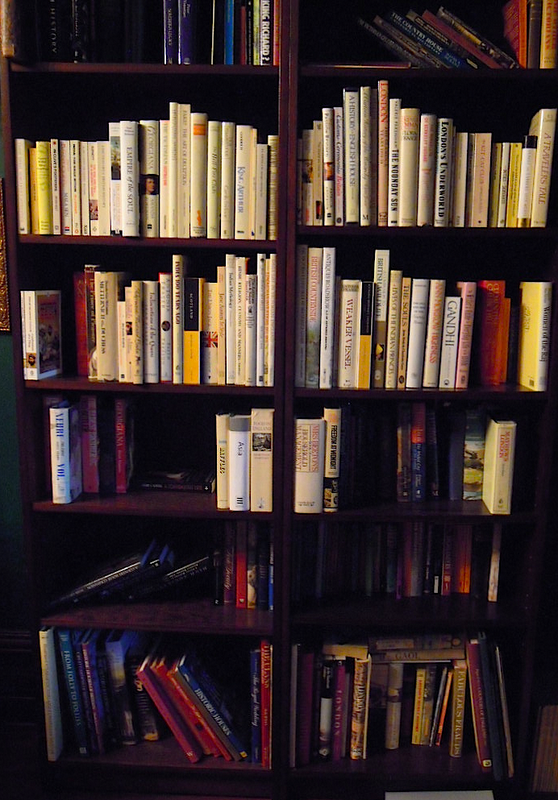
I started by taking down all the little toys and things sitting in front of the books themselves. I used a pair of bookshelves sitting side by side as my "canvas", with a total width of 122 cm (48 inches). The shelves contain a collection of books on British history, and this is what they looked like before I started.


I thought briefly about taking all the books out before starting, but from previous experience, I know that's a heck of a lot of heavy lifting. So instead, I decided to visualize where the general outline of the elephant might go. I didn't think I was going to have much luck with an entire elephant, so I had more or less already visualized making just an elephant head.

I could already see that I was going to have a few issues with this activity:

1. The books vary wildly in size and spine width.
2. The shelves are different heights, meaning that not all books can be accommodated on all shelves.
3. The spines not only come in a dizzying array of colours, but most spines feature more than one colour.

All of which meant that this activity was going to be more like making a patchwork quilt or photomosaic. And when I was done, it was probably going to require serious squinting in order to see any kind of elephant.

My first idea was to do a sideways elephant, with trunk raised. The photo below shows this particular false start. The trunk is in lighter-coloured books, and curves up towards the left.


This might have worked as a design—but only if I'd had about twice as many bookcases. With this configuration, the elephant's head and ear was going to be mighty squished and attenuated. So I switched to a head-on elephant.

I started by laying out the top of the elephant's head and part of its trunk, beginning with the second shelf from the top. Already I could see that I was definitely going to run out of light-coloured book spines with this collection of books.


I had already made quite a few mistakes. The first was not starting on the topmost shelf. The second was trying to make eyes with dark-coloured books. I didn't have books dark enough for this to work. You can sort of see my first stab at eyes on the second shelf in the photograph below.


I didn't much like the way this was going, but I stuck with it long enough to move stuff up a shelf and rejig everything some more. I decided that, instead of fooling around with black-spined books, I'd lay small books across a blank area to make eyes. It felt a little like cheating, but after three hours of stacking and restacking books, I didn't care anymore.

I had to scavenge books with light-coloured spines from all over the house. We have a huge home library, but light spines were curiously rare. It was also hard to find light-coloured spines in the right heights, adding to this delightful challenge. And I made an incredible mess in the library. There are books from all over the house, in higgledy-piggledy stacks across the floor. The whole idea of having to put them all away makes me want to ignore everything and have a bowl of ice cream on the front porch instead.


This is certainly not the easiest elephant I've ever made. I would have thought that stacking books in some sort of pattern would be boring but fairly straightforward. It isn't.

I must have fussed with every shelf a good dozen times. Each. First the elephant's head was too wide. Then it was too narrow. Then the trunk was too fat at the very bottom. Then too skinny. Then the eyes were too far apart. Then the ears were too big. Then they were droopy and odd. It got to the point where I was chasing my tail, and it wasn't getting any better. You know it's time to stop when you begin cursing inanimate objects with great fluency.

In the end, I don't hate the elephant head I created, but I would never do this activity again. It took me nearly four hours to arrive at the final result, and it looks more like a zombie elephant than anything you'd see in real life. And that's only if you squint.

Worse still, I have to take it all apart and put literally hundreds of books back where they belong. Maybe I'll take a page out of Scarlett O'Hara's playbook and think about it tomorrow.


Elephant Lore of the Day
In many parts of India, elephants have been domesticated for centuries, if not millennia. As a result, a sort of Bible has evolved over the years to guide buyers in determining whether a potential purchase is auspicious. The list is quite long, but I've included a few of my favourites. For the full list of important elephant characteristics, click here.

• An auspicious elephant should have a dignified look, with a raised head and low back.
• The eyes must be clear, honey-coloured and moist. The pupils must be dilated. Red eyes indicate an aggressive temperament. Also be wary of elephants with a fixed gaze.
• Tusks are important in judging an elephant. Ideally, the tusks should grow downwards, curve up and be evenly separated, with the colour of butter or sandalwood.
• The trunk should be fleshy, broad, and trail on the ground. The tip of the trunk should be long, triangular and strong.
• The tail must be long enough to touch the ankle, but not so long that it trails on the ground. It should not have any twists or kinks.
• Elephants usually have eighteen toenails: five on each foreleg, and four on each hind leg. Occasionally an elephant will have 20 toenails, which is seen as very auspicious. Elephants with 16 nails are considered inauspicious for individuals, but okay for institutions like temples.
• When multiple hairs arise from a single root, it is seen as an indicator of long life, and is a good sign.
• If the insides of the mouth or upper surface of the tongue is black, the elephant is considered to have an unpredictable character.
• If the elephant makes a gurgling sound when seeing its favourite mahout or owner, it is a good sign. If the elephant remains motionless, not fanning its ears when approached, beware.


Elephant with mahout in Kerala, India, 2010.
Photo: Ian MacKnight
Source: http://www.flickr.com/photos/14893072@N06/
4400774745/


To Support Elephant Welfare
Elephant sanctuaries (this Wikipedia list allows you to click through to information
on a number of sanctuaries around the world)
Wildlife Trust of India

Saturday, 14 July 2012

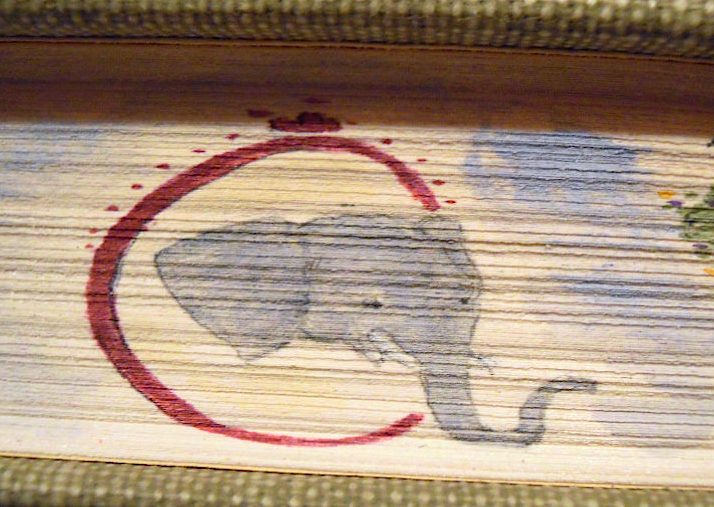
Elephant No. 286: Fore-Edge Painting


I never knew there was an official name for this type of painting, but it looked like an interesting thing to try for today's elephant.

A fore-edge painting is, as the name suggests, a painting on the "fore-edge" of a book's pages: the side of the page farthest away from the spine. The earliest fore-edge paintings may date back as far as the tenth century A.D., when they generally consisted of symbolic designs. By the fourteenth century, fore-edge paintings in England featured heraldic designs in gold and/or other colours.

There are two basic types of fore-edge painting. The most common type involves edges that have been fanned: the effect you get when you gently bend a book's binding. In this type, the design can only be fully seen when the pages are fanned. The other type involves edges that are closed, meaning that the painting shows properly only when the book is closed and the edges are flush.


Fore-edge painting of a billiard game on a 1772 copy of the Book of Common Prayer,
part of a private American collection auctioned by Christies in 2010.
Source: http://www.nytimes.com/2010/11/19/arts/design/19antiques.html?_r=1


There are a number of variations in fore-edge painting:

Single fore-edge painting: Painting only on one side of the book's pages. Gilt or marbling is applied to the closed edge after the painting has dried, making the painting invisible when the book is closed.

Double fore-edge painting: Paintings on both sides of the outer margin, so that one painting is visible when the pages are fanned one way, and another is visible when the pages are fanned the other way.

Triple fore-edge painting: Paintings on both sides of the outer margin, as well as a third painting directly on the edges, instead of gilding or marbling.

Panoramic fore-edge painting: Paintings wrapped around more than one edge. This is also sometimes called "triple-edge painting".

The earliest example of a fore-edge painting that becomes invisible when the book is closed dates to A.D. 1649. By 1750, fore-edge paintings had evolved from heraldic designs and decorative patterns to religious scenes, portraits and landscapes, usually in full colour. These often bore no direct relation to the subject of the book.

Fore-edge paintings from the nineteenth and twentieth centuries were far more elaborate than earlier types, and often featured scenes from novels. The choice of subject matter was usually made by a bookbinder, artist, bookseller, or even the owner of the book, making for an extensive range of scenes. Most existing examples of fore-edge painting date from the late nineteenth and early twentieth centuries.

Today, there are a number of artists producing expert works of fore-edge painting, largely in the United Kingdom. Most involve fanned pages, and some are incredibly elaborate. It is unusual to see a fore-edge painting on display, however, because of the damage fanning does to a book's binding.


Panoramic fanned fore-edge painting of London by modern
master Martin Frost.
Source: http://www.ursispaltenstein.ch/blog/weblog.php?/weblog/fore_edge_painting/


Despite the fact that I have a very large personal library, I don't have a single example of fore-edge painting on any of my books—unless you count the scribbled pen on the closed edges of some of my childhood books. I  blame this on one of my brothers, who showed a remarkable tendency to add personal graffiti to my toys when he was small.

Because I didn't really have an appropriate book to muck about with, I went to a local thrift store and bought this copy of Samuel Butler's The Way of All Flesh. It came in a "Classics Club" edition, so it looks nice but isn't overly valuable.


Although this is a novel criticizing Victorianism and has really nothing to do with elephants, it does refer to them from time to time, as in this passage recommending a course of treatment for one of the characters who is of a rather nervous disposition:
I have found the Zoological Gardens of service to many of my patients. I should prescribe for Mr Pontifex a course of the larger mammals. Don’t let him think he is taking them medicinally, but let him go to their house twice a week for a fortnight, and stay with the hippopotamus, the rhinoceros, and the elephants, till they begin to bore him. I find these beasts do my patients more good than any others. The monkeys are not a wide enough cross; they do not stimulate sufficiently.  The larger carnivora are unsympathetic. The reptiles are worse than useless, and the marsupials are not much better. Birds again, except parrots, are not very beneficial; he may look at them now and again, but with the elephants and the pig tribe generally he should mix just now as freely as possible.        —Samuel Butler, The Way of All Flesh, Chapter 79

The "elephants and the pig tribe" it is.

If you decide to try a fore-edge painting, a few tips on choosing the right book:

1. Use a hardcover book. A pretty binding is nice, but make sure it's not falling apart. Fanning the pages and holding them in place while you paint puts a lot of strain on the binding.

2. Make sure the edges are reasonably even. Some older books have loose bindings or rough edges that will make painting difficult. If the edges are somewhat soft and frayed, the paint will also absorb differently than if the edges are more crisp. Similarly, an uncoated paper is better than a glossy paper, in terms of accepting the paint.

3. Avoid edges that are foxed or heavily stained. Not only is it difficult to paint these heavily enough to make them disappear, but foxing (a form of mould) can spread over time, ruining your work.

It took me about half an hour to find a book that met all of the above conditions. Once I got it home, I fanned it to a width I liked, and clamped it between two pieces of foamcore. The clamping is important in terms of keeping the pages in place while you're working. Even if you're working with a closed book rather than a fanned one, clamping will help. Before tightening the clamps, make sure your pages are lying evenly in relation to one another on the sides and on your painting surface, as well as in relation to the cover.

(I apologize for the final photograph in the trio of images below. It was in focus when I snapped the shutter, but the camera clearly had other ideas. It will give you some idea, however, of the angle at which the pages were fanned.)


Once I was ready to go, I thought I should perhaps sketch something to guide me. I took my inspiration from the Butler quotation and did something that I thought might be evocative of zoological gardens. The sketching actually took me a lot longer than I expected. This was partly because I was going to include other animals in addition to an elephant, but adding a hippopotamus and a rhinoceros looked odd. Then I was going to do a scene which included humans, but I didn't like the way that looked, either. So I settled on a design with three elephants.


In an attempt to be as traditional as possible, I used good-quality cake watercolours. I started by roughing in the elephants with grey paint.


Painting something like this is actually quite tricky. If the paint is too wet, it tends to bleed and/or suck into the paper immediately. If the paint is too dry, it doesn't spread at all. What eventually worked best for me was to use relatively dry paint for the shadows and outlines, then colour things in with much wetter paint. The dry paint acted as a sort of resist in this case, keeping the wet paint more or less contained.


Because I found the final drawing too soft-focus due to paint bleed, I used faint pencil lines to add a bit of definition here and there.


For a fanned painting, the closed edges are often gilded or marbled once the fore-edge painting is done. This is done by closing the book, clamping it, then gilding or marbling the edges. This makes the fore-edge painting "disappear" until the book is fanned again.

I was actually going to try for a disappearing painting, but a gilding test I on a cheap paperback was underwhelming. Rather than risk destroying my painting, I decided to leave it as it was. As you can see, the painting is deformed and compressed when the book is closed, but the painting is still quite recognizable.


In principle, I suppose this isn't all that different from doodling on the side of a textbook during a boring lecture—although in execution it's obviously far more time-consuming. I think it would have been more exciting and magical if I'd used a thicker book and fanned the pages even wider. And if I could have gilded it.

I'm determined to try again for a disappearing painting once I've had a chance to play with gilded book edges, but for now, this is quite pretty in real life.


Elephant Lore of the Day
Although the London Zoo in Regent's Park is considered the world's oldest scientific zoo, it has had a rather checkered history when it comes to elephants.

Founded in 1826, the Zoological Society of London opened its Gardens in April 1828. The collection of animals had been established for the purposes of scientific study, and admission was limited to members of the Society until 1847. The zoo featured some unusual and exotic animals, including the now-extinct quagga and thylacine. As time went on, animals were transferred from other collections, including the Royal Menageries at the Tower of London and Windsor Castle.

The first elephant house was built at the zoo in 1831. Designed by Decimus Burton, it was an amalgam of exotic elements and British styles. Called the Elephant Stables, it was an attractive building, but far too small to comfortably house large animals such as elephants. The situation was even sadder because zoos of the time believed that tropical animals living in northern climates should not be allowed outdoors except during the hottest months. It wasn't until 1902 that zookeepers realized that tropical animals could be acclimatized to colder weather.


Original elephant house by Decimus Burton at the Gardens of
the Zoological Society of London.
From: Natural History and Views of London, 1835.
Source: http://cumbria.academia.edu/MarkHaywood/Papers/1429475/A_Brief_History_of_European_Elephant_Houses_from_Londons_Imperial_
Stables_to_Copenhagens_Post-modern_Glasshouse


By 1869, the original Elephant Stables had been enlarged and combined with rhinoceros enclosures. The animals' new home looked more like a house for humans than a place for elephants. This was also too small for elephants—or rhinoceros, for that matter.


Renovated Elephant and Rhinoceros House by Anthony Salvin.
From: The Illustrated London News, 1869.
Source: http://cumbria.academia.edu/MarkHaywood/Papers/1429475 A_Brief_History_of_European_Elephant_Houses_from_Londons_Imperial_
Stables_to_Copenhagens_Post-modern_Glasshouse


This is not to say that Londoners didn't care about elephants. London's elephants were, in fact, much loved by the general population. A number of elephants—including the famous Jumbo—were trained to give children rides in special carriers on their backs, and when it looked as though Jumbo would be sold in 1887, thousands of schoolchildren petitioned Queen Victoria to keep Jumbo in the country.

By the early 1930s, scientists were more aware of the needs of elephants, and new enclosures were built at the London Zoo's location in Whipsnade Park, Bedfordshire. These were utilitarian structures, rather than decorative ones, providing the elephants with room and amenities more suited to their size and special needs.


Lubetkin/Tekton Elephant Houses, Whipsnade Zoo, 1935.
Source: http://cumbria.academia.edu/MarkHaywood/Papers/1429475/A_Brief_History_of_European_Elephant_Houses_from_Londons_Imperial_
Stables_to_Copenhagens_Post-modern_Glasshouse


The decorative elephant houses at Regent Park—still being used to house elephants—were rebuilt in the early 1960s. The buildings by Sir Hugh Casson were meant to evoke a group of elephants at a waterhole. The rough concrete shell was supposed to have a texture similar to elephant hide, and the green lantern roofs were supposed to look like elephants' raised heads. These buildings worked for many years, providing elephants with an adequate environment.


Elephant and Rhino Pavilion by Sir Hugh Casson. Today, the pavilion is
home to a herd of East Indian bearded pigs, seen in this photograph.
Source: http://cumbria.academia.edu/MarkHaywood/Papers/1429475/A_Brief_History_of_European_Elephant_Houses_from_Londons_Imperial_
Stables_to_Copenhagens_Post-modern_Glasshouse


Today, however, there are no elephants at the zoo in Regent's Park. In October 2001, a zookeeper named Jim Robson was crushed to death when an elephant rolled on him. The Zoological Society decided that it would be best for the zoo's three elephants if they were moved to the Whipsnade facility, to join the elephants already in residence there.

A zoo spokesman said that plans to move the elephants had been in the works for some time, and that the move was not connected to Robson's death. The elephants were transferred to Whipsnade in late 2001, where they were given a larger enclosure and became part of the zoo's breeding program. After 170 years at the zoo, and centuries more in menageries and circuses, London's last live elephants packed up their trunks and left the city.


Asian elephants at London Whipsnade Zoo, Bedfordshire.
Photo: ZSL Whipsnade Zoo/PA
Source: blog.mongabay.com


To Support Elephant Welfare
Elephant sanctuaries (this Wikipedia list allows you to click through to information
on a number of sanctuaries around the world)
Wildlife Trust of India