Showing posts with label home decor. Show all posts

Monday, 1 October 2012

Elephant No. 365: Door Hanger


Technically, today marks the end of a calendar year's worth of this blog, but since 2012 is a leap year, I ended up with 366 days.

But because it's almost the last day, when I saw a plain wooden door hanger in a discount store, I thought it might be perfect for today's elephant.

A door hanger is generally rectangular in shape, with a cut-out to allow it to slip over a doorknob. The most common form of door hanger is a "Do Not Disturb" sign, hung over the outer handle in hotel rooms, classrooms, bedrooms, and so forth. They are also often used as a form of advertising, or as a means of leaving delivery notices.

Some people use do-not-disturb signs on their hotel rooms to make thieves think that the room is occupied. In other instances, do-not-disturb signs have been blamed for concealing evidence of a homicide or other crime. In some hotels, instead of a do-not-disturb sign, a privacy button can now be triggered from inside the room, lighting up an indicator on the outside of the door.

For today's elephant, I thought I'd make my own do-not-disturb sign, since the minute I finish tomorrow's blog, I'm taking a few days away from anything remotely like blogging.

This was the wooden door hanger I bought. It came in a package of two for a dollar, which I thought was a pretty good deal.


I started by painting the whole thing red on both sides with acrylic paint.


Once both sides were dry, I sketched an elephant on paper. I didn't really want to sketch too much on the painted piece, because an eraser might leave marks.


I began by painting right on the door hanger, using my sketch as inspiration. I did do a bit of sketching once I'd painted the head, just to keep me on track. I roughed in the head first, then the yellow pyjamas, then the bits of arms and legs peeking out. I then added a little stuffed bunny, rather than the pull toy from my original sketch.


It took about six coats of yellow in total to give me a surface I liked, which probably distracted me a bit, because I forgot to photograph any of the other stages in between. To give you an idea of how I proceeded, however, I added pink to the ears, trunk and toenails, as well as the bunny's nose. Then I added all the blue dots on the pyjamas, followed by eyes and tusks. To finish up, I wrote "DO NOT DISTURB" in gold paint, added dots of gold for the crown, and picked out the edge of the entire thing in gold dots.

It took me about an hour in actual working time to paint this, along with about half an hour to let the red dry, and about half an hour to build up enough layers of yellow. It wasn't particularly difficult, however, and the final piece is quite nice in real life.

I think it will also look very nice on my study door at the end of the day tomorrow.


Elephant Lore of the Day
Lin Wang is thought to be the oldest elephant who ever lived. Born in 1917, Lin Wang was an Asian elephant who also served with the Chinese Expeditionary Force during the Second Sino-Japanese War (1937–1945), and later with the Kuomintang in Taiwan.

During the war, when the Japanese began attacking British colonies in Burma, Chiang Kai-Shek formed the Chinese Expeditionary Force, under General Sun Li-jen. After a 1943 battle near a Japanese camp in Burma, Lin Wang and twelve other elephants were captured by the Chinese. The elephants had been used by the Japanese to haul large guns and other supplies, and were pressed into action by the Allies for similar purposes.

In 1945, the Expeditionary Force was recalled to China. The elephants and their handlers marched out along the Burma Road, but six elephants died on the difficult journey. By the time they arrived in Guangdong, the war was over. The elephants' wartime service was not over, however. They were used to haul building materials for war monuments, and in 1946 also performed in a circus to help raise money for famine relief in Hunan province. Four of the elephants were sent to four separate zoos, while Lin Wang and the two others were sent to a park in Guangzhou.

In 1947, General Sun was sent to Taiwan to train new troops, and took the three elephants with him. One died while crossing the Taiwan Strait; the two others were used to haul logs and perform other labour near a military base. In 1951, another elephant died. The zoo elephants had also died over the years, leaving only Lin Wang of the thirteen original elephants.


Lin Wang and General Sun, 1947.
Source: http://en.wikipedia.org/wiki/File:Lin_Wang_and_Sun.jpg


In 1952, Lin Wang was sent to the Taipei Zoo, where he joined the female elephant Malan. Lin Wang soon became the most popular and famous animal in Taiwan. In 1983, the zoo threw a birthday party for his sixty-sixth birthday, and continued throwing parties for him every year until his death.

In early 2003, Lin Wang developed arthritis in one of his hind legs. Lacking the companionship of Malan, who had died some months earlier, Lin Wang stopped eating. He declined rapidly, and died on February 26. His memorial at the zoo lasted several weeks, and was visited by tens of thousands of people, many of whom left cards and flowers. He was also posthumously made an Honorary Taipei Citizen by the Mayor of Taipei. Taiwan's President even sent a wreath with a card to "our forever friend, Lin Wang."

Today, Lin Wang has become part of Taiwan's national identity, and children and adults alike remember him as "Grandpa Lin Wang". In 2004, the Taipei Zoo erected a life-sized monument to him, and an animated film about his life is currently in the works.


Monument to Lin Wang at the Taipei Zoo.
Source: http://lang-8.com/237451/journals/1141852/
Taipei-Zoo%2528-II-%2529-Who-is-Lin-Wang%253F


To Support Elephant Welfare
Boon Lott's Elephant Sanctuary (Thailand)
Wildlife SOS (India) 
 
The Elephant Sanctuary (Tennessee)

Friday, 28 September 2012

Elephant No. 362: Glass Vials


For a couple of weeks now, I've been eyeing a set of glass vials in a discount store, trying to think of a way to use them for an elephant. I admit that I was drawn to them mostly because I like little containers of any kind, but I didn't want to buy them unless I could make something interesting. I thought of filling them with sand or beads, grouping them, glueing them, and even buying multiples and stacking them. Then it occurred to me that I could simply paint them to produce a modular elephant herd.

The word "vial" comes from the Greek phiale and the Latin phiala, meaning "a broad, flat container". Technically speaking, a vial or phial is a small glass or plastic bottle. Vials are most commonly used to store medications and small samples.


Glass vial discovered in Syria, ca. 4th century A.D.
Collection of the Louvre, Paris
Photo: Marie-Lan Nguyen
Source: http://en.wikipedia.org/wiki/File:Double-handled_vial_
Louvre_MND1503.jpg


Glass vials have been around for millennia, used for everything from medicines, herbs and spices, to tomb offerings of gold and blood. Although traditionally sealed with corks, wax or even glass stoppers, modern vials often have flip-tops, snap caps and other closures. The bottom of a vial is usually flat. The small vials used in laboratories—often with a volume of 10 ml at most—are known as "bijou bottles" or "McCartney's bottles".

For today's elephant, this was the set of four vials I bought, for under $1.50. They range in size from 7 m to 20 ml (0.24 to 0.68 U.S. fl. oz.), so I guess a couple of them are technically "bijou bottles".


I already had a set of glass paints that I'd used for my painting on glass post, so I decided to use those, along with some regular acrylic paint.


 My idea was fairly simple: use all four vials to create a mini-herd of elephants.

I thought briefly about drawing elephants on the vials first, then decided I'd rather just get started. I began by roughing in an elephant on each of the four vials. The four pictured below are not necessarily my first attempt at each. For one or two of them, I wiped off my first try while it was still wet and started over.


These were pretty streaky-looking when the light shone through, so I waited for them to be dry to the touch, then glopped on more grey paint. When that dried, I added a few black lines for definition, and a bit of pink in the ears, the tip of the trunk, and on the toes. The elephant with an open mouth also got a bit of pink in the mouth, and two elephants got white tusks.


My idea from the beginning was to make a series of little bottles that could be grouped together to resemble a herd of elephants. I thus took advantage of the clear glass to draw some long grass on the side opposite to the elephants.


To finish up, I added dots of green under the elephants, and dots of gold above the elephants' heads, and above the grass on the reverse.


It only took me about two hours to paint all four of these, but that was partly because I didn't wait for the different layers of paint to dry. Although all of the paints dried relatively quickly, I was definitely risking smudges—particularly when it came to the dots. If you try this, I would recommend a bit more patience than I had, just in case. I didn't smudge anything this time; but if I had, it would have been pretty difficult to remove the offending area on something this small.

In real life, these are quite fun. The light doesn't shine through them as strongly as it does in these photographs, so they don't look quite as streaky. They're also fun to group, and actually look a little like a herd of elephants seen in the distance, which was exactly what I'd hoped for.


Elephant Lore of the Day
Suleiman was an Asian elephant presented to Archduke Maximilian II in the sixteenth century. Born in the stables of the King of Ceylon in 1540, Suleiman was originally presented as a gift to the Prince of Portugal in 1542.

Although flattered by the auspicious and generous gift, the Portuguese ultimately found Suleiman's care and maintenance too expensive and complicated. They accordingly offered him to Archduke Maximilian, who happened to be the Prince's uncle. Suleiman was sent to Spain then Genoa by ship, and finally overland through the Alps to Austria. He arrived in Vienna in 1552.


Woodcut of Suleiman, ca. 1552.
Source: http://en.wikipedia.org/wiki/File:Soliman.1.jpg


Suleiman proved highly popular with the Austrian people. He was drawn and painted, and was celebrated in poems and songs. He was installed with some ceremony in the menagerie at Kaiser-Ebersdorf castle, but died only a year and a half later, in December 1553.

Suleiman's afterlife was rather bizarre. Although the Archduke had a commemorative medal struck featuring the elephant, he also had no qualms about having Suleiman's body vivisected and distributed across the Holy Roman Empire.

Suleiman's right front foot and part of a shoulderblade were given to the Mayor of Vienna, who had them fashioned into a chair that can still be found in Kresmünster Abbey. His skin was stuffed and put on display in Vienna until 1572, when Maximilian decided to give it to Albert, Duke of Bavaria.

Suleiman's stuffed effigy survived for centuries in the Wittlesbach royal collection and the Munich Residenz. Ultimately transferred to the Bavarian National Museum, Suleiman was stored, forgotten, in a cellar. Although his effigy survived even bombing raids on Munich in 1943, conditions in the cellar were damp, and Suleiman's skin mildewed. Following the war, Suleiman was dismembered yet again, and his hide was sold—rather poignantly—for shoe leather.

That isn't the end of his story, however. So famous was Suleiman that several books have been written about him, including the recent novel, The Elephant's Journey by José Sararamago. He has also been featured in at least two exhibitions—one of which was presented in Vienna, where Suleiman had been so celebrated in life.


Commemorative medal designed by
Michael Fuchs following Suleiman's
death in 1554.
Source: http://en.wikipedia.org/wiki/File:Soliman.2.jpg

To Support Elephant Welfare
Fauna & Flora International

Wednesday, 26 September 2012

Elephant No. 360: Marbles


When I was little, someone gave me a small worm made of marbles glued together with some kind of silicone. It even had tiny googly eyes. Even back then, I found it intriguing that something as slippery as glass could be stuck so firmly together with glue—as witnessed by my many attempts to pry the pieces apart—so I thought I'd try it for today's elephant.

Marbles are small spherical toys made usually of glass, although there are also marbles made of agate, clay, steel and plastic. The earliest known marbles were made of stone, and date to the Indus Valley civilization (ca. 3300–1300 B.C.). Games involving marbles made of stone, clay and glass were also played in Rome and Ancient Egypt.

In 1846, a German glassblower invented special "marble scissors" which could be used to clip off and form individual marbles. Mass-production of marbles began with ceramic marbles in the 1870s, followed by the first sets of mass-produced clay marbles, which were produced in the early 1890s.


Traditional marble scissors.
Source: http://dumpdiggers.blogspot.ca/2007_12_01_archive.html


In 1903, the first U.S. produced glass marbles were being mass-produced in Akron, Ohio on a machine patented by Martin Frederick Christensen. M.F. Christensen & Son manufactured millions of toy and industrial glass marbles until the company closed up shop in 1917.

For millennia, children and adults have played games with marbles. One of the most common games involves first drawing a circle in the sand. Players then take turns rolling their marbles into the circle, attempting to knock other marbles out. Other commonly played games involve shooting marbles at holes or at target marbles. In many of these games, the winner of each round keeps the other player's marble.

Most marble-related games involve rolling marbles along a surface; in others, players toss marbles from a standing position. Marbles are also used in board-style games such as Chinese Checkers, in which each player hops his or her marbles over those of other players.


Chinese Checkers board.
Source: http://mathworld.wolfram.com/ChineseCheckers.html


There are many colourful terms in the world of marbles. One of my favourites is the move called the "elephant stomp". This is when a player gets to stomp his or her marble level with the surface of the ground, making it virtually impossible for other players to hit it.

Different types of marbles also have interesting names. Alleys, for example, are marbles made of marble or alabaster—"alley" being short for "alabaster". Toothpaste marbles are the ones with a little twist of coloured glass in the centre. Aggies look like agate; bumblebees are yellow with two black stripes on each side; catseyes have a central eye-shaped insert of coloured glass; and elephant eggs are a type of particularly large marble. For an exhaustive list of marble names and types, visit the Wikipedia page on marbles.


Different types of marbles.
Source: http://mariemillard.blogspot.ca/2007/12/i-havent-lost-my-marbles.html


When I was young, I had a small jar of marbles—some of which I had won away from my brothers and other neighbourhood boys, and some of which I bought because they were pretty. Today, a marble collection can range from a couple of handfuls contained in a jar or bowl, to elaborate displays grouped by maker, style, material, quality, age and rarity. Because of their relative fragility, even a tiny chip can have a major impact on value.

Marbles were originally made by hand. If made of stone, bone or ivory, they were carved and polished. If made of clay, ceramic or porcelain, they were rolled into balls then fired and usually glazed. Handmade glass marbles are produced by stacking glass rods together to form a pattern, which is then cut into marble-sized pieces with marble scissors and rounded while still molten. Mass-produced glass marbles are produced by dropping blobs of molten glass into a groove. As the glass passes along the groove and cools, it is shaped into spheres.

In the United States, many companies started in Akron, Ohio, where the original marble-making machine was located. Today, the world's largest maker of mass-produced marbles is Vacor de Mexico, which produces 90 per cent of the world's marbles, at the rate of more than 12 million per day.

Glass artists also produce art marbles for the collector market. Many of these are much larger than the average playing marble, and are meant solely for display.


Spectacular art marble by Mike Gong.
Source: http://www.marblesgalore.com/page/15/


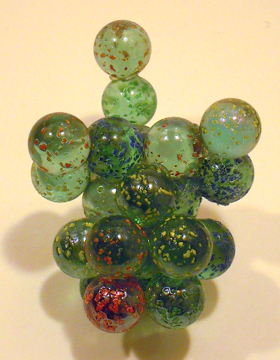
For today's elephant, I bought a sort of hodge-podge bag of strange bumpy marbles for less than two dollars. I bought these particular marbles because there were weird-looking, and because there were twice as many marbles in this bag as in any of the nicely packaged sets.


To glue the marbles together, I bought a tube of clear silicone.


I had absolutely no idea what I was doing, nor if I was even going to be able to construct an elephant shape of glass marbles. The trunk was a particular concern, as there aren't teeny marbles anywhere to be found.

Accordingly, I started with the trunk, glueing three marbles together in a slight curve.


Next, I put four marbles together in a square to provide a place to hold the trunk. I then added another marble to the back of this head shape. My idea was that the extra marble at the back of the head would help to anchor any body shape I added.


I attached the trunk next, and left things to set for a while. Although this process is very, very easy, it takes at least 10–15 minutes for the silicone to set each time. It won't be completely cured within 15 minutes, but you can at least handle the piece enough to glue on something else. Because of this, making this small elephant took most of the day—although the total actual working time was probably about 45 minutes.


After this, I got a bit distracted with other work I had to do today, every so often wandering over to glue on another marble or two. I also forgot to photograph the various stages. To give you an idea of how I did it, however, I glued on the marbles approximately like this: four marbles between the existing head and the body; a ring of six marbles around a central marble for the main body; four single marbles glued to the bottom of the body for legs; two marbles at the back to fill out the body; and two marbles stuck to each side of the head for ears.


This was easy enough for a child to try—although it would have to be a child with considerable patience, unless he or she was making something like a simple worm or snake. For more complicated forms, they have to be built in a sort of modular fashion, reassessing the shape at each stage. In my experience, the shape can't really be laid out any other way.

In the end, I rather liked this process. It's not something you'd use if you were in a hurry, but the final piece is actually rather pretty, despite the strange mismatched marbles and my rather lackadaisical approach to a tidy glueing technique. It's also quite heavy, so I think it will probably end up on my desk as a rather fun paperweight.


Elephant Lore of the Day
Lawrence Anthony—who became known as "The Elephant Whisperer" for his ability to heal the psyches of traumatized adult elephants—writes about being out in the bush one day, watching the still-unfriendly herd. He was studying them to learn the locations of their favourite watering holes, as well as what they were eating and where.

When he thought the herd was a safe distance away, he got out of his landrover to make a call on his brand-new cellphone. Some instinct, however, made him look over his shoulder, just as he was about to complete his call. To his horror, he saw the herd's most dangerous elephant, Frankie, a mere twenty metres away, with the rest of her family herd in tow.

Anthony leapt into his landrover with, as he wrote, "an alacrity which surprised even me." In his haste, he dropped his new cellphone. Soon the herd had arrived at the very spot where he'd been, and were milling about the phone. Anthony had no choice but to wait until they left, before he could retrieve the hapless device.

Suddenly the phone rang, its sound piercing the quiet. The elephants stopped in their tracks, turned around and approached the source of the unusual noise. Frankie arrived first, sleeking her trunk over the small piece of plastic, trying to figure out what it was. The others soon followed suit, and Anthony watched as seven elephants swung their trunks around over a chirping cellphone in the African bush.

Frankie finally decided that she'd had enough. Raising one of her feet, she stomped on the cellphone. The ringing stopped. The herd then turned around and ambled off.

When the herd was finally out of sight, Anthony went to retrieve his phone. Although it was buried deep in the soil, it still worked.

In addition to becoming famous for helping to rescue animals from the Baghdad Zoo during the recent conflict in Iraq, Lawrence Anthony has also become known for an unusual tribute paid to him following his death in March 2012. As if knowing that their friend and rescuer had died, the herds of Thula Thula walked twelve hours from their home in the bush to visit Anthony's home, remaining there for a short time before turning around and walking back.


Lawrence Anthony with an unnamed member of the Thula Thula herd.
Source: http://www.smh.com.au/environment/conservation/what-
elephants-can-teach-us-about-love-20090617-chyi.html


To Support Elephant Welfare
Fauna & Flora International

Sunday, 23 September 2012

Elephant No. 357: Cardboard Chandelier


The package for this called it an "ice chandelier", but it's neither made of ice, nor strictly speaking a chandelier, since I think putting candles anywhere near this would cause a very interesting fire.

That being said, I could see making an elephant with this kit, and it was only three dollars, so I thought I'd give it a try.

A chandelier—derived from various words for "candle"—is a branched lighting fixture with arms that bear either candles or lightbulbs. Although we normally think of chandeliers as sparkling crystal constructions, any branched lighting fixture is technically a chandelier.

The earliest chandeliers often consisted of two wooden crosspieces, fitted with spikes to hold candles. First used among wealthy Europeans during the Middle Ages, chandeliers were lit near ground level, then hoisted aloft on a chain or rope.


Medieval chandelier from King René's
Tournament Book
, 1460.
Source: http://en.wikipedia.org/wiki/File:Medieval_
Illustration_of_Chandelier.jpg


Beginning in the fifteenth century, more elaborate forms were developed, often featuring large wheel-like designs. Because candles were expensive, the larger the chandelier, the higher the implied status of the homeowner.

By the eighteenth century, as metal-casting and glassmaking techniques improved, highly decorative chandeliers were produced, featuring long, curved arms, gilding, and—perhaps most importantly of all—large quantities of lead crystal. To make the most of the limited light available from candles, everything from gilded picture frames to the silver and gold in a woman's dress was designed to reflect light. Lead crystal was thus a major leap forward in evening illumination, and crystal chandeliers became all the rage.

In the nineteenth century, with the introduction of gaslight, many chandeliers were converted to piped gas. Others were designed specifically for this exciting new form of illumination. By the end of the century, as electricity became both more dependable and more widely available, chandeliers were converted yet again.

The world's largest chandelier is thought to be the one in the Hassan Sharbatley Mosque in Cairo, Egypt. The world's largest Bohemian crystal chandelier is located in the Dolmabahçe Palace in Istanbul. Given to Turkey by Queen Victoria, it has 750 lamps and weighs 4.5 tonnes. The Dolmabahçe Palace, incidentally, has the largest collection of Bohemian and Baccarat crystal chandeliers in the world.


Crystal chandelier in Dolmabahçe Palace,
Istanbul, Turkey: a gift from Queen Victoria.
Source: http://turkishtravelblog.com/dolmabahce-palace-
ottoman-empire/


For today's elephant, this is the kit I had.


And this is what it contained.


I started by putting the armature together.


I then realized that there was no way I was going to be able to visualize a three-dimensional floaty elephant if I didn't hang it up to work on it. After that, I completely forgot to photograph what I was doing. Essentially, however, each piece of foil-covered cardboard is linked with small plastic rings that lock into place.

To give you an idea of how this was constructed, I hung a couple of round discs from each of the rings closest to the core of the armature. I then linked these to one another by bridging the gaps with an additional disc.

I then constructed the trunk by linking discs and diamond shapes, sometimes using two plastic rings instead of one, in order to make it hang properly.


For the ears, I simply added a couple of discs and diamond shapes to two of the side branches.


I didn't use the ice markers. They were interesting, but I didn't like the way they looked on the discs. My original idea had been to write the names of elephants I've written about in this blog over the past year, as well as numerous words for "elephant" in different languages. But it looked ugly when I did that, so I decided to leave the whole thing grey and silver.

It took me about an hour to construct this, which seemed quite reasonable. It's a bit on the plain side, but it does catch the light quite nicely, so it might look interesting tucked away in a corner somewhere. It is definitely weighted towards the front, so I might add some kind of weight to the back, inside the central ring, just to balance things out.


It's definitely an abstract piece, but I was rather pleased with the look of it when I was finished. It looks a lot like an elephant in real life, and I may even add some more sparkle with a few beads at some point. Actually, if I ever get truly ambitious, I might redesign this as a functioning electrical fixture, using glass and crystal.


Elephant Lore of the Day
Elephants often die of a broken heart. This is usually due to the sudden loss of someone—either elephant, human, or even another animal—with whom they have bonded.

In a 2006 New York Times article, Charles Siebert related the story of an elephant that had been hand-raised by the du Zulueta family in Uganda. The family lived on the edge of Queen Elizabeth National Park, where Dr. Zulueta had established a malaria-eradication program.

Local villagers came across a baby elephant that had been orphaned by poachers, and gave the elephant to the doctor and his family, who housed it in the family garage. As the elephant grew, however, Dr. and Mrs. Zulueta wondered what they would do when it outgrew the garage. A decision was made to give the elephant to the Entebbe Zoo in Kampala.

Although the Zoo gave the growing elephant all he needed in the way of appropriate food and care, he died soon after. Having grown up with a close-knit "family group", he pined away for lack of companionship, and simply lost the will to live.

Dame Daphne Sheldrick of the David Sheldrick Wildlife Trust tells a similar story. Years ago, she was hand-rearing a baby elephant named Aisha, and for six months rarely left the elephant's side. She left for a short time to attend her daughter's wedding, and when she returned, she discovered that Aisha passed away. Deprived of her closest companion, the elephant had essentially died of a broken heart. Since that time, elephants at the Wildlife Trust have never been left in the care of a single keeper.

And then there's the story of little Nyika, another resident of the David Sheldrick Wildlife Trust. Orphaned in July of this year near Kenya's border with Somalia—where poaching is now so rampant and so violent that even rangers are being killed—Nyika was terribly emaciated. He had been deprived of his mother's milk for some time, and was also severely traumatized.

Soon realizing that the ten-month-old elephant was failing to thrive, staff at the Trust drew blood and sent it away for analysis. His white blood cell count was normal, which meant he wasn't suffering from an infection. The vet recommended a B-vitamin supplement and tender loving care.

Despite the team's best efforts, however, Nyika was so unhappy that he couldn't be coaxed to bond with humans or other elephants. He spent a lot of time on his own, despite the attempts of several other elephants to befriend him. The team watched helplessly as little Nyika essentially gave up. He died this month, having never really recovered from the loss of his herd—under circumstances that can only have been horrific in the highly mechanized world of modern poaching.


Nyika (centre) being comforted by Balguda, 2012.
Source: http://www.sheldrickwildlifetrust.org/
updates/updates.asp?ID=446


To Support Elephant Welfare
Fauna & Flora International