Showing posts with label fibre arts. Show all posts

Tuesday, 25 September 2012

Elephant No. 359: Wooden Buttons


I was in a dollar store yesterday and happened across a package of rather nice wooden buttons, so I thought I'd try painting them for today's elephant.

Since I've already covered the history of buttons in a previous post, I'll just describe today's activity here.

This was the package of buttons I bought—40 buttons for a mere $1.29, which I thought was a pretty good deal.


It contained four different sizes—ranging from 2.5 cm (1 inch) in diameter to 0.6 cm (1/4 inch)—with the bulk of the buttons being in the smallest size.


At first, I didn't think I wanted to paint all of them today. Then I decided to at least cover each of in a basecoat of solid colour. I chose the three primary colours and the three secondary colours, and divided the buttons more or less equally into each colour.


Because of the size of some of these, I didn't bother to draw anything with a pencil, instead just winging it. I quickly discovered that the smallest buttons were just too small to paint any kind of recognizable elephant—mostly because of the holes—so I stopped painting those.


The holes were actually a bit of an issue, because it was too easy to think of them as eyes, and hard to remember that they would ultimately be filled in with thread. There are also four holes to each button, making them fairly intrusive. Once I sew these to something, I suppose I'll see how successful I was in thinking around the holes.

Once I'd painted all but the smallest buttons with grey elephant shapes of some sort, I left them to dry.


Because these looked awfully plain to me, and because it was virtually impossible for me to add shading or outlines with any kind of finesse, I decided to add gold. I added a little gold crown to each, then a gold dot for an eye. I also added gold dots all around the rim of each button.


To make the smallest buttons match, I added a few gold dots in the central area, and dots to the rim.


This was a pretty simple activity, although it was quite time-consuming to paint the underlying colours. There is a front, back and rim to each, as well as holes to jam paint into, so it takes a while to cover the entire surface.

As for the elephant shapes, those took no time at all. The gold dots were fairly quick as well, and not even as tedious as I expected.

If I ever decide to use these on actual clothing, I'll probably have to seal them with varnish. I'm not sure I want elephant buttons on my own clothing, but they'd probably be fun on kids' clothing or a bag of some sort.

It took me a few hours to make all of these, mostly because of the underpainting, but it's not a stressful or difficult activity. I also really liked the idea of painting my own buttons, so I'm sure I'll try a variation on this again sometime.


Elephant Lore of the Day
Elephants don't like to be teased. When people extend food towards an elephant, then pull it away at the last minute, the elephant will often suffer the indignity for a short time. When the elephant has had enough, however, it will usually retaliate with tactics that range from blasting the offender with muddy water, to a good smack with tusks or trunk. Even baby elephants will readily express their displeasure, as seen in the video below of a baby elephant being teased with tasty morsels of banana.


It's an even worse idea to tease a fully grown elephant. And if an elephant suspects you of trying to steal some of its food, the consequences can be quite serious. Elephants have been known to kill people for simply borrowing a bit of hay to use as a bed, and think nothing of tossing people against a wall if unduly irritated.

In the video below, a man appears to be trying to bond with an elephant by offering it palm fronds. He also looks at one point as though he might be trying to remove one of the fronds—at least, that's how the elephant probably viewed it. If you've ever wondered how far you'd fly if an elephant were to hit you with its trunk, this video will give you a pretty good idea.


To Support Elephant Welfare
Fauna & Flora International

Saturday, 22 September 2012

Elephant No. 356: String Art


I was in a discount store a few days ago, and saw some inexpensive metal rings. Although I've never tried any kind of string art, I thought I'd try it for today's elephant, using one of these rings.

String art usually involves running lines of thread between nails or other points on a black velvet board to create abstract designs. Although each line is straight, because of the angles at which some lines intersect, Bézier curves are often created, creating the illusion of curved shapes.

String art was originally created by Mary Boole at the end of the nineteenth century—originally as a way of making mathematical concepts easier for children to grasp. She called her version "curve stitching", using something like the method seen here.


Chi Ball by John Eichinger.
This string mandala measures almost a metre in diameter. It has 180 nail points
and 15 layers of thread.
Source: http://www.stringmandalas.com/Mandalas/ChiBall/ChiBallIndex.html


During the late 1960s, string art became something of a fad. Kits were produced for all age levels, featuring purely geometric patterns as well as simple representational images of sails, owls and butterflies.


Simple butterfly string art pattern.
Source: http://www.stringartfun.com/product.php/8/butterfly


Today, string art has been embraced by a number of visual artists. Some create elaborate abstracts and mandalas; others create detailed representations of birds, insects, and even film characters. Computer programs have also been developed to produce elaborate string-art emulations and patterns.


Star Wars string art by JJR.
Source: http://www.flickr.com/photos/bonniegrrl/1055953262/


For today's elephant, I pretty much had this ring, a big cone of black thread, and no idea what I was doing. Most of the instructions I've seen involve pounding a series of nails into a black velvet board first. I didn't want to do that. At all.


So I decided that I would simply start winding and tying thread onto my ring, and hope that I ended up with something that, if you squinted, might look like an elephant.

I started with the black thread, making a trunk, then the start of the ears. As I went, however, I found that the thread was just too slippery to work with the ring, and all the lines kept sliding around.


I switched instead to a variegated cotton-silk yarn I had lying around. It was just a small ball left over from a knitting project, so I decided to try using it on the ring instead.

This worked much better. I started again with the trunk, then the ears. 


Next, I wrapped a lot of yarn over the trunk and forehead area, to give it some dimensionality. I also started adding knots along the ring in the spaces between the ear "veins". I did this to fill in the space, and to add a sort of edge for the ears.


To finish up, I added two long wraps for tusks, and pulled two small loops of yarn through the face area for eyes.


The final result is a bit too rough-looking for me to love it, and it only barely squeaks into the category of actual string art. But it does look like an elephant if you squint. Or Leonardo da Vinci's Vitruvian Man.


Elephant Lore of the Day
Elephants often "hear" through their feet, assessing the vibrations they feel to determine what might be coming their way.

This particular skill stands them in good stead when marauding bands of poachers approach by jeep. It also means that they know exactly when safari groups are in the area, allowing them to either flee or remain, depending on their previous experiences.

One of the more interesting examples of elephants hearing through their feet comes from researcher Caitlin O'Connell. During her fieldwork in Namibia over a decade ago, O'Connell watched as a large female elephant nicknamed Broken Ear—the matriarch of her herd—suddenly began scanning the horizon. She did this repeatedly, sometimes with her ears out, and sometimes with her ears pulled in, but one foot tipped gently forward, so that only her toenails were touching the ground.

The rest of her herd soon followed suit, balancing one foot in exactly the same way. Suddenly a large bull elephant loomed into view nearly a kilometre (a half-mile) away.

O'Connell appears to have been the first researcher to realize that elephants hear through their feet and legs. Since then, she has worked tirelessly to find ways in which to help elephants and humans co-exist—perhaps someday using vibrations as a way of reducing human-elephant conflict.


This African elephant appears to be listening for something
it can't yet see. Its foot is tipped and touching the ground with its
toenails, and its trunk is up, indicating that it's alert and
waiting for something to happen.
Source: http://www.stevescottsite.com/how-to-chain-an-elephant


To Support Elephant Welfare
Fauna & Flora International

Sunday, 9 September 2012

Elephant No. 343: Miniature Velvet Painting


One of my friends dislikes velvet paintings so much that he has vowed to buy every one he sees at a yard sale or flea market, just so he can destroy it and take it off the market. I think he must mean the kind featuring children and clowns with large, sad eyes, because would you really destroy a large velvet Elvis? Well, I might, but I know others who would be horrified at the very idea.

Although mostly viewed as a kitsch form of art, black velvet paintings actually have much more venerable origins.

Velvet was invented in Kashmir, on the border between India and Pakistan. The first paintings on velvet likely originated here, and were later introduced to Western Europe by Marco Polo. In the Caucasus, early velvet paintings were religious in nature. Painted by Russian Orthodox priests, they portrayed saints and other figures as icons. Some of these works can still be found today in the collections of the Vatican Museums.


Modern painting of the Hindu goddess Durga, India, 2011.
This design shares similar content with earlier paintings produced
in parts of Kashmir and India.
Source: http://handicrafts-india-info.blogspot.ca/2011/01/
velvet-paintings.html


Over the centuries, velvet was painted with small patterns for use in high-end clothing. As with virtually all older forms of art and craft the technique also enjoyed a bit of a resurgence in Victorian times, as a craft for ladies. Firescreens, portraits, upholstery and other forms of painted velvet all appeared in the mid- to late nineteenth century.

American artist Edgar Leeteg is thought to have initiated the modern taste for paintings on velvet. In the mid-1930s, he moved to Tahiti, where he painted semi-clothed Tahitian women on black velvet, as well as religious subjects such as Jesus. His work eventually found its way to a gallery in Hawaii, where his paintings sold for thousands of dollars. Although some compared Leeteg to artists such as Frederick Remington and Paul Gauguin, most viewed his work as kitsch.

Leeteg died in a motorcycle accident in 1953, his body riddled with an antibiotic-resistant strain of venereal disease that had resulted in women publicly warning others away from him. Leeteg probably would have concurred, having once described himself as a "fornicating, gin-soaked dopehead."


Conch Blower by Edgar Leeteg.
Source: http://www.zuckerloft.com/archives/2006/09/


The heyday of velvet painting, however, was likely the 1970s. In Ciudad Juárez, Mexico, an expatriate Georgia, U.S.A. farm boy named Doyle Harden created an enormous velvet-painting factory, turning out paintings by the thousands. The factory was run something like an assembly line, with one artist painting one section of a picture, then passing it to the next artist, who would paint another section, and so one. Harden's factory approach is thought to have single-handedly fuelled the American craze for velvet paintings during the 1970s.

Following on the craze for buying ready-made velvet paintings were kits that allowed people to paint their own in a paint-by-numbers format. Popular topics included clowns, cowboys, landscapes, and of course sad-eyed children. I'm pretty sure I painted one of the latter myself when I was little.

Today, velvet paintings are still widely available, particularly in the United States, often with kitsch themes. They often feature iconic figures such as Elvis Presley, Dale Earnhardt, Marilyn Monroe, and Jesus. Other popular subject matter includes Native Americans, cowboys, wolves, nudes, bullfights, as well as more avant garde themes.


Spock by Bruce White.
Source: http://velvetgeek.com/?p=758

In recent years, some artists have also revisited the content of vintage velvet paintings to inspire other works. My favourite is Angelina Wrona, who happens to be a local girl, with a gallery in Merrickville, Ontario.


Clarice by Angelina Wrona,
Source: http://www.squidoo.com/angelina-wrona


So iconic is the notion of velvet painting in pop culture that, from 2005 to 2010, there was an entire museum devoted to the art in Portland, Oregon, called the Velveteria.


The now-closed Velveteria in Portland, Oregon.
Photo: © 2006 Casey Bisson
Source: http://tlc.howstuffworks.com/family/portland-city-guide11.htm


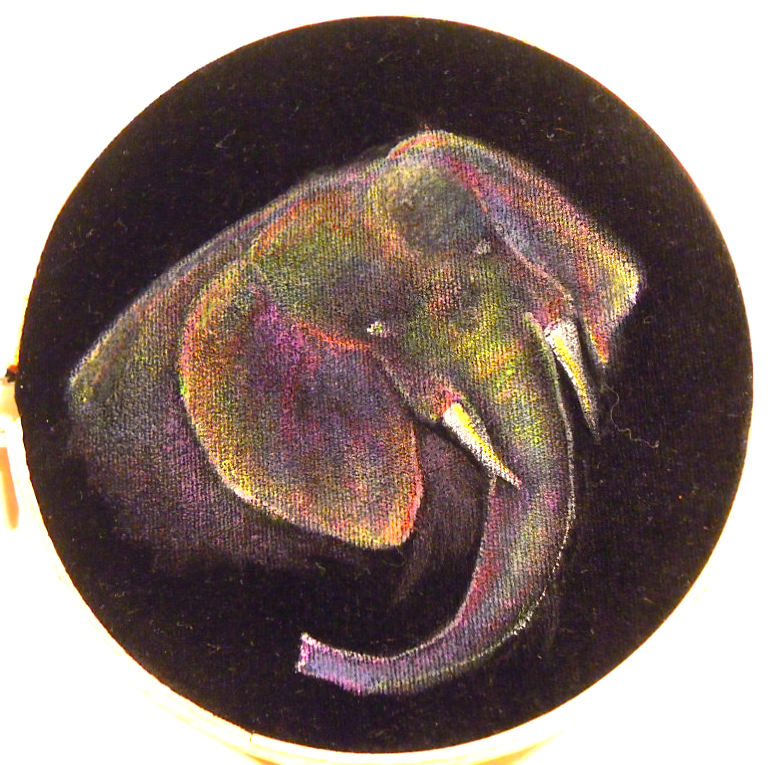
For today's elephant, I wanted to work small. I also thought I should have an elephant with large, sad eyes.

I decided to base my design on my Etch a Sketch elephant and fabric markers elephant, since these struck me as most likely to accommodate sad eyes with tears. Neither of these was based on a photograph, so the pose is probably unrealistic. Elephants don't cry or shed tears as we do, either, so I was taking a fair amount of artistic license here.


For my painting surface, I used a piece of black cotton velveteen measuring approximately 12.5 cm (5 inches) square. To keep my painting surface taut, I put it in a small embroidery hoop. This gave me a canvas of about 10 cm (4 inches) in diameter.

I started by making a faint sketch using a white tailor's chalk pencil. You could also use regular chalk.


Next, I used white bottled acrylic paint to emphasize some of the outlines. I used white because I thought a bit of white underlay would probably make the design pop a bit against the black background.


Next, I added some mauve, blended with a bit of white. I used it mostly full-strength, working it into the fibres to create some shading. I also discovered at this point that, if the paint is the least bit watery, it sucks right into the fabric. Full-strength paint, however, is hard to manipulate on velvet, so it's a bit of a toss-up.


After this, I added blue, then leaf green, then yellow and a hint of red. I mostly layered these colours over one another, to make the colours dance a bit.


To finish up, I added some more white to create additional highlights, working it into the fabric so that it didn't overwhelm the colours. I also added the sad eyes. I didn't really know how to draw eyes with tears, so maybe these should have been a bit more transparent. Oh well.


If you decide to try this, here are a few tips.

1. You can use either acrylic or oils on velvet. I chose acrylics because they're easier to thin, but either works nicely on fabric.

2. The thinner the paint, the more likely it will be to suck into the fabric and not sit on the surface. This can be good if you want to create subtle shading, but will require considerable layering if you want more vibrant colours.

3. Let the background colour do some of the work. I thought about this too late in my painting, and wish I'd left a bit more black near the outlines and in the shadows.

4. If you do layer, use lots of colours you may not think you need. It will give your design depth and life.

5. Be sure to include a few highlights in thicker paint to make your design pop against the dark background.

6. Play with your brushstrokes. I found that I got the most interesting effects if I ground a small amount of paint into the velvet fibres. You can also play with paint thickness: watery paint creates more subtle effects than thick paint, for example.

This took me nearly two hours, which was more time-consuming than I expected it to be. I was very glad I'd decided to work small today.

In the end, I was happy with the way this turned out, but I doubt very much that I'll ever start producing velvet paintings. This would probably be an interesting technique to use in connection with other fibre-based art, however, and I'll probably play with it some more.

I just hope my friend likes this little piece well enough not to want to kill it.


Elephant Lore of the Day
Although there are no elephants today in velvet's home state of Kashmir, the fossil record indicates that the mountain region may once have had a sub-tropical climate in which elephants flourished.

In 2000, Indian geologists unearthed a 50,000-year-old elephant fossil in the state of Jammu and Kashmir. It was unexpectedly discovered in a field of saffron near Srinagar by geology students. The find consisted of a skull measuring 1.5 by 1.2 metres (5 by 4 feet), with complete upper and lower jaws, a broken tusk, and a vertebra.

Similar fossils had been discovered on India's central Gangetic Plain and in the southern Narmada Valley, but this was a first for Kashmir. The find was expected to shed new light on changes in climate and wildlife patterns in Kashmir, and initial research suggests that Kashmir once had a sub-tropical climate—unlike the cooler climate it has today. 


Elephant fossil being unearthed in Kashmir, 2000. It took four days to remove it.
Source: http://news.bbc.co.uk/2/hi/south_asia/913788.stm


To Support Elephant Welfare

Saturday, 1 September 2012

Elephant No. 335: Macramé


I saw some sparkly metallic cord in a shop yesterday and thought it might be interesting to try making some sort of macramé elephant with it. Or maybe this is just a knotted elephant, since it certainly lacks the orderly look of most macramé.

Macrame is thought to have originated among Arab weavers during the thirteenth century. Fabrics produced by these artisans often featured edges knotted in elaborate patterns to produce fringe and other decorative edging.

Following the Moorish conquest of Spain, the art of migramah—an Arab word meaning "ornamental fringe", "embroidered veil" or "striped towel"—spread throughout Europe. Given the name "macramé" by the Spanish, this knotting technique was introduced to England during the late seventeenth century.

Sailors were actually the most avid proponents of macramé, often making macramé objects during long hours at sea. This, in turn, introduced the art to the Far East and the Americas. British and American sailors often called the work "square-knotting" for the knot they used most often.


Macramé owls by Monika, 2009.
Source: http://en.wikipedia.org/wiki/File:Macrame_Owls.jpg


Macramé was particularly popular during the Victorian period. Women made trims for clothing, as well as fringes and edging for household linens. In the early part of the twentieth century, macramé fell out of favour, but was revived during the 1970s, when it was used to make wall hangings, plant hangers, draperies, clothing and even furniture. Macramé has also remained popular in jewellery-making, and is often used to produce bracelets and necklaces with beads knotted into the work.


Macramé necklace with blue opals by Isha Elafi.
Source: http://www.magical-macrame-jewelry.com/index.html


The most common knots in macramé are the square knot, full hitch and half hitch, as well as more exotic knots such as the lark's head and the wrapped knot. Skilled macramé artists combine these to produce elaborate works which can range from exquisite wall hangings to three-dimensional objects. Although some artists work freehand, many work on boards or knot their work over dowels and other forms.


Award-winning macramé chair by Marcel Wanders, 1996.
Source: http://www.marcelwanders.nl/wanders/pages/seaters-
knotchair_1_8_grouppage.shtml


I apologize in advance for the chaos of my own macramé. I took a workshop when I was about ten years old. I think I made an owl, but never tried it again. Knots are not my forte.

I bought two small spools of metallic cord, with no real idea about what kind of elephant I could produce. As with some of my crochet projects, I decided I would just wing it. The only notion I had was that I wanted to make small elephants.


Outside of instructions on tying knots and making elaborate creations such as owls and vases, I couldn't find a basic online guide to making macrame. So this was definitely an adventure.

I started by making a series of tightly spaced knots to form a trunk.


I didn't really know what to do next, so I made a series of knots to form a loop for the head. I had no idea how I was going to attach an ear, but I assumed I could figure that out later.


I know there are many knots I could have used to help me in this activity, but I don't actually know a lot of different knots, and I didn't have time to train myself today. So I simply kept on making a string of knots, with the idea that I would eventually form some kind of outline of body and legs. My plan after that was to knot in a random pattern across the open area of the body.


Once I had a sort of outline, I began running cord across the empty area, tying it onto the outline here and there. I also left a piece hanging off as a tail.


At this point, it looked pretty disheartening to me, so I played a bit with the green cord, making just an elephant head. Which looks an awful lot like a hairdryer.


I went back to the purple elephant. I took whatever was left of the spool of cord and simply knotted it in a random fashion to fill in the elephant's body a bit, and to add an ear. To finish up, I tied the strand at the neck into a little ball to represent a bell.

This was a somewhat frustrating activity, mostly because I didn't know what I was doing. It was also more time-consuming than I anticipated. This took me about two hours, which I thought was a lot for something that fits in the palm of my hand.

I don't mind the final result, but it's not as sturdy as I'd like, and I'm not entirely sure it won't unravel at some point. That being said, I'm not completely put off macrame. I just need to learn how to tie a few knots and get some good instructions.


Elephant Lore of the Day
Elephants have many ways of punishing those who offend them. If an elephant is greatly offended, or even enraged, it will often destroy the immediate area, including the person who caused the offence in the first place. Sometimes, however, elephants have more gentle ways of making a point.  

In the late nineteenth century, a circus was parading through the streets of London. A man in the crowd, egged on by his friends, grabbed hold of the tail of one of the elephants and yanked it.

This kind of thing might usually result in the elephant swinging around and grabbing the person in its trunk, then tossing the offender as far away as possible. This time, however, the elephant wheeled around, grabbed the man in its trunk, then held him against the iron railings of a nearby building.

Paying absolutely no attention to the howling man, or his friends, the elephant seemed determined to keep the man there forever, if need be. The elephant only released its prisoner following the entreaties of its keeper—dropping the man unceremoniously to the ground and turning back to rejoin the parade.


African elephant.
Source: http://vintage.johnnyjet.com/folder/archive/WheresJohnny01162008.html

 
To Support Elephant Welfare