Saturday, 28 January 2012

Elephant No. 118: Rice Krispies Treats


A few people have suggested that I make a Rice Krispies elephant, so today I thought I'd give it a try.

Rice Krispies were created in 1927 by Clayton Rindlisbacher for the Kellogg's company of Battle Creek, Michigan, U.S.A., and made their public debut a year later. Known as "Rice Bubbles" in Australia and New Zealand, Rice Krispies are made of a rice-and-sugar paste that is formed into rice shapes, then cooked, dried and toasted. As the mixture cooks, it expands, forming thin, bubbled walls. When the cereal is subjected to any change in heat, the walls often collapse, resulting in the trademark "Snap, crackle, pop" sound. The sound is particularly noticeable when milk is added, and is spelled out in different ways on packaging around the world:

English: Snap! Crackle! Pop!
French Canada: Cric! Crac! Croc!
Mexico and Spain: Pim! Pam! Pum!
Finland: Riks! Raks! Poks!
Sweden: Piff! Paff! Puff!
The Netherlands and South Africa: Pif! Paf! Pof!
Germany: Knisper! Knasper! Knusper!


Vintage Rice Krispies box, pre-Snap! Crackle! Pop!
Photo: Grosscha
Collection of the Michigan Historical Museum, Lansing, U.S.A.
Source: http://en.wikipedia.org/wiki/File:Vintage_Rice_Krispies_Box.JPG


The elves that adorn the box today were created in the 1930s by well-known illustrator Vernon Grant. After hearing a radio advertisement for Rice Krispies in 1932, Grant developed the Snap! character, and took it to Kellogg's. The company loved it, and Snap! first appeared on a package of Kellogg's Rice Bubbles in 1933. Crackle! and Pop! arrived later, and since 1939 all three have been featured together in various forms of advertising, including radio, television, film shorts, comic strips, and of course, packaging. The characters first appeared on television in 1960, and the Rolling Stones actually recorded a short song for a Rice Krispies television ad in 1963. You can see the rather bizarre spot here.

Rice Krispies treats were invented in 1941 by Kellogg's employee Mildred Day, who published the original recipe for a Camp Fire Girls bake sale. The recipe for basic Rice Krispies treats has remained unchanged for the past 70 years, and is still made with butter or margarine, melted marshmallows, and Rice Krispies. There are also innumerable variations on the basic recipe around the world, including the addition of everything from hazelnut spread and peppermint candy, to chocolate and dried fruit.

For today's elephant, I used the basic recipe that is printed on pretty much every box of Rice Krispies. I used the stovetop instructions, but the box usually contains microwave instructions as well.


Rice Krispies Treats

1/4 cup (60 ml) butter or margarine
40 regular marshmallows, or 5 cups mini-marshmallows (or a 250 g package of either)
1/2 tsp (2.5 ml) vanilla or other flavouring
6 cups (1.5 l) Rice Krispies

1. Melt butter or margarine on stovetop.
2. Put marshmallows in pan and melt with butter or margarine.
3. When marshmallows are fully melted, blend in flavouring.
4. Add Rice Krispies and stir well to ensure that the cereal is fully coated with the marshmallow mixture.
5. Turn into a large pan to cool.

This was very easy to make, taking all of about half an hour—most of which was spent waiting for the marshmallows to melt.


I let it cool almost completely before starting to play with it. The colder it is, the better it holds together; however, the warmer it is, the easier it is to mould, so it's a bit of a toss-up.


I started by making a small body shape.


Then I added on four legs. The mixture sticks to itself quite readily, so all you need to do is form whatever shapes you like, and press them onto existing parts.


Next I added a head with trunk, then a pair of ears.


This took me about five minutes, so I turned my attention to the remaining mixture—and there was a lot of it. If you want to make something small, or only one or two shapes, cut the recipe in half, or even in four.

I made three more full elephants, each of which took about the same amount of time. The thing I didn't much like was the way their heads kept drooping and attempting to fall off.


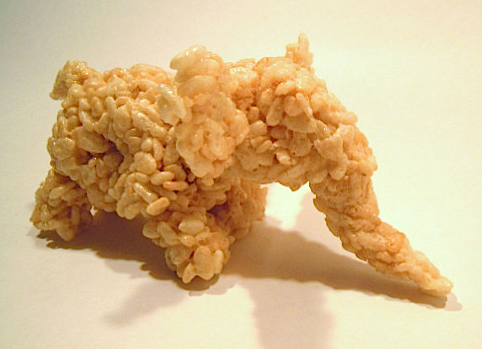


The whole head-falling-off thing made me decide that I was done with making elephants. And pretty much done with Rice Krispies treats, since I've never liked the taste anyway. I decided instead to use the rest of the mixture to make a big elephant head. The trunk and ears were what kept trying to fall off on this one.


I used the little bit that was left to make a small elephant head. The trunk drooped and flattened out almost immediately.


Aside from the propensity of gravity to wreak havoc with various parts of these elephants, this is actually a rather interesting medium. Because the individual Rice Krispies squish and crush so readily into the marshmallow mixture, it's easy to create the shape you want—including, in this case, thin tails and points on tusks.

The main drawback is the marshmallow "glue". If I were to attempt moulding with Rice Krispies again, I think I would try adding something like corn syrup and cooking it a bit longer to create a stiffer adhesive. The only problem then would be working fast enough to keep it from hardening before you're done. And you'd have to handle it while it was pretty warm, so it wouldn't be something to do with children.

In the end, this wasn't hard, wasn't time-consuming, and was interesting as a sculptural medium. Just don't ask me to eat them.


Elephant Lore of the Day
Although water buffalo are usually used to plough rice paddies across Asia, the Karen tribe of northern Thailand uses elephants. The Karen have used elephants in farming for centuries, largely because the land in their tribal areas is too hard and too tough for water buffalo. This makes the elephant ideal.


Elephants ploughing rice paddy in northern Thailand.
Photo: C. Smith
Source: http://zoonewsdigest.blogspot.com/2009/08/elephants-ploughing-rice-paddies-in.html


Although the Karen now often keep working elephants in enclosures, they used to capture elephants from the forests for use only during the ploughing season, releasing them back into the wild as soon as they were no longer needed.


Elephants ploughing rice paddy in northern Thailand.
Photo: C. Smith
Source: http://zoonewsdigest.blogspot.com/2009/08/
elephants-ploughing-rice-paddies-in.html


To Support Elephant Welfare
World Wildlife Fund
World Society for the Protection of Animals
Elephant sanctuaries (this Wikipedia list allows you to click through to information on a number of sanctuaries around the world)
Performing Animal Welfare Society
Zoocheck
Bring the Elephant Home
African Wildlife Foundation 
Elephants Without Borders


Friday, 27 January 2012

Elephant No. 117: Rubber Band Sculpture


When I was in a stationery store recently, I noticed that they still sell balls made up of rubber bands, and it occurred to me that it might be worth trying to create an elephant with rubber bands. I had absolutely no idea if it would work without wires or something to help shape it, but I figured it was worth a try.

I won't go into the history of rubber again, since I covered it in my post about eraser printing. Rubber bands, however, seem to have originated in England around 1845, when they were patented by Stephen Perry. Rubber bands are made by extruding rubber into a long tube that provides the general shape. The tube is then placed on a metal form known as a mandrel and cured with heat. Once cured, it is sliced across the width of the tube into bands of varying width.

Interestingly, rubber bands release heat when they are stretched—an effect you can apparently feel by holding it to your lips. By the same token, when the rubber band is released, it will absorb heat, causing the atmosphere around it to cool.

For today's elephant, I used all the rubber bands I could find in the house, which amounted to this pile.


I didn't realize I had animal-shaped rubber bands when I threw this pile together, but when I looked at the pile, I discovered that there were two of these sitting right on top. I didn't use them in today's elephant, but it was funny to find them there.


I started by balling up a heavy rubber band into a small, round shape.


Next, I wrapped a bunch of smaller rubber bands around this basic form.


I kept wrapping rubber bands around the basic shape I'd started, then added a couple of wide rubber bands as legs, tying them off with tiny rubber bands wrapped around four times.


I secured this whole little bundle around its circumference with another rubber band. This, I decided, would be the elephant's hindquarters.


I made a similar bundle for the front. I wasn't sure at this point how the body was going to work, but I thought I could probably just bind them together with another rubber band.


Next, I made the head. I formed the ears by wrapping a long, wide rubber band around the bundle I'd made for the head shape, then tied it off on each side with tiny rubber bands.


I used a similar idea to form the trunk. Once the trunk was on the head, I secured it with a few more rubber bands.


To secure the head to the body, I ran a couple of rubber bands over the forehead and down behind the front legs, then wrapped a rubber band around the admittedly floppy join to form a stronger neck.


The photo below shows the general shape I now had to work with, although I could see that I was going to at least have to lengthen the legs somehow.

Lengthening the legs was by far the most frustrating and difficult part of this whole thing. I wrapped wide rubber bands around the little feet I had, but it was incredibly hard to make them stay. Eventually, with enough tiny rubber bands wrapped around, they stayed on, but there has to be a better was to do this.


From here on, I mostly just wrapped rubber bands around the whole thing in various ways to shape the elephant, make it secure, and make it look a little neater. I forgot to photograph the stages along the way, but you can see that I wrapped a lot of rubber bands around the body from front to back, and around the mid-section.


The finishing touches were a little tail I tucked up under the rubber bands on the elephant's hindquarters, and a bunch of tiny rubber bands down the trunk to give it some shape. I left the ears as they were—mostly because I didn't know what else to do with them in the time I had.


It's not the tidiest thing I've ever made, but it worked out better than I thought it would. It took longer than I expected, at about two hours, mostly because of the trouble I had with the leg extensions.


I'm definitely not going into the rubber band animal business anytime soon, but I can live with this. It's also got entertainment value, because the rubber is so densely packed that it has a heck of a bounce when it falls on the floor.


Elephant Lore of the Day
Elephants seem to have a predilection for running amok in rubber plantations. This is partly because they like the leaves of palm and rubber trees, but also because the plantations have encroached significantly on existing elephant habitat.

In recent years, there have been increasing numbers of lethal encounters between elephants and humans on plantations across South and Southeast Asia. This occasionally results in humans being trampled to death, although it is more common for the elephants to be destroyed. One of the saddest victims of this uneasy relationship has been the Sumatran elephant, which just this week was placed on the critically endangered list—largely because it is no longer welcome across its former range.


To Support Elephant Welfare
World Wildlife Fund
World Society for the Protection of Animals
Elephant sanctuaries (this Wikipedia list allows you to click through to information on a number of sanctuaries around the world)
Performing Animal Welfare Society
Zoocheck
Bring the Elephant Home
African Wildlife Foundation 
Elephants Without Borders

Thursday, 26 January 2012

Elephant No. 116: Movement of Liquid Down a Vertical Surface


Surprising as it may seem, Movement of a Liquid Down a Vertical Surface is the official name of this Surrealist technique. When I first read about it, I thought of the betting books at private clubs in Georgian London, in which men wagered on which raindrop would hit the windowsill first. This particular technique amounts to pretty much the same thing.

According to the scant information I was able to find online, this technique was invented by Surrealists in Romania. To them, it was considered a surautomatic art related to indecipherable writing. The technique itself was simple: make a picture by dripping, drizzling or allowing a liquid to simply flow down a vertical surface. The idea was either to use the resulting forms to inspire an image, or to attempt to create a pleasing form by controlling the flow and placement of the liquid.

I couldn't find a single online image of this technique. On the other hand, anyone who has applied either too thin, or too much, paint to a vertical surface has seen this principle in action.

Since there was so little information on how to proceed, I was free to interpret it as I pleased. My tools were simple: a bunch of acrylic paints, a little squeeze bottle that I last used for my mendhi debacle and a 10 x 15.25 cm  (4 x 6-inch) canvas board propped up vertically against my kitchen backsplash.


This is obviously a very hard technique to control if you're actually trying to produce something representational. I had no idea what to expect, so I was very hesitant at first, as you can see.


I used a fairly watery paint so that it would flow well. It flowed a little too well, but if I kept the paint  any thicker, it was more like my experiment with bulletism, so I decided to make the best of watery paint.


As you can see in the photo above, the paint pools considerably at the bottom. I found it useful to put down some wax paper, topped with paper towels. I also began to notice that, when you drip new paint on the canvas, it is wildly attracted to any existing paint. This creates a sort of branching effect. Serendipitously, however, in the photograph below I could start to see something that looked to me like an elephant hiding in long grass.


I started adding more colours, not really knowing what I was doing, and not sure how I was going to address the way everything rolled to the bottom. I didn't really want it to look like an elephant curtain, but I hadn't figured out what to do about it.


Then I realized that I could flip it around and make the paint go the other way. It was too late to save the bottom, but I thought it might look interesting if I added new lines going in the opposite direction, to separate the elephant shape a bit. It wasn't a brilliant success, but it was worth a try. I also tried tipping the canvas in different directions. I don't recommend this, however, as the process becomes even more chaotic and unmanageable.

It then occurred to me that water is also a liquid that could move down this particular vertical surface. In other words, there was nothing to say that I couldn't shoot water at some of the paint to wash it away. So I did that too, particularly under the trunk area. Having a bottle with a very tiny nozzle is helpful for blasting away excess paint. Obviously this would only work with a water-based paint—and acrylics in particular, because they have a rubbery consistency that blasts away quite nicely.


I wasn't entirely sure I liked the faded look under the trunk, and I also thought the whole thing needed a bit more modelling, so I mixed some paint with a lot of white in it and drizzled that under the trunk. To finish, I mixed some darker paint to fill in some of the white I'd just added. It's a fiddly process, to be sure.


This would be kind of fun if you had no real expectations—in other words, if you were approaching it as a proper Surrealist. It's not the easiest activity, however, if you're trying to make something recognizable. I disliked it so much at one point that I started an even less successful version, and briefly thought about giving up entirely and starting a whole different activity. That would have made no sense, however, so I stuck it out.

It's a bit messy, but not all that time-consuming. This took me a little over an hour, including my extra attempt (which lasted about ten minutes).

It's certainly no perfect work of art, but I don't hate it as much as I thought I would. It has a weird underwater look that I almost like. It may even grow on me—eventually.


Elephant Lore of the Day
In regions in which elephant populations are on the rise—usually due to reduced poaching and the creation of artificial watering holes—researchers have discovered that the populations of other herbivores are declining. 

It was originally thought that the reason for the decline of certain species was that elephants were chasing other animals away from the watering holes. When researcher Marion Valeix set out to see if this was the case at Hwange National Park in Zimbabwe, she was surprised to find that the opposite was true.

Instead of running away from watering holes when elephants arrived, nine herbivore species—including the wildebeest, warthog, buffalo and zebra—increased their drinking time by as much as 40%. Valeix believes that elephants may actually make other herbivores feel safer from predators, noting that she has seen lions back away from buffalo at a watering hole as soon as elephants approach.

According to Valeix, it is also possible that drinking time increases because other herbivores are nervous around elephants and spend extra time keeping an eye on the pachyderms. The only way to test this theory, however, is to study the amount of time animals spend looking around while at a watering hole with elephants.

As for declining populations of other herbivores in areas where elephants are making a comeback, it is more likely that smaller herbivores are unable to compete with elephants for food. Elephants eat trees in particular, leaving less for other tree-eating herbivores such as giraffes.


Elephant and impalas at watering hole.
Photo: Daryl Balfour/NHPA
Source: http://www.newscientist.com/article/dn16302-
are-elephants-thugs-or-guardians-of-the-water-hole.html


To Support Elephant Welfare
World Wildlife Fund
World Society for the Protection of Animals
Elephant sanctuaries (this Wikipedia list allows you to click through to information on a number of sanctuaries around the world)
Performing Animal Welfare Society
Zoocheck
Bring the Elephant Home
African Wildlife Foundation 
Elephants Without Borders

Wednesday, 25 January 2012

Elephant No. 115: Sock Puppet


A couple of days ago, I decided to tackle my basket of odd socks. I always think the mates will show up, but there are a few socks that have been in the basket so long that it's time to give up on them. Hence today's elephant.

In their purest form, sock puppets are indeed made from socks. The sock is decorated and embellished, then worn on the puppeteer's hand and forearm like a glove. The puppet's mouth is formed from the sock's heel and toe, with the puppeteer's thumb manipulating the jaw. Sometimes the mouth is cut and re-stitched, and may be padded and/or have a tongue glued inside. Occasionally, legs, arms and clothing may be added.

There is little information on the history of sock puppetry, although sock puppets are probably as old as socks themselves. The largest sock puppet may have been a puppet made in 1873 by  famous English sock puppeteer John Carpenter. Measuring 47.5 cm (18.7 inches) in length, the puppet required both of the puppeteer's arms to be effectively manipulated. The mammoth sock from which the puppet was made was half of a pair of "Musty Socks" made in Musty, Scotland, a small village south of Glasgow famed for its production of long, warm socks.

Sometimes a sock puppet is manipulated from behind a stand; more often, the puppeteer stands in full view of the audience, holding conversations with the puppet using ventriloquism. One of the most famous practitioners of this form of puppetry was Shari Lewis, whose sock puppet Lamb Chop was a beloved character for two generations of children.


Shari Lewis with Lamb Chop and Charlie Horse on her 1960 show.
Source: http://www.newsfromme.com/?p=1274


Sock puppets are not limited to children's entertainment, however. During the 1990s, Ed the Sock was an abrasive sock-puppet character on the MuchMusic video network in Canada, and Pets.com used a dog "spokespuppet" in its advertising. Perhaps one of the most unusual sock puppets is the puppet Mr. Socko, used by professional wrestler Mick Foley. Mr. Socko is usually drawn out of some part of Foley's clothing, just in time for a manoeuvre he calls the "Mandible Claw" or "Socko Claw".


Sock puppet by Wendy Pearsall. See this link for her charming
tutorial on making a giraffe sock puppet.
Source: http://www.craftjr.com/recycled-crafts-giraffe-sock-puppet/


For today's elephant, I started with two mismatched cotton socks belonging to my husband. I figured I'd need two: one for the body and trunk, and one to cut up for ears.


To make a sock puppet, it's not a bad idea to put the sock on your hand first to inspire you. Your thumb goes in the heel, and your four fingers go in the toe. Because my hands are relatively small, and this is a man's sock, the sock looks a bit like Mr. Snuffleupagus of Sesame Street fame. 


Rather than add on a trunk, I simply gathered the extra material in the toe with some loose stitching. I wanted it to look a bit eccentric, so the gathers aren't particularly even, but I liked the lumpy, sculptural quality I ended up with.


Next, I wanted to add some ears, so I cut up the other sock. I made the ears single-layer, with a simple rolled hem around three sides.


To place the ears, I put the puppet back on my hand, and pinned the ears where I wanted them, then stitched them in place, gathering slightly to give them a bit of lift. I also tacked the corners of each ear to the main body of the sock, so that they didn't look too flyaway.


To shape the mouth a bit so that it wasn't quite so floppy, I put the puppet back on my hand and sewed about four stitches through the roof of the mouth into the top of the head. This divided my fingers into two sections, but shaped the mouth nicely.


To finish the stitching, I sewed on two faceted plastic button eyes, but you could use any kind of button.


I had decided against adding tusks, so the final touch was painting a bit of pink inside the mouth. I used acrylic paint and painted it with fairly soft edges.


I really like this little guy. It was very easy, and took less than an hour. He's also pretty cute in real life—even more so when animated with a a little paw inside.


Elephant Lore of the Day
Although elephants never wear socks, they do occasionally wear prostheses.

Many elephants migrate across current and former conflict zones that are peppered with landmines. As a result, many elephants have been killed or grievously injured. In Thailand, however, several elephants have been fitted with prostheses to replace their lost limbs. Two of these—Mosha and Motala—are elephant survivors of landmines. Living permanently at the Friends of the Asian Elephant (FAE) Elephant Hospital, both Mosha and Motala have been fitted with multiple prostheses over the years.


Elephant prostheses, FAE Elephant Hospital, Thailand.
Photo: Soraida Salwala
Source: http://www.eyesofthailand.com/2011/11/14/new-prostheses-2011/


Mosha stepped on a landmine in 2006, when she was only seven months old. In 2008, she received the world's first elephant prosthetic, designed by Dr. Jivacite of the Prostheses Foundation, which normally provides prosthetics for humans. The following year, Motala received her first prosthesis—a decade after she stepped on a landmine. Just like humans, elephant prosthetics must be refitted from time to time, particularly as an elephant grows. In November 2011, Mosha received her seventh prosthesis, and Motala received her fourth.

All of the prostheses at the FAE Elephant Hospital were designed by Dr. Jivacite, and were donated by the Prostheses Foundation in Chiang Mai, Thailand. 


Motala wearing her new prosthesis.
Photo: Soraida Salwala
Source: http://www.eyesofthailand.com/2011/11/14/new-prostheses-2011/


Elephants in other countries have also been fitted with prostheses, including Chhouk, who was injured by a poacher's snare in Cambodia. You can see Chhouk walking with his prosthesis here.

Interestingly, elephants moving into southern Angola seem to have developed the ability to avoid the landmines that still litter the region. Biologist Michael Chase of Elephants Without Borders first noticed this ability from satellite-collar tracking images. When the war in Angola ended in 2002, elephants began migrating back into the country. Unfortunately, during the initial migration, many elephants were killed or horrifically injured by landmines. 

Since that initial migration, however, Chase has discovered that later arrivals are avoiding mined areas. Although no one can be sure, it appears to Chase that elephants have "learned" to avoid landmines. In the three years that Chase and his team have been studying the region's elephants, there has been no evidence of elephants being either blown up or injured by exploding landmines.

While the elephants appear to know how to avoid mined areas, it isn't clear whether this is due to a learned response, or to an ability to detect the mines by smell or some other means. Since elephants move with their trunks along the ground, they may pick up the scent of mines as they walk. However, elephants are also intelligent animals that travel in herds, and may have learned to avoid areas where they have seen other elephants killed.


To Support Elephant Welfare
World Wildlife Fund
World Society for the Protection of Animals
Elephant sanctuaries (this Wikipedia list allows you to click through to information on a number of sanctuaries around the world)
Performing Animal Welfare Society
Zoocheck
Bring the Elephant Home
African Wildlife Foundation 
Elephants Without Borders