Monday, 26 March 2012

Elephant No. 176: Upholstery Foam


While cleaning out some dead storage last week, I came across a thick slab of upholstery foam, left over from a cushion I made a couple of years ago. I was going to throw it out, then I decided it might be interesting to try carving an elephant shape of some sort.

Upholstery foam is made of polyurethane: a type of polymer used in the manufacture of everything from gaskets and skateboard wheels, to spandex and hard plastics. The earliest work on polyurethane polymers was done by Otto Bayer and his colleagues in 1937 at the I.G. Farben company in Germany. Initial work focused on producing flexible foam and fibres. This work was largely interrupted by the Second World War, and the first polyurethanes did not become commercially available until 1952, with polyurethane foam following in 1954.

In 1960, more than 45,000 metric tonnes of flexible polyurethane foams were produced by a range of companies. Over the ensuing decade, new types of foam were developed, with greater thermal stability and fire-resistance. Extensive use of polyurethane foam—including foam rubber and plastic panels—was made in the automotive industry during the 1960s, including entire vehicles made from various types of polyurethane materials.

Today, polyurethanes come in many different forms, for many different purposes, and are often combined with other substances such as ground glass, mica and mineral fibres. From coatings on wooden floors, to sofa cushions, to plastic electronics, polyurethanes have become an intrinsic part of daily life for many people around the world.

For today's elephant, I was pretty sure I was going to make a heck of a mess. Polyurethane foam likes to trail bits of itself all over the place. In the past, I've used an electric carving knife to slice polyurethane foam into various sizes. I thought a rotary tool might also work for finer details, and maybe scissors in a pinch.

I started out by cutting a piece of foam measuring about 7.5 cm by 9 cm (3 x 3.5 inches). For this, I used an electric carving knife (which I only use for cutting foam).


I thought briefly about drawing an elephant on the piece of foam, then decided I'd rather wing it.

I started by carving off the main corners of the original squared-off piece, also with the electric knife. This is about as delicate a process as using a chainsaw on wood, so the knife is best used just for the rough cuts.


I tried the rotary tool at this point, which was completely useless. It more or less catches on the foam and spins without actually removing anything. So resorted to scissors. This was a much better idea. I also discovered that tweezers are a pretty good tool for something like this. The eye and the lines around the trunk that you see below were created by plucking out small bits with tweezers.


After this, I just kept trimming various parts with scissors, pulling out little tufts with tweezers, and generally reshaping bit by bit. It's surprisingly fussy work, and sometimes it's a bit hard to see the bigger picture when you're trimming such small amounts at a time. The closest analogy for me is trimming hair.


This took me about an hour and a half, but I could have spent a lot longer. I like the final well enough, but this isn't something I'd be keen on doing often. Although, looking at the final piece, I can see how this technique might come in useful for creating foam stamps—as long as absolute precision isn't a must.


Elephant Lore of the Day
Contrary to surprisingly widespread belief, King Mongkut of Siam (today's Thailand) never gave an American president a herd of elephants.

There are two elephant-related stories about King Mongkut—coincidentally the king described in Anna and the King of Siam and played by Yul Brynner in the musical The King and I—and American presidents. The first suggests that King Mongkut offered a herd of war elephants to President Abraham Lincoln during the American Civil War (1861–1865). The second says that he actually gave Lincoln's predecessor, President James Buchanan, a herd of elephants that ended up in the National Zoo. Neither of these stories is true.

The king did write a letter to President Buchanan on February 14, 1861—before the Civil War started—offering a gift of domesticated elephants to use as transportion and beasts of burden. By the time the letter arrived in Washington, D.C., however, Buchanan was out of office, and Lincoln was president.

When asked what the elephants could be used for, Lincoln is said to have jokingly replied that he wasn't sure, unless they could be used to "stamp out the rebellion." When framing a reply to King Mongkut on February 3, 1862, Lincoln said nothing about the Civil War. Instead, he politely declined the elephants, explaining that the American climate might not be the best place for elephants, and that locomotives were more conventional in America for the transportation of heavy loads.

Interestingly, when King Mongkut's great-grandson, King Bhumibol, visited the United States in 1960, he referred to the exchange in an address before the U.S. Congress. "My great-grandfather," he said, "offered to send the President and Congress elephants to be turned loose in the uncultivated land of America for breeding purposes. That offer was made with no other objective than to provide a friend with what he lacks."


King Mongkut of Siam in European dress, 1865–1866.
Photo: John Thompson
Collection of the National Library of Scotland
Source: http://en.wikipedia.org/wiki/File:Thomson,_King_Mongkut
_of_Siam.jpg


Sunday, 25 March 2012

Elephant No. 175: Painting on China


I was about to get rid of a trio of mismatched off-white plates, when it occurred to me that I could paint them and give them new life instead.

Although clay bowls, jugs and other types of ware were known in Turkey as early as 7000 B.C., it wasn't until the seventh century A.D. that porcelain was invented. During the T'ang Dynasty (A.D. 618–907), the Chinese began making hard porcelain after discovering that white, translucent ceramics could be produced with a combination of kaolin clay and felspar. Because of its origins, porcelain—from the Italian word porcellana ("cowrie shell")—is also known as china.

For hundreds of years, the Chinese kept the porcelain formula to themselves, remaining the world's sole producers of hard-bodied porcelain until the early eighteenth century. Imported into Europe as a luxury item—perhaps by Marco Polo in the thirteenth century—porcelain was found only in the homes of wealthy aristocrats.

As time went on and porcelain continued to gain in popularity, Europeans sought the secrets of producing the delicate ceramic. King Augustus II of Poland literally locked up his alchemist Johann Bottger, threatening him with execution if he didn't come up with the porcelain formula. Bottger eventually succeeded, leading Augustus to found the Meissen factory in 1710.


Conductor from Meissen's famous Monkey Band, 19th century.
Meissen copy of their eighteenth-century original.
Source: http://www.liveauctioneers.com/item/6002477


For nearly ten years, the recipe for porcelain remained a closely guarded secret. Eventually, however, companies in Germany and France worked out the formula for themselves, and the making of porcelain exploded. The European craze for porcelain led to its being made into vases, snuffboxes, bowls, plates, teapots, figurines, cups and saucers, plaques, jewellery, and tables. Augustus II even considered having a castle made of porcelain.

In time, the painting of porcelain became as important as the object itself. Enamel paints were applied over a glaze, then fired at temperatures of 1300˚C (2372˚F) or higher. Factories had artists on staff who painted in styles that soon became associated with specific companies. Sèvres, for example, became famous for delicate miniatures on vases, cups and boxes. Meissen produced figurines and vases. Italian companies developed elaborate floral designs, animals, fruit and scenes from daily life.


Sèvres bowl, ca. 1773.
Source: http://www.antique-marks.com/sevres-porcelain.html


Today, fine porcelain is still made by a number of companies around the world, often in patterns and designs very similar to those of eighteenth-century Europe. In addition, contemporary artists produce both painted and unpainted porcelain, ranging from minimalist forms to elaborate room-sized installations.


Chinese artist Ai Weiwei with some of the 100 million porcelain seeds in his
Sunflower Seeds installation at the Tate Britain in October 2010. It took 1,600 Chinese
workers to produce the individually handpainted seeds.
Photo: Getty Images
Source: http://www.dailymail.co.uk/news/article-1319515/Tate-Modern-carpeted-
millions-sunflower-seeds-art.html


Although the traditional techniques for painting porcelain are similar—paint, let dry, heat to set the paint—the paints I used for today's elephant are quite different. Painting porcelain in the traditional way is somewhat like painting with glass enamels, requiring things like lavender oil and various other types of liquid medium. I already had some oven-firing porcelain paints from a previous attempt at plate-painting, however, so that's what I decided to use.


It had been a couple of years since I'd painting anything with oven-fired paint, so I wasn't sure if the paints would still be good. Although they had thickened a little, they are water-based and can be moderately thinned with water.

This is the little plate I used. It measures about 15 cm (6 inches across) and is made of a fairly thick china—one might even say industrial.


I started by sketching something on the plate with a china marker. The marks dissolve when you paint over them, and if there are still lines after you're finished painting, they can be wiped or washed off after the piece is "fired".


I didn't have any grey, and I didn't think I'd have enough working time if I mixed black and white, so I made the elephant silver.


The paint can be applied as thick or as thin as you like, the only difference being the length of time it needs to dry before firing. I was trying to lay on the colour relatively thickly for this base coat, but it ended up a bit streaky. Still okay, but it wasn't quite what I had intended.

After this, I started colouring in the other areas. The paints dry out quickly, so I worked fast and didn't document much of the process, other than the feather and the polka dots I added to finish off the edge.


This took about an hour from sketch to final. It has to dry for at least 24 hours before I can bake it in the oven, but the colours should remain the same. The only real difference after firing is that the brushstrokes will soften a little and the paint will develop a bit more gloss. This makes it different from painting with pottery glazes, for example, when you're not exactly sure what the final colour will look like until it's fired.

I like the final piece, even though it looks a bit like nursery china. If I'd been thinking of this as a porcelain-painting exercise, rather than simply producing a design on china, I might have tried for a more painterly effect. Then again, I still have two more orphaned off-white plates to play with.


Elephant Lore of the Day
In early June 2010, Sabu the circus elephant went on walkabout through the streets of downtown Zurich, Switzerland.

Frightened by nearby storms, Sabu ran off when her keeper turned away for a moment while loading her into a trailer. After a dip in Lake Zurich around 7:30 p.m., she went for a walk along city streets. She did some window shopping along the Bahnhofstrasse—Zurich's most exclusive shopping street—walked by the city's main railway station, and strolled past banking houses in the Paradeplatz.

Police and handlers from the Zirkus Knie chased Sabu around the city streets for nearly an hour before she was peacefully recaptured. Although her keepers followed her the whole time, calling her name, she didn't respond. While on the lam, Sabu walked slowly, although still too fast for the police to keep up with her. Surprisingly, she caused no damage to property, to herself, or to anyone she encountered along the way.

After she was caught and loaded onto a truck, circus staff took her to rejoin the other circus animals. Sabu was reported as being tired, but "happy to be back." For video of Sabu's adventure, click here.


Sabu taking a bath in Lake Geneva, August 2010.
Photo: Keystone
Source: http://www.basellandschaftlichezeitung.ch/limmattal/zuerich/circus-knie-
wird-wegen-sabu-ausflug-nicht-bestraft-100832650


Saturday, 24 March 2012

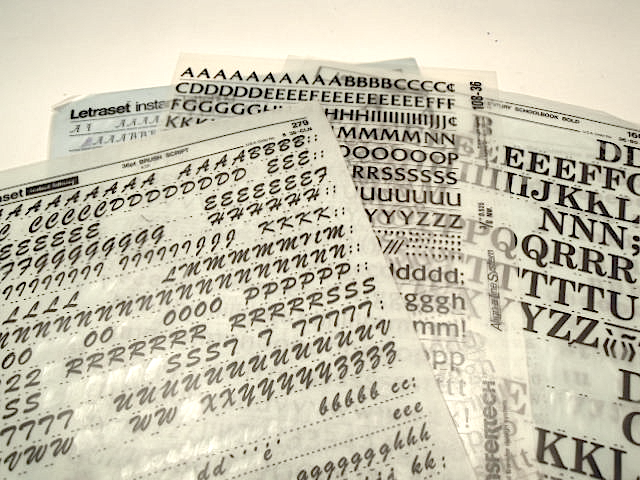
Elephant No. 174: Letraset


A couple of years ago, my sister gave me a huge quantity of Letraset®, which I came across again yesterday. I haven't used Letraset in years, so it seemed like an interesting thing to try for today's elephant.

Although the name has become generic, Letraset is actually a brand name for materials produced by the eponymous company in Kent, England. The most famous of the company's products was dry-transfer lettering, which was the gold standard for graphic layouts for more than thirty years.

When first launched in 1961, Letraset took the industry by storm. Instead of having to letter things by hand, graphic artists could simply rub on letters from a sheet of Letraset. Although this was a tedious process if a great deal of lettering was involved, it was still far less tedious than having to hand-draw every letter perfectly.

In addition to lettering, the Letraset company and others began producing "rub-ons" featuring cartoon characters, animals and more. As a result, many children grew up using rub-ons to create scenes in which football players floated in mid-air, fish swam through trees, and monkeys drove cars while standing on their heads.

Dry-transfer lettering was ubiquitous right into the early 1990s, when desktop publishing took the place of most hand-lettering. Today, Letraset is still available from the company that started it all, and still includes sets of letters in a wide range of typefaces, as well as sheets of patterns and textures. In addition to dry-transfer sheets, the Letraset company also makes art supplies such as markers, inks, rubber stamps and fonts, largely aimed at the serious hobbyist and graphic artists.

I had literally hundreds of sheets of Letraset from which to choose today, but I limited myself to these few sheets of black letters. Having too many choices is always a bad idea for me.


The rules for today's activity were simple: I could use only the letters in the word "elephant", but I could use upper or lower case, and I could apply them in any direction I liked. I also didn't have to spell "elephant" anywhere, since I'd already done that in my rubber-stamp typography activity months ago.

I started by sketching an elephant lightly in pencil, on a good-quality sheet of bristol board measuring 28 x 38 cm (11 x 15 inches). I knew I'd get very lost, very quickly, if I didn't have some kind of sketch to guide me.


After that, I simply rubbed on letters as I liked. I used the pointy end of a bamboo skewer for this, as this was both soft enough and hard enough to rub the letters on nicely, while also allowing me a bit of precision.


A few technical tips if you get your hands on some Letraset and want to try this:

1. Make sure your Letraset is relatively fresh. Some of mine was from 1983, and it not only cracked but also didn't stick very well in spots.

2. If you need to remove anything, don't try using an eraser or scraping it. Simply find a place on your Letraset sheet where there are no letters, place it over the mistake and rub hard. It should pull off cleanly. Well, unless it's old, in which case, you may have to try this a few times—or, as I did in a couple of places, give up and rub a new letter over top of it.

3. Try not to lay letters on top of one another unless you plan to be incredibly precise when laying down the new letter. If you inadvertently rub over the top of a letter that's already there, it will pull away, as if you had intended to erase it.


This whole activity was harder than I thought it would be—mostly because it's actually rather complicated to find letters that will fit a specific shape without looking clunky. Not that it's truly difficult; it was just more of a challenge than I expected. That being said, I'm pleased at how well it turned out, particularly through the ear area.

I would definitely try this again, perhaps on something much bigger, so that I could use larger letters—and use up more Letraset. I'd also make sure I could spend a few days on it, so that I could create something with shading rather than mostly outlines.


Elephant Lore of the Day
Although he first achieved fame for risking his life to save animals in the Baghdad Zoo during the recent war in Iraq, Lawrence Anthony was also known as "The Elephant Whisperer". Showing an uncanny ability to calm traumatized elephants, Anthony had forged a profound bond with the elephants living in and around the Thula Thula private game preserve in Zululand, South Africa.

Anthony had literally saved the lives of many of Thula Thula's elephants. Asked to take in a rogue herd that would otherwise be destroyed, Anthony had agreed, although common sense told him it was a bad idea. In the years that followed, Anthony worked closely with the elephants, and came to be accepted as part of their family.

Following Anthony's untimely death of a heart attack on March 2, 2012, family and friends witnessed an astonishing sight. In what appeared to be a tribute to Anthony, the two elephant herds of Thula Thula began arriving en masse at Anthony's house on the preserve.

According to Anthony's son Dylan, the elephants had not been at the house in eighteen months, making their arrival unusual at the very least. Even more surprising was the fact that it would have taken the herds at least 12 hours to get there. The first herd arrived on a Sunday; the second herd arrived a day later. After remaining quietly around the house for two days, the elephants turned around and made their way back into the bush.

It is not known why the elephants made the trek. Perhaps they missed seeing Anthony out in the bush, and came looking for him—although this was something they'd never done before. Or perhaps Anthony's family and friends were right in thinking that somehow the elephants knew he was gone, and came to pay their last respects, as they often do with their own kind.

Anthony's work with the elephants of Thula Thula is detailed in the book The Elephant Whisperer, co-authored with Graham Spence.


Elephants arriving at Lawrence Anthony's home on the Thula Thula
private game preserve, South Africa.
Source: http://www.iol.co.za/news/south-africa/kwazulu-natal/
elephants-say-goodbye-to-the-whisperer-1.1253463

To Support Elephant Welfare
World Wildlife Fund
World Society for the Protection of Animals
Elephant sanctuaries (this Wikipedia list allows you to click through to information
on a number of sanctuaries around the world)
Performing Animal Welfare Society
Zoocheck
Bring the Elephant Home
African Wildlife Foundation
Elephants Without Borders 
Save the Elephants
International Elephant Foundation
Elephant's World (Thailand) 
David Sheldrick Wildlife Trust
Elephant Nature Park (Thailand) 

Friday, 23 March 2012

Elephant No. 173: Sponge Painting


When I came across the elephant stamp I used for my embossed velvet activity, I also came across some little sponges that I had used to sponge-paint some flowerpots a few years ago. So I thought I'd try sponge-painting for today's elephant.

Natural sponges are multicellular organisms with bodies full of pores and channels, allowing water to circulate through them. Sponges don't have nervous, circulatory or digestive systems, relying instead on a constant flow of water through their bodies to provide them with food and oxygen, while also removing wastes.

Sponges come in many shapes and sizes, all adapted to ensure optimal water flow. Water enters the sponge through a central cavity, deposits nutrients, and leaves through a hole called an osculum. The process functions something like a chimney: water is pulled in from the bottom and is expelled through the top, where waste is washed away by the surrounding currents. Sponges are capable of controlling water flow through various means, and will even close off if there is too much silt in the water.


Yellow tube sponges, Cozumel, Mexico.
Source: http://goodnews.ws/blog/2010/02/22/marine-sponges-can-fight-cancer/

There are as many as 10,000 known species of sponges, most of which feed on bacteria and small food particles in the water. In food-poor environments, some species of sponge have become carnivores, feeding on tiny crustaceans. Although there are a few freshwater species of sponge, most are saltwater species, and live anywhere from shallow tidal zones to astonishing depths of 8,800 metres (5.5 miles). Sponges in temperate zones live for only a few years, but some tropical and deep-ocean species may live for more than two centuries.

Sponges are found in every part of the world, including polar regions. Most live in calm, clear waters, as sediment tends to block their pores, making it difficult for them to breathe and feed. The great majority of sponges are found on rocks, although some can attach themselves to a sandy floor with a root-like foot. There are more sponges—although fewer species—in temperate zones, likely because there are more predators such as turtles and fish in tropical zones. In polar seas and the deepest oceans, glass sponges are the most common type, as their porous structure enables them to glean nutrients from an otherwise food-poor environment. If a sponge dries out even partially—as, for example, in an aquarium—its pores close, and the sponge begins to starve and suffocate.


Euplectella sp., a deep-ocean glass sponge.
http://avernaculararchitecture.blogspot.ca/2009/01/glass-sponge.html


Very few sponges actually have the soft, fibrous texture we usually associate with sponges. For millennia, humans have harvested these particular species for use in cleaning and padding. By the 1950s, these particular types of sponge had been so heavily overfished that the sponge industry nearly collapsed, and today most sponge-like materials are synthetic. A loofah "sponge" is actually not a sponge at all, but the inner part of a gourd.

In addition to their use by humans, it was recently discovered that bottlenose dolphins also use sponges. In Western Australia's Shark Bay, dolphins have been observed spearing marine sponges with their rostrums, or nose areas. It is thought that the dolphins are using sponges as a type of rostrum-guard when they search for food on the sandy seabed. Known as "sponging", this behaviour has only been observed in Shark Bay, and almost exclusively by females. A 2005 study suggests that mother dolphins have been teaching their daughters to sponge, and that all sponge-users are related, likely making this a recent innovation.


Sponging dolphin, Shark Bay, Australia.
Photo: Ewa Krzyszczyk
Source: http://www.cosmosmagazine.com/news/2418/dolphins-use-
sponges-catch-fish-study-says


For today's elephant, I had this small selection of sponges, which I opted to use with acrylic paint on a sheet of good-quality bristol board. I'm not sure why I cut these little squares and triangles, given that I don't remember making any kind of regular pattern when I sponge-painted the flowerpots. However, since this is what I had on hand, I decided to limit myself to these particular shapes.


I squeezed blobs of acrylic paint onto an aluminum pie plate, wet the sponges and started painting. I didn't bother drawing anything first, although it might have been easier if I had.

My first effort was a baby elephant. I began with purple, then added blue, then green.


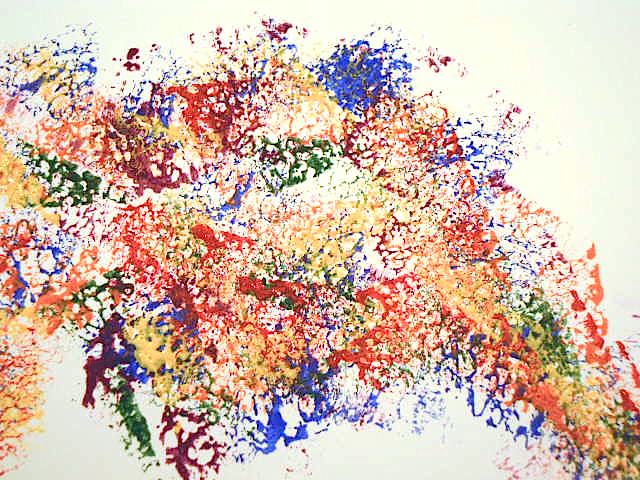
 It was beginning to remind me of my experiments with fumage, which wasn't really what I had in mind, but I finished it anyway.


I decided next to make a simple elephant head, following the same colour sequence.


I liked this one better, partly because I had a better feel for the process by now. I layered multiple colours, but also left a lot of white space to give it more dimension and life.


It only took me about a 45 minutes to do both of these, and it was pretty painless. I think I might try to layer in more colour next time, but I'm quite happy with the way they turned out.


Elephant Lore of the Day
At the deservedly renowned David Sheldrick Wildlife Trust in Kenya, orphaned baby elephants are coaxed into feeding by surrogate mother elephants—in the form of rough, grey blankets hanging from trees. Although to us these blankets look nothing like mother elephants, they actually serve an important purpose.

Baby elephants usually arrive at the orphanage following traumatic rescue from life-and-death situations. Distraught and frightened, they often succumb to pneumonia and gastric infections caused by stress. They also frequently refuse to eat. This presents a particular challenge for the people trying to save them.

It was discovered however, that if a baby elephant feels something similar to the texture of its mother's stomach when it reaches up, it can be coaxed to feed. Encountering large expanses of grey hanging throughout the bush, baby elephants will walk over to the blankets, touching them with the tips of their trunks in curiosity. Reassured by the texture, they will snuggle closer and run their trunks over the surface, just as they would do with their mothers in the wild. It then becomes easier to feed them from a bottle.


Baby elephant and grey blanket, David Sheldrick Wildlife Trust, Nairobi, Kenya.
Photo: Worldwide Features.com
Source: http://www.dailymail.co.uk/news/article-2115392/Baby-elephants-comfort-
blanket-How-huge-grey-rug-doubles-surrogate-mother-orphan-feeding-time.html


The babies remain dependent on the blankets for the first few months, then take the bottle without the blanket, then become tactile with the rest of the herd. When the elephants are between twelve and eighteen months old, they are moved to rehabilitation centres in Kenya's East Tsavo National Park, and are eventually released back into the wild.


Keeper feeding orphaned baby elephant at David Sheldrick Wildlife Trust.
Photo: Worldwide Features.com
Source: http://www.dailymail.co.uk/news/article-2115392/Baby-elephants-comfort-
blanket-How-huge-grey-rug-doubles-surrogate-mother-orphan-feeding-time.html


To Support Elephant Welfare
World Wildlife Fund
World Society for the Protection of Animals
Elephant sanctuaries (this Wikipedia list allows you to click through to information
on a number of sanctuaries around the world)
Performing Animal Welfare Society
Zoocheck
Bring the Elephant Home
African Wildlife Foundation
Elephants Without Borders 
Save the Elephants
International Elephant Foundation
Elephant's World (Thailand) 
David Sheldrick Wildlife Trust

Elephant Nature Park (Thailand) 

Thursday, 22 March 2012

Elephant No. 172: Inukshuk


I suppose I shouldn't really call this an inukshuk, since inuk means "person" in the northern Canadian language of Inuktitut, and the word inukshuk means "in the likeness of a human". Traditionally, there was no word for "elephant" in Inuktitut for obvious reasons, but alipa has recently been added to the lexicon, so I suppose I could call today's elephant an alipashuk or, to be more traditional, an uumajuqshuk—meaning more or less "in the likeness of an animal".

Inuksuit—the plural of inukshuk—are found across the circumpolar world, particularly in North America. Traditionally meaning "someone has already passed this way" or "you are on the right path", inuksuit have been used for centuries as a form of communication, and as navigational aids. They can also serve as memorials to loved ones, to mark migration routes, and to point the way to sources of food source such as fish. Similar stone structures indicated places of power and served as objects of veneration. Most inuksuit are solitary, although they can also stretch out in long lines across the Arctic. Occasionally they are even grouped together, as at Enusko Point on Canada's Baffin Island, where there are more than 100 inuksuit. 


Inukshuk, Cambridge Bay, Nunavut.
Source: http://www.arcticvoice.org/blog/?cat=4


Inuit tradition forbids the destruction of inuksuit, partly because they are venerated as representations of ancestors who survived off the land. As most of us do with well-known landmarks, the Inuit welcome the sight of a familiar inukshuk when crossing the Arctic.  

Inuksuit range in size from the small to the truly monumental. Although the most familiar form is the human-like figure—known as an inunnguaq—an inukshuk can be made of a single rock, or a stacked grouping of rocks, boulders and flat stones. Inuksuit are built from whatever stones are in the immediate environment, making each one unique. The purpose of the inukshuk is indicated by the way the stones are arranged. The figure's arms or legs, for example, could point the way to open water, or to a passage through the mountains. An inukshuk without arms, or with antlers propped up on top, usually indicates a cache of food. 

The flag for the Canadian territory of Nunavut features an inukshuk, as did the 2010 Winter Olympics. In recent years, the inukshuk has become an informal symbol of Canada, with inuksuit erected at cities across the country, as well as at some of Canada's high commissions. Canada has also donated inuksuit to five cities around the world: Brisbane, Monterrey, Oslo, Washington, D.C., and Guatemala City. 


The flag of the Canadian territory of Nunavut features an inukshuk in the middle.
Source: http://shop.flagshop.com/index.php/canada-flags/provincial-territory-
flags/nunavut.html


Lately, inuksuit erected by hikers and campers in more southerly parts of Canada have actually become something of a nuisance. In some areas they are so prevalent that park wardens have had to dismantle a plethora of inuksuit in order to keep the actual trail markers visible.


For today's elephant, I wasn't sure how well I was going to be able to stack rocks into something that looked like an elephant of any kind. However, since I'm quite capable of building a rock wall and even laying a flagstone patio, I was willing to give it a try. And one thing there's no shortage of around here is rocks.

I didn't, however, have a lot of flat rocks. Oh well, since I wasn't planning to make anything huge, I figured I could probably make it work.

I started by making the legs—only two legs, mind you, because I didn't think I was going to be able to manage the balancing act that four legs would have entailed. These first legs ended up being too tall, and a bit too far apart, but this is how I started.


When the legs seemed more or less the same height, I started filling in the middle. This worked well enough until I tried to add a trunk, when the whole thing fell in. Many times.


I was determined, however, to make the trunk piece fit, so I kept at it. The problem with the trunk piece was that it was razor-thin where it connected to the head, giving it a disturbing tendency to swing around and fall off. This brought everything on top of it down as well. You can see how precarious the trunk area is from the view below of the other side.


Eventually it stayed together. I even managed to add an ear and a tail. Because of the many times it collapsed, this took me about an hour, but it wasn't an unpleasant activity by any means.


I'm actually quite proud of this, despite the vaguely Elvis toupee. I know it probably won't be there in the morning—one swish of a feral cat's tail, and it will fall to pieces, I'm sure—but I like that I managed to include a trunk, an ear and a tail. I doubt that there's a herd of alipasuit in my future, but I wouldn't be averse to trying this again. Maybe even with four legs next time.


Elephant Lore of the Day
In late February 2012, palaeontologists working in the United Arab Emirates uncovered a series of elephant footprints that are estimated to be seven million years old. This makes them the oldest of their kind ever found, as well as the longest preserved trackway in the world.

The footprints came from a herd of at least thirteen elephants, ranging from a young calf to adults of both genders. The herd walked through mud, which later hardened, preserving the tracks. The tracks then became buried, revealed only millions of years later through erosion.


Photomosaic of elephant tracks discovered in Abu Dhabi in February 2012.
Source: http://news.nationalgeographic.com/news/2012/02/pictures/120223-prehistoric-
elephants-tracks-science-animals/#/millions-year-old-elephant-trails-aerial_49193_
600x450.jpg


Interestingly, it is believed that the tracks also tell us a great deal about elephant social structures. One set of tracks veers off from those of the main herd. Given that these tracks are larger, it is thought that this was a male elephant—leaving the herd as male elephants still do today, once they reach a certain age.

The site has since been surrounded with a fence by the Historical Environment Department of the Abu Dhabi Tourism and Culture Authority. This valuable find is the oldest fossil record of elephants ever found, and an important indicator of behaviour that would not be evident through a study of fossilized remains such as bones and teeth.


Male prehistoric elephant (stegotretrabelodon) leaving the herd.
Illustration: Mauricio Antón
Source: http://news.nationalgeographic.com/news/2012/02/pictures/120223-
prehistoric-elephants-tracks-science-animals/
 
-------------
Don't go where the path may lead, go instead where there is no path and leave a trail.
— Ralph Waldo Emerson
------------
Elephant's World (Thailand) 
David Sheldrick Wildlife Trust
Elephant Nature Park (Thailand)